
Why Is a San Diego Charter School Spending $500,000 on Two Humanoid Robots?
If you were a charter school with a cool half a million to drop, what would you spend it on? Budgeting for multiple new teachers? Perhaps expanding your curriculum or purchasing new teaching materials? Funding some sort of overseas trip to broaden your students’ horizons? Capital expenditure on your campus? Scholarships for underprivileged kids?
If you answered any of the above, that’s why you’re not running a charter school. The correct answer is “buying two humanoid robots to lurk in your classrooms and function as fancy mouthpieces for ChatGPT.”
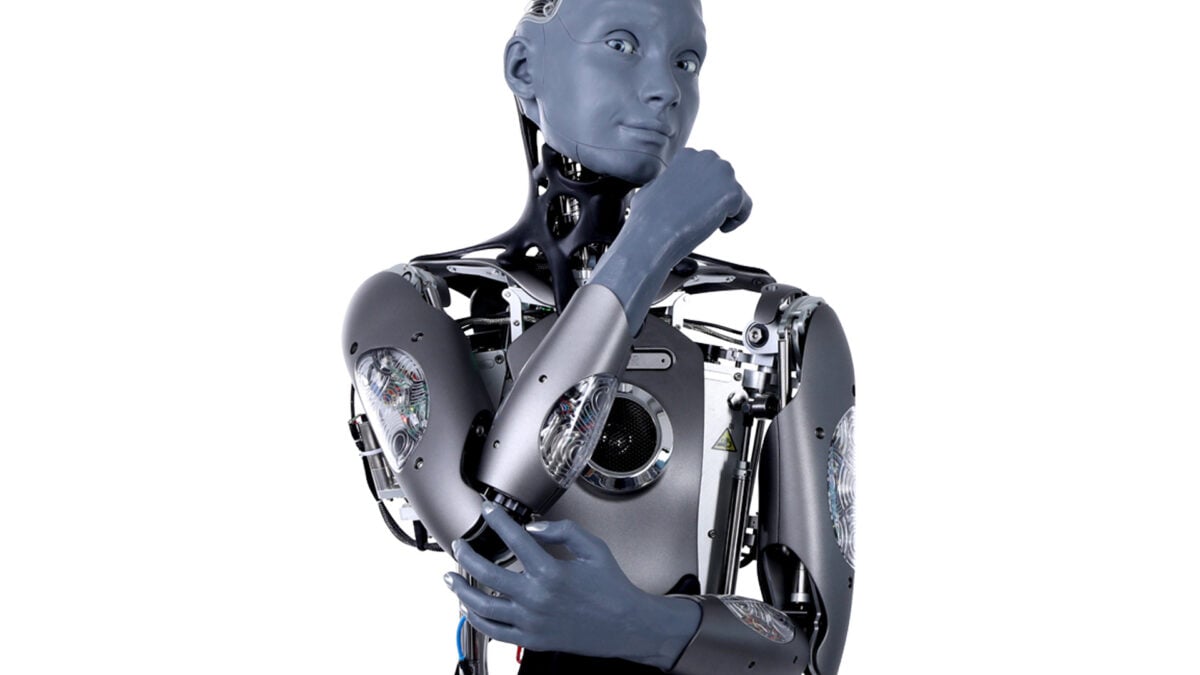
Or, at least, that’s what San Diego charter school chain Altus Schools has decided. According to local news site Voice of San Diego, the school has spent $500,000 on two Ameca robots, a model described by its manufacturer, British-based company Engineered Arts, as “the world’s most advanced social humanoid robot.” The Ameca—which looks like a cross between Natalie Portman in Ex Machina and the sadly underutilized shape-changing android Kamelion from Fifth Doctor-era Doctor Who—apparently features “61 actuated degrees of freedom, allowing for natural and lifelike movements” and “a sophisticated communication system [that] enables multilingual conversations with advanced voice synthesis and personalization options for engaging human-robot interactions.”
The story is even wilder than it looks at first glance, too, because Voice of San Diego also acquired an email from the school’s principal Cathryn Rambo, in which she professes to be “thrilled to be the first school in the world researching the use of physical AI as a teaching partner,” going on to explain that “this initiative is part of a research study examining how AI can enhance student engagement and learning outcomes,” and that “we plan to have Ameca onsite until Fall 2026.”
So, wait: what is this $500,000 actually getting the school? Engineered Arts’ site doesn’t provide a price for the Ameca, instead inviting potential buyers to request a quote, but this review puts the price at between $100,000 and $500,000, depending on configuration. If Altus is spending $500,000 on two robots, they’re costing $250,000 each, which sounds like it should be enough for a purchase—in which case, why are they only onsite for a few months? And whatever the cost, why is Altus paying six figures to provide data for a study? What is this study? Who’s conducting it?
Financial and ethical considerations aside, you might also find yourself wondering what the robots actually do. The answer appears to be that they function as a mouthpiece for a restricted version of ChatGPT. This, of course, raises the question of whether LLMs should be anywhere near a classroom, especially given that some experts are calling for an immediate ban on chatbot use by children.
And even if for whatever reason a school does decide that LLMs have some utility in education—a decision that’d be based on vibes, because it sure as hell ain’t based on research—it’s unclear why you need to spend six figures on a weird robot to embody them, especially since it sounds like the experience of interacting with one of these things is awkward and difficult. Voice of San Diego sent a reporter to the school to watch a lesson wherein one of the robots pretended to be Nikola Tesla, in an interaction that even Rambo conceded was “clunky”:
“The interaction was rife with stops and starts[…]. Throughout it all, the robot spoke too quickly for the students[…]. They ultimately asked it to repeat its Tesla introduction three additional times as they scribbled away dutifully.”
This would be all fun and games if charter schools didn’t get to do stuff like this while also merrily accepting public money. On average, the US Public Education system spends about $16,500 per student in a given year; California’s spending is a little higher, at an average of $21,600. (If you’re wondering, the District of Columbia has the highest per-student figure at $37,300, while Idaho brings up the rear with $11,200.) That means you could fund 23 kids’ education for a year with the $500,000 spent on these robots, and still have change for some new books or something.
But no, instead Altus Schools are spending half a million dollars to buy—or maybe rent—two glorified chatbots for a few months, all while providing data to someone else’s study. If I were a parent whose kid was at one of these schools, I’d have many, many questions for Rambo at the next parent/teacher conference.
Eric Migicovsky, leader of the revived Pebble, is making smartwatches for himself. You're just along for the ride.
Stay cool and enjoy the long, sunny days ahead with these gadgets to upgrade your life this summer and beyond.
As if anyone is supposed to know what a million tokens adds up to.
State-backed Chinese hackers "sought to exploit and amplify existing public concerns about energy prices and local impacts of data center development," the company said.
It’s not the first time OpenAI has hinted at something like this.
"Lockdown Mode is not intended for everyone," OpenAI's blog post says. In other words, you're probably not important enough.