
100GW of nuclear power by 2047, 5 reactors this decade: Inside PM Modi's energy self-reliance plan
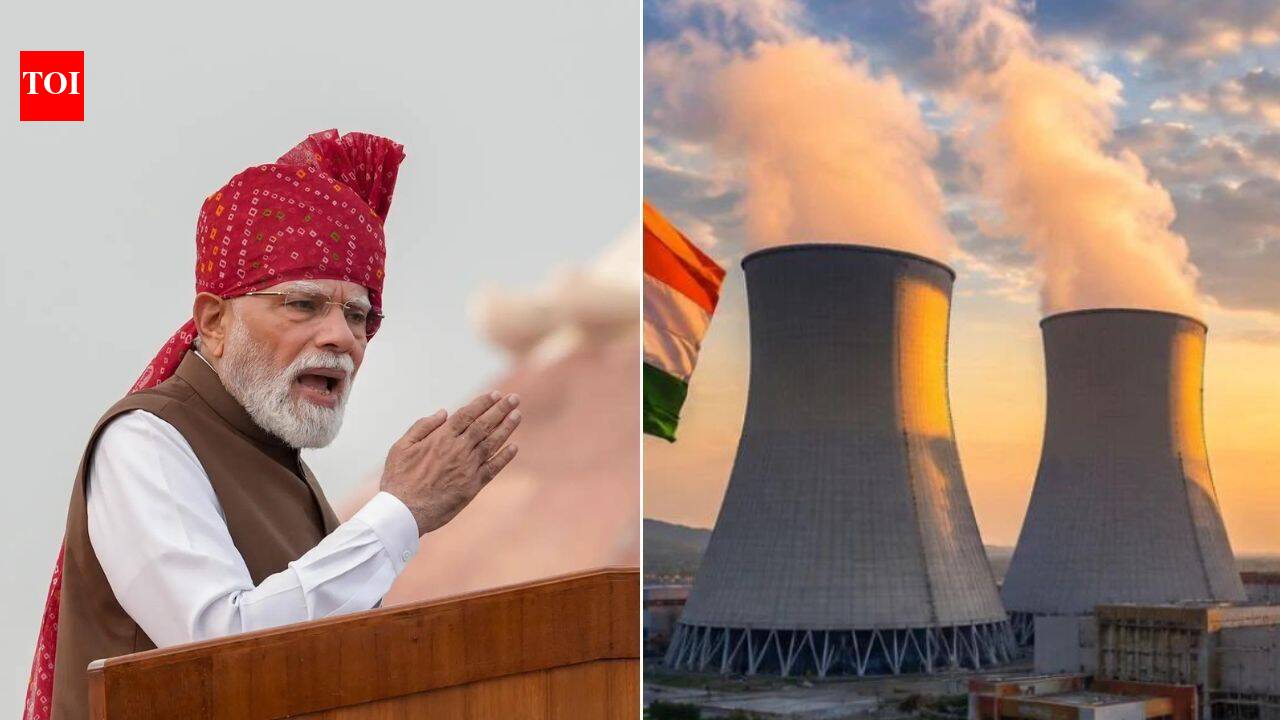
NEW DELHI: Prime Minister Narendra Modi on Saturday announced an expansion of India's ambitious nuclear power programme, setting a target of 100 GW of nuclear power capacity by 2047.PM Modi said five new nuclear reactors would be operationalised during this decade as the country seeks greater energy security and self-reliance.Addressing the nation from the ramparts of the Red Fort on the 80th Independence Day, PM Modi said India had taken an important step towards self-reliance in nuclear energy with the 500 MWe Prototype Fast Breeder Reactor (PFBR) at Kalpakkam in Tamil Nadu attaining first criticality in April this year.PM Modi said nuclear power would be an important component of India's energy security as demand for electricity rises with the expansion of technologies such as semiconductors, artificial intelligence and data centres.
He also referred to the government's nuclear policy reforms and the SHANTI Act, enacted in December 2025, as part of efforts to expand the sector.“The new world cannot run without energy. Whether they are (semiconductor) chips, AI or data centres, the country needs lots of electricity … That’s why we have already taken strong steps to ensure energy security,” he added.PM Modi said India had set the goal of reaching 100 GW of nuclear power capacity by 2047, with five new reactors expected to become operational in the current decade.India enters second stage of three-stage nuclear programmeThe PFBR at Kalpakkam marks India's entry into the second stage of its three-stage nuclear power programme, originally conceived by Homi J Bhabha.The 500 MWe reactor, developed and built indigenously at the Kalpakkam Nuclear Complex, attained first criticality on April 6, 2026.
It is being built by Bharatiya Nabhikiya Vidyut Nigam Limited, or BHAVINI, under the Department of Atomic Energy, with technology developed by the Indira Gandhi Centre for Atomic Research.The first stage of India's nuclear programme relies on Pressurised Heavy Water Reactors, or PHWRs, which use natural uranium as fuel and produce plutonium as a byproduct.The second stage uses this plutonium in fast breeder reactors.
The PFBR uses uranium-plutonium mixed oxide, or MOX, fuel and is designed to produce more fissile material than it consumes.The third stage of the programme is aimed at using India's large thorium reserves to produce uranium-233 for nuclear power generation.The PFBR is therefore intended to serve as a bridge between India's existing uranium-based nuclear programme and its longer-term thorium-based energy strategy.Why PFBR matters for India's nuclear expansionThe PFBR is a 500 MWe sodium-cooled fast breeder reactor designed to use plutonium-based fuel while breeding additional fissile material.A blanket of uranium-238 around the reactor core can be converted into plutonium-239 through the action of fast neutrons.
This allows the reactor to generate electricity while producing additional fuel.The reactor's technology is particularly relevant to India's nuclear strategy because the country has relatively limited uranium resources but substantial thorium reserves.The Department of Atomic Energy has said the PFBR will eventually help lay the foundation for the third stage of India's nuclear programme, in which thorium would be used to produce uranium-233.PM Modi had earlier described the PFBR milestone as a major development in India's civil nuclear programme.“Today, India takes a defining step in its civil nuclear journey, advancing the second stage of its nuclear programme.”PM Modi had also said, “This advanced reactor, capable of producing more fuel than it consumes, reflects the depth of our scientific capability and the strength of our engineering enterprise.
It is a decisive step towards harnessing our vast thorium reserves in the third stage of the programme.”Nuclear power seen as key to meeting rising electricity demandIn his Independence Day address, PM Modi linked India's nuclear expansion with the country's rapidly increasing demand for electricity.He pointed to the growing power requirements of semiconductor manufacturing, artificial intelligence and data centres, saying energy security would become increasingly important as India expands its technology and manufacturing sectors.“It is difficult to build a new world.
That is why, whether it is a chip, AI, or data centre, we need electricity in large quantity. The new era demands energy.”PM Modi said India had taken steps to strengthen energy security by expanding both nuclear and renewable energy capacity.He said nuclear energy was vital for ensuring a stable supply of electricity while the country simultaneously expands solar, wind and other renewable sources.India targets 500 GW renewable energy by 2030Alongside the nuclear expansion, PM Modi highlighted the growth of India's renewable energy capacity.He said India's solar energy capacity had risen from 2 GW in 2014 to 160 GW, while the country had set a target of 500 GW of renewable energy capacity by 2030.PM Modi also referred to the PM Surya Ghar Muft Bijli Yojana, saying around 50 lakh households had been covered under the rooftop solar programme.Thousands of consumers, he said, were also earning through electricity generated from rooftop solar systems.Beneficiaries under the scheme can receive a subsidy of up to Rs 80,000 per household for installing rooftop solar systems.PM Modi also said India's railway electrification had expanded sharply, helping reduce diesel consumption and imports.He said India had also started work on a hydrogen train as part of its broader clean-energy transition.SHANTI Act seeks to reshape India's nuclear power frameworkPM Modi also referred to the Sustainable Harnessing and Advancement of Nuclear Energy for Transforming India, or SHANTI Act, enacted in December 2025.The legislation is intended to modernise India's nuclear legal framework and facilitate greater participation in the nuclear sector under regulatory oversight.The law forms part of the government's broader effort to expand nuclear power capacity and bring new investment and technology into the sector.The Union Budget 2025-26 had also announced a Nuclear Energy Mission with an allocation of Rs 20,000 crore for the design, development and deployment of Small Modular Reactors.The government has set a target of having at least five indigenously designed small modular reactors operational by 2033.India’s nuclear capacity to expand from 8.78 GWIndia's installed nuclear power capacity currently stands at around 8.78 GW, according to government data.Nuclear power accounted for about 3.1% of India's electricity generation in 2024-25, when nuclear plants generated 56,681 million units of electricity.The government has projected that India's nuclear capacity could reach around 22.38 GW by 2031-32 through the development of indigenous 700 MW reactors and larger reactors being developed through international cooperation.The 100 GW target by 2047 would therefore require a substantial expansion in both the number and scale of nuclear power projects over the next two decades.Five reactors to be operationalised this decadePM Modi said India would operationalise five nuclear reactors during the current decade as part of its push towards greater nuclear capacity.The expansion is expected to involve multiple reactor technologies, including India's indigenous PHWR designs and advanced reactor technologies.The government is also developing small modular reactor designs, including the 200 MWe Bharat Small Modular Reactor and the 55 MWe SMR-55, as well as other advanced reactor concepts.The expansion is aimed at increasing the contribution of nuclear energy to India's electricity mix while maintaining the country's broader clean-energy and net-zero commitments.Nuclear power and India's 2070 net-zero targetThe expansion of nuclear power is also linked to India's commitment to achieve net-zero carbon emissions by 2070.Unlike solar and wind power, nuclear reactors can provide continuous electricity and are not dependent on weather conditions.
This makes nuclear generation a potential source of firm, low-carbon electricity alongside renewable energy.The government has therefore positioned nuclear power as part of a wider energy mix that includes solar, wind, hydrogen and other clean-energy sources.PM Modi's announcement of the 100 GW target marks a substantial increase in India's long-term nuclear ambitions and places nuclear power at the centre of the country's energy security strategy as it works towards the Viksit Bharat 2047 goal.Get the latest India News and Live updates.
Download the TOI app.