
18 ancient Egyptian tombs found along the Mediterranean coast with dozens of ‘gold tongues’ meant for the afterlife
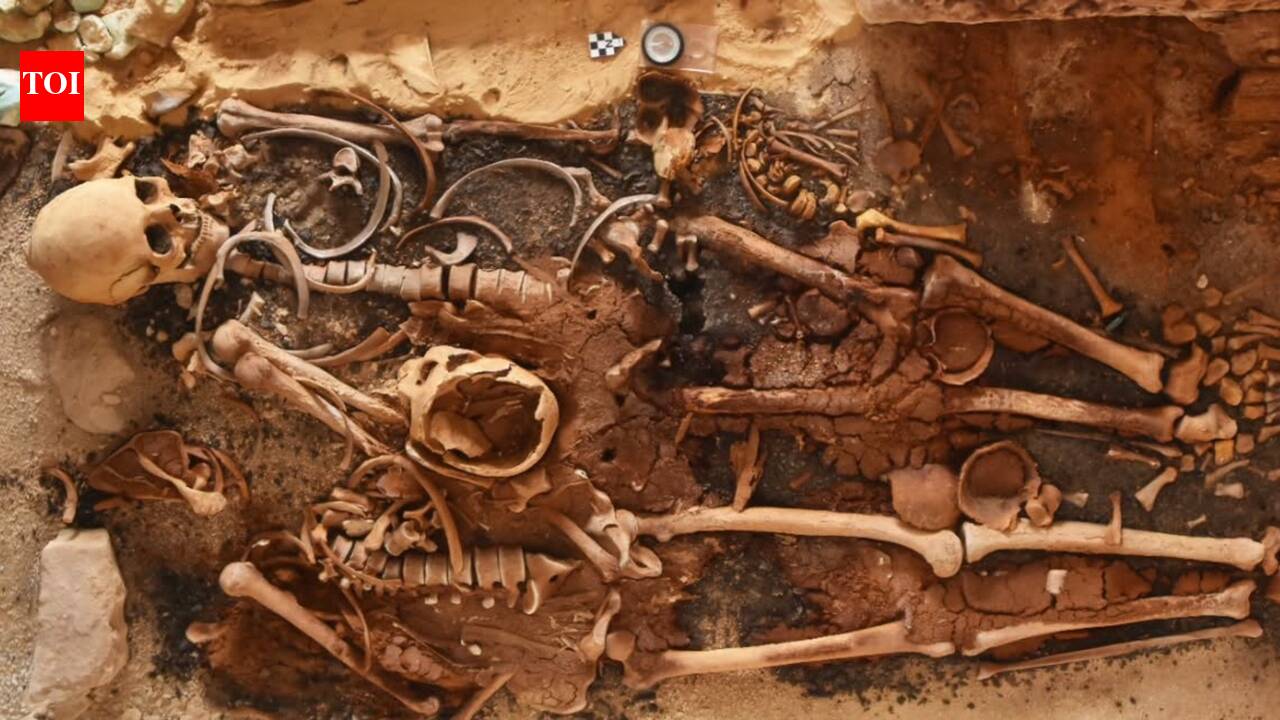
Archaeologists have discovered 18 ancient Egyptian tombs along the Mediterranean coast, and they came with golden tongues, literally. They uncovered 18 tombs along a stretch of coastline near Marina el-Alamein, about 60 miles west of Alexandria, untouched for roughly two thousand years. Inside, they found sealed stone slabs, a granite coffin nearly the length of a small car, and dozens of gold tongues, which are said to be meant for the afterlife.
The tombs date to the Ptolemaic (322 to 30 BC) or Roman (30 BC to AD 395) period, the Egyptian Ministry of Tourism and Antiquities said in a translated statement. Egypt was ruled by the descendants of one of Alexander the Great’s generals during the Ptolemaic period. After Cleopatra VII died, Egypt became part of the Roman Empire.A rare discovery of 18 tombsThe archaeologists unearthed 18 ancient tombs in an Egyptian town along the Mediterranean Sea.
Eleven of them were buried deep underground, some reaching more than 26 feet down. The other seven lay closer to the surface, built from limestone. A few chambers were still sealed with their original stone slabs, untouched since they were placed there. One of the tombs contained a massive 8.2-foot granite coffin, with the lid intact.
Archaeologists are now studying the skeletal remains inside.Gold tongues for the afterlifeOne of the fascinating finds from the excavation was a set of 24 gold tongues. The gold tongues were found placed in the mouths of the mummies. Ancient Egyptians treated gold as something close to divine, ‘the flesh of the gods’.
They slipped these tongues into the mouths of the dead to help the deceased speak in the afterlife.“Gold tongues are a well-documented feature of some burials dating to the Ptolemaic and Roman periods in Egypt. They are generally interpreted as symbolic funerary amulets intended to enable the deceased to speak in the afterlife, particularly during the judgment before Osiris, or, more broadly, to communicate and recite sacred formulas in the next world,” Hesham Hussein, Undersecretary for Lower Egypt and Sinai archaeology at Egypt’s antiquities ministry, told Live Science.The archaeologists also found a gold tongue shaped like the Eye of Horus, a protective symbol tied to the falcon god associated with the sky and warfare.
Artefacts shaped like the eye were said to be used to ward off evil in ancient Egypt.A ‘false’ doorThe archaeologists also unearthed an offering altar with a base carved to resemble a false door. Think of it like a door, but not actually one. “The false door is one of the oldest and most recognisable elements of ancient Egyptian funerary architecture.
In traditional Egyptian belief, it symbolised the interface between the worlds of the living and the dead, through which the deceased could spiritually receive offerings presented by the living,” Hussein said.Aphrodite, the Greek goddess, also showed upAmong the finds was an incomplete statue of Aphrodite, the Greek goddess of love and beauty.
Greek religion and culture became increasingly popular in Egypt during the Ptolemaic dynasty.A reminder that, by the time these tombs were filled, Greek religion had thoroughly worked its way into Egyptian burial customs. The real question now, according to Mastrocinque, is to see whether there is a structure for Aphrodite near the statue.
“It is important to know where this statue has been found. Was there a small cultic place of Aphrodite within this funerary complex?” he said.Meanwhile, the excavation site was discovered in 1986 during construction work in the Marina area. Archaeologists have conducted excavations and extensive studies since then, as this site has one of the best-preserved ancient coastal cities in Egypt, including a network of streets, houses, public facilities, a port, and commercial areas.