
$29 billion stock offering going live this week will test investor appetite for AI companies
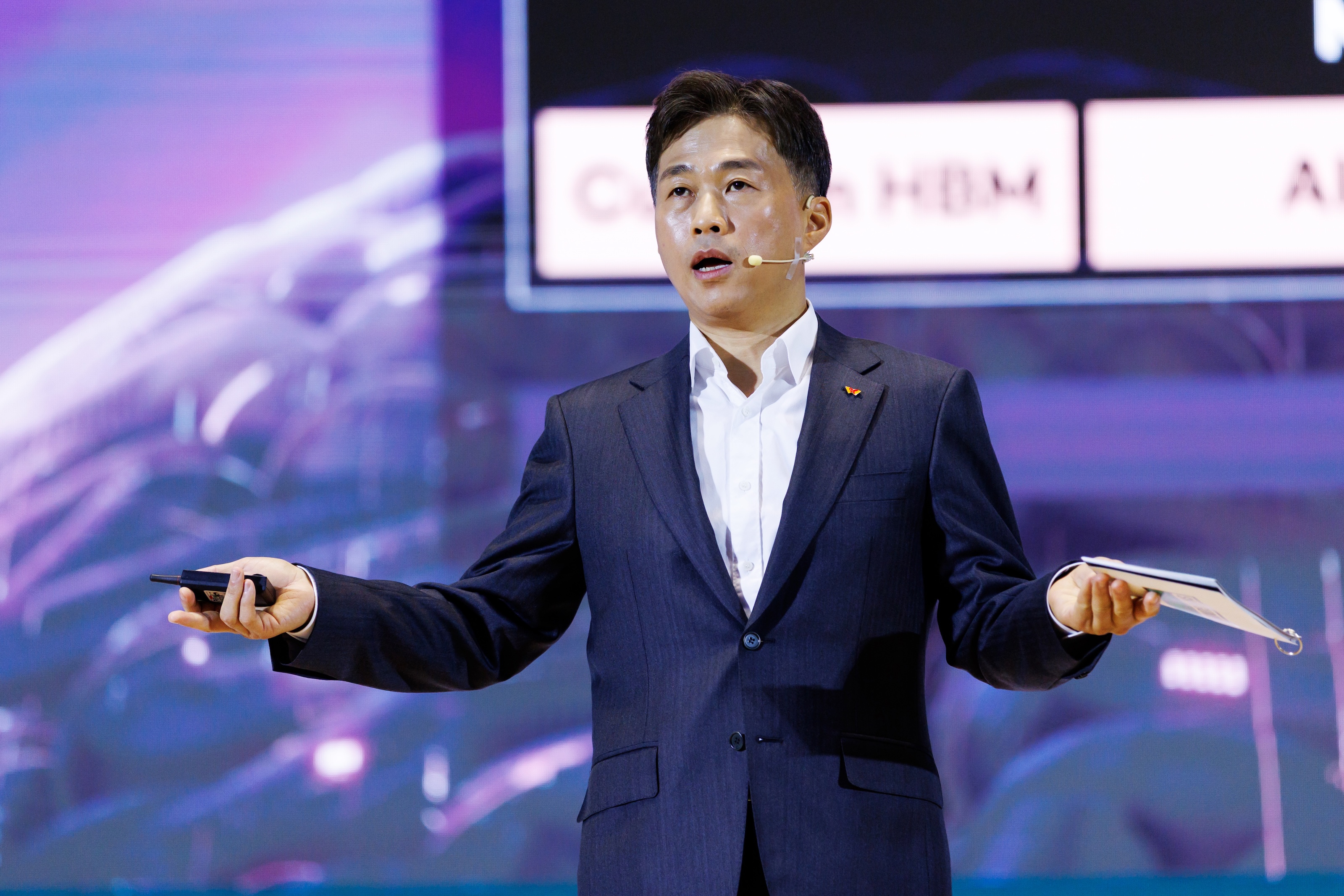
South Korean chipmaker SK Hynix isn’t one of the Magnificent Seven stocks but is in a class of its own after pulling off a stunning rally on the back of the AI boom, and it’s about to land on U.S. markets, Fortune’s Jason Ma reports.
The offering will be a crucial test of investors’ desire to keep funding the AI boom. Shares will list on the Nasdaq and are expected to start trading on Friday, raising about $29 billion in what could be the biggest-ever first-time share sale by a foreign company. That’s after SK Hynix’s Korea-listed stock shot up 770% over the past 12 months, even after a 20% selloff from its June peak.
The surge even outpaces Micron Technology’s 700% rally over the same time, with makers of memory chips emerging as critical enablers of AI agents. And SK Hynix is the top supplier of high-bandwidth memory after becoming Nvidia’s favorite provider.
South Korean stocks have been on a wild ride this year, with the main exchange, the KOSPI, up 87% year-to-date. That’s because SK Hynix is heavily overrepresented within the KOSPI market cap. Samsung and SK Hynix alone represent about half the entire index.
“Samsung and SK Hynix helped the KOSPI triple over the past year after 17 years of doing nothing, even if some air has escaped from the balloon in recent days. Their combined market cap is still around 16 times that of the third largest company in the index,” Deutsche Bank said in a chartbook published July 3.
“My team sends emails. We have an intranet. I will write white papers for the team. No one reads any of it. No one watches any of this until I put it on LinkedIn.”—LinkedIn editor-in-chief Daniel Roth on why CEOs end up being forced to use social media eventually.
There’s an ugly new phenomenon in the U.S. labor market—the increasing number of Americans who have dropped out of the workforce and don’t want to get back in. One reason U.S. unemployment has stayed low at 4.2% is that hundreds of thousands of people have dropped out of the workforce altogether. The “unemployment” category only counts people without jobs who are also actively looking for work.
This chart from Pantheon Macroeconomics shows how the labor force participation rate has declined over time, to 61.5%:
Pantheon’s Samuel Tombs thinks the drop is so sharp that it must be statistical noise. Maybe stock market gains are prompting workers near retirement to cash in early, he said in a note. “It’s possible that the dearth of job openings is prompting many people toward the start of their careers to defer looking for work. But we think the more likely explanation is that this drop is just sampling noise, and that it reverses in July’s report,” he added.
But that doesn’t explain the dropout rate noticed by Jeffrey Roach, chief economist for LPL Financial. More people are moving from officially “unemployed” (i.e. they don’t have a job but are looking for one) to “not in the labor force” (meaning they’ve dropped out of the market altogether). Similarly, there’s a flow of people who had jobs who go directly into “not in the labor force” category.
“This suggests the job market is cooling down,” Roach said in an email to Fortune.
Gen Z was ‘jaded about employment before we ever entered the workforce’—now psychologists say the stare has hardened into something worse - Nick Lichtenberg
The stock market is about to suffer a ‘snapback’ and will lose much of this year’s gains as ‘speculation is hitting extreme levels,’ BofA warns - Jason Ma
Investment firm’s cofounder sues after being fired for neglecting the in-person work mandate he signed, saying it applies to employees not owners - Jason Ma
Shark Tank’s Kevin O’Leary says if he were 25 today, he’d chase these two booming opportunities in the world of AI - Marco Quiroz-Gutierrez
Mark Zuckerberg takes business calls on a jet ski wearing his $800 Meta glasses—and insists ‘the other person could not tell’ - Sydney Lake
Despite return-to-office-crackdowns, remote work is alive and well as the rate has barely changed over the last two years - Marco Quiroz-Gutierrez
OpenAI and Anthropic are struggling to maintain the price of AI tokens—the basic units of compute that they offer to clients. The Silicon Data LLM Token Expenditure Index, which tracks token prices, is down 20% since May. That’s an indicator that clients are unwilling to pay ever-increasing prices.
Increasingly, companies are refusing to pay for the top-ranked, most expensive models, forcing their employees to use more basic AI products instead. Others are putting caps on how many tokens their staff can use, 404 Media reports.
Citi has banned its staff from the most up-to-date models of Claude and ChatGPT. Adobe and Atlassian have ended unlimited use too, 404M says.
Online business makes everything easier and faster, and that has a noticeable effect on inflation, according to Richard Lung and his team at Visa. “It constrains inflation by making online markets more contestable, which reduces customer stickiness and makes it harder for firms to pass higher costs through in full,” he said in his recent midyear outlook.
This chart shows “the Spotify effect”—the idea that countries with a high share of transactions conducted online tend to have lower inflation.
The percentage of AI-using daters who have used AI to write “Dear John” letters when they are dumping someone, according to a survey from Wingmate, an AI life coaching platform.
It was one small step for a robot, but a giant leap for robotkind. At halftime in New Jersey during Sunday’s Brazil v Norway match in the FIFA World Cup (Norway won 2-1), a Boston Dynamics/Hyundai robot named Atlas handed the match ball to the referee. While the stunt looked simple enough, it in fact demonstrated a huge amount of processing and logistical power. The trick wasn’t programmed. Rather, Atlas learned how to navigate the conditions around it, Alberto Rodriguez, Boston Dynamics’ director of robot behavior, told Fortune’s Catherina Gioino.
Part of the robot’s training was to handle situations in which its handlers have deliberately deceived it. “We keep pushing it around, or lying to it about where the ball is, or putting obstacles on the ground, or changing the friction with the ground,” Rodriguez said.
“Grass has that interesting property where sometimes you slip, but sometimes your feet can get caught on it,” Rodriguez said. The result is what Rodriguez calls “muscle memory,” a first for robot behavior.