
Inside the Chernobyl Exclusion Zone, With Ukrainian Soldiers Intercepting Russian Drones
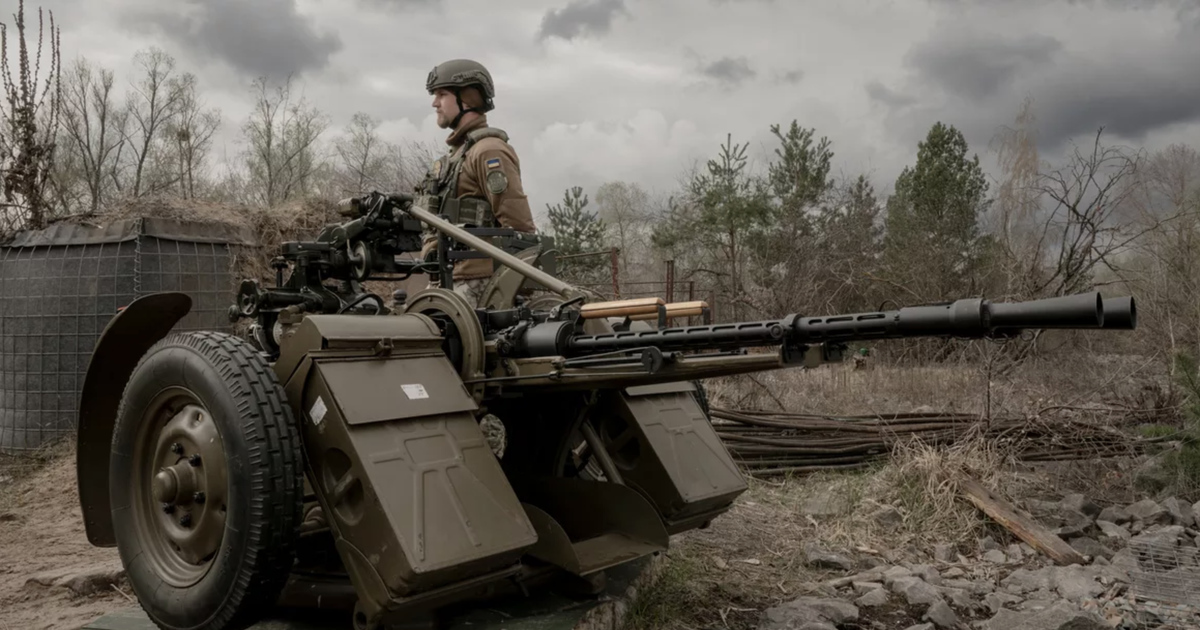
As a child, Yevhen had always dreamed of coming to Chernobyl. Sitting for long hours at the controls of a mobile machine-gun station, the soldier sometimes has time to think about it as he scans the sky, his gun barrel pointed toward the Belarusian border. Behind him, beyond a patch of forest, rises the enormous dome of the nuclear plant’s sarcophagus. Beneath the arch lie 400,000 cubic meters of radioactive waste.
“Our role is to intercept drones before they fly over the plant,” Yevhen explains. “We have radars, but most of the work is done with our eyes and ears.”
It is an extremely sensitive mission assigned to the National Guard’s special forces. Known for infiltration missions in eastern Ukraine, their Omega unit has also been protecting Chernobyl’s skies since 2024.
The exclusion zone lies directly in the path of Russian missiles and drones transiting through Belarus, Moscow’s client state, on their way toward Kyiv or western Ukraine.
“We get alerts at least twice a week. They can come from anywhere, north or south, because they adapt their routes, making detours to avoid our radars,” explains Sergeant Artem, 34, who heads Omega’s anti-Shahed unit.
The nights spent scanning the darkness are sometimes punctuated only by the furtive sounds of nocturnal visitors—deer, moose, wolves—which have recolonized the area since humans abandoned it.
“Still, we’re only one small part of a vast air-defense network,” Yevhen says. “We fire. Other units jam signals. Sometimes the air force tells us: ‘Don’t shoot, we’ve got this.’”
If necessary, one of his comrades hoists a rocket launcher onto his shoulder to support the machine gun and anti-aircraft cannon.
Since July 2024 and the beginning of massive air attacks against Ukraine, 92 Shahed or Gerbera drones have officially been detected within a five-kilometer radius of the nuclear plant’s anti-radiation shield, Ukraine’s Prosecutor General’s Office revealed last month.
The office added that in reality many more escape detection, as Chernobyl—and another nuclear site in western Ukraine, Khmelnytskyi—also lie along the trajectory of Russian Kinzhal hypersonic missiles.
Thirty-five more were detected within roughly 20 kilometers of the two plants, prosecutor Ruslan Kravchenko said, denouncing acts that were “extremely irresponsible” and showed “complete disregard for civilian safety, not only in Ukraine but across Europe.”
In February 2025, one impact nearly triggered a major disaster. A Russian drone struck the sarcophagus covering Reactor No. 4 and its radioactive waste. A white patch 15 meters in diameter now marks the repaired section where the fire burned through the dome.
Although no radiation leak was reported, the IAEA (International Atomic Energy Agency) announced last December that the protective structure had “lost its primary safety functions” and now requires repairs estimated at around €1.5 billion.
Did Russia deliberately target the plant? Was it a navigation error? The investigation conducted by Ukrainian prosecutors is still ongoing. However, citing the drone’s flight path, prosecutors stated in an April 22 communiqué that preliminary findings suggested the act was “likely deliberate.”
A drone strike damaged the protective shell of the Chernobyl nuclear power plant, creating a breach several meters wide.
For Ukrainian authorities, there is no doubt that Russia intentionally targeted the plant. More cautious, Viktor Kevliuk, an expert at Kyiv’s Center for Defense Strategies, does not believe Moscow is willing to cross certain thresholds.
“The adversary does not fear catastrophe, but manages the risk,” the reserve colonel told Le Figaro “It controls its escalation logic. The objective is to keep nuclear plants under constant threat, whether through overflights or physical control as at the Zaporizhzhia nuclear plant.”
Still, the Omega unit has noticed a significant decline in overflights since the incident.
“The Russians may also have measured the consequences and changed their strategy,” suggests Artem, Omega’s unit commander.
That may also be because Chernobyl has upgraded its radar and jamming capabilities, prompting the Russians to seek alternative routes. But new threats have emerged in recent months: small Mavic-type surveillance drones, lightweight and difficult to detect. Omega soldiers spot them almost daily along the border.
Long-range drones—Shaheds, Gerberas, Orlans and Zalas—are now also equipped with cameras. A mannequin dressed as a soldier and wearing a gas mask, used as a military decoy to mislead Russian reconnaissance services, stands in front of one of Chernobyl’s reactors.
In this drone ballet, electronic warfare is raging on both sides of the border. “Their jamming sometimes prevents our drones from taking off even as far as Pripyat, miles away,” says Andriy, a member of the 1st battalion of the Ukrainian National Guard, stationed at Chernobyl for 40 years to secure the site.
Just days before commemorations of history’s worst nuclear disaster, on April 26, 1986, President Volodymyr Zelensky, who will visit the site last month, warned of a different type of threat.
According to Ukrainian intelligence, the Belarusians are carrying out worrying military preparations along the border. Minsk is “building roads toward Ukrainian territory and setting up artillery positions,” the Ukrainian president warned in a message on his Telegram channel.
Back in 2022, Russian tank columns used this route in their drive toward Kyiv before being stopped at the last minute by Ukrainian forces. Russian troops occupied the plant for 35 days, holding staff hostage.
Without waiting for another assault, Chernobyl is fortifying itself. As Artem travels through the zone, he sees other units piling earth and building positions. Raised trenches appear like molehills—because the radioactive soil cannot be dug into.
Anti-drone nets have been erected. Three days before the disaster commemorations, teams were installing more above the roads. Anti-drone nets cover certain parts of the Chernobyl exclusion zone, installed to protect key areas and infrastructure from Russian drone strikes.
After finishing their shift, Omega’s men leave their position and take the bumpy road back, skirting the immense sarcophagus to return to their base near this strange radioactive neighbor.
After a shower and some rest, they remain ready to respond at the first alert. Some soldiers occasionally venture as far as Pripyat, the ghost town evacuated in an emergency 40 years ago on the day of the explosion. The decaying buildings, their wallpaper peeling and radioactive for decades still to come, are sometimes shaken by the roar of helicopters and the crack of gunfire when they serve as training grounds for urban assault exercises.
Konstantin, an Omega soldier with rounded cheeks beneath his camouflage bucket hat, gazes thoughtfully at this frozen landscape. He remembers the stories told by his father, one of the “liquidators” mobilized by the Soviet Union after the disaster to demolish anything contaminated by radioactive substances.
“He died at 43 from stomach cancer. Probably because of the aftereffects,” Konstantin says. “I never thought fate would bring me to Chernobyl, and even less as a soldier.”
In his time, his father protected others from harmful substances. He now protects them from drone attacks. Adjusting his bucket hat, the soldier reflects on the present: “After all, whether in Chernobyl or elsewhere, our job is the same: bring down the Shaheds.”