
Next Target for Bezalel Smotrich, Israel’s Most Radical Cabinet Minister: A Bedouin Village
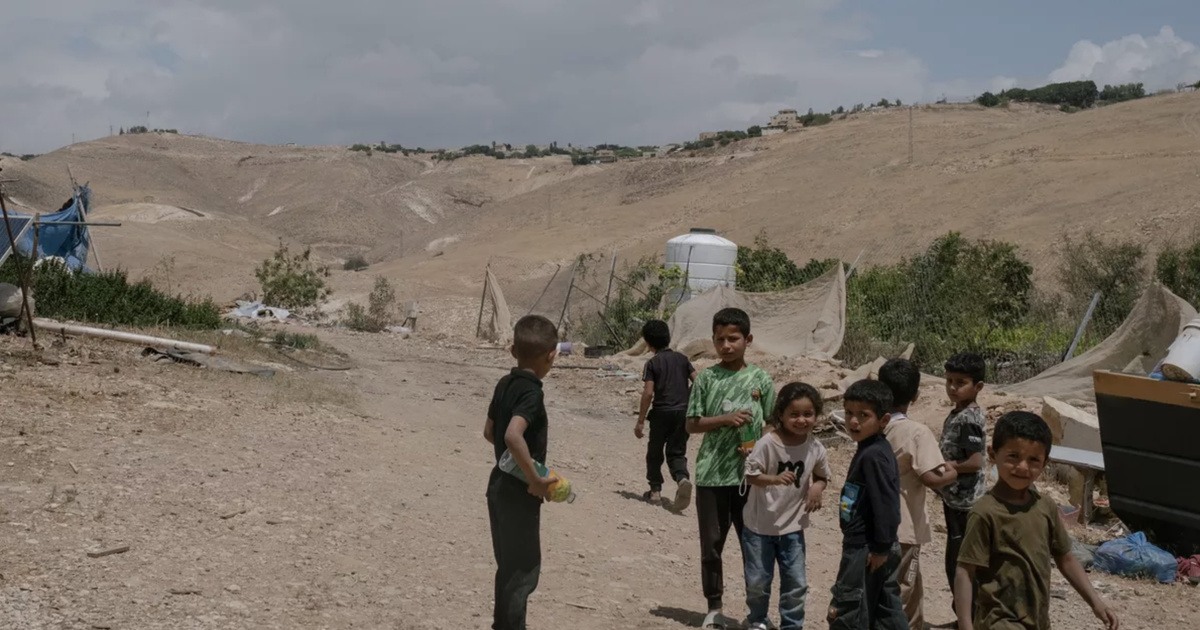
Khan al-Ahmar is almost deserted this Thursday morning. It is still early, but the Judean sun is already beating down. Bands of mischievous children seem to rule the dusty streets of this small Palestinian Bedouin village hemmed in by Israeli settlements.
Beneath the dense foliage of majestic fig trees, his weathered face marked by the dry desert air, Eid Abu Khamis looks worried. Khan al-Ahmar is once again under threat of eradication. The small Bedouin village, perched on the side of a hill overlooking Highway 1, has been slated for destruction by Israeli Finance Minister Bezalel Smotrich.
“The children, the women, everyone is afraid,” the old man says quietly. “We don’t know when the bulldozers will arrive. It could happen in the middle of the night.”
Smotrich, leader of the Religious Zionism party and a fervent supporter of settlement expansion in a “Greater Israel” extending far beyond its current borders, has promised to make an example of Khan al-Ahmar’s 300 residents in retaliation for the arrest warrant issued against him by the International Criminal Court (ICC). “The issuance of arrest warrants against the prime minister, the defense minister, and the finance minister (of Israel) amounts to a declaration of war (...) I am not a submissive Jew,” the minister declared last month at a press conference. “I hereby announce the first target that will be struck: as soon as I finish speaking, I will sign an evacuation order for Khan al-Ahmar. This is only the beginning.”
Since 1970 and an initial expropriation ordered by the Israeli government for the construction of the settlement of Maale Adumim, Khan al-Ahmar has known it was in danger. The Bedouin village is surrounded by settlements—illegal under international law—in this West Bank territory under Israeli military occupation. From the 1980s to the present day, one by one, the surrounding hills have been dotted with buildings and Israeli flags.
To the north, Kfar Adumim expands year after year. The gray outline of a new neighborhood under construction is already visible on a nearby ridge. “They get a little closer every year. In 2024, they settled at the edge of the village, 100 meters from the last houses,” complains Ahmed Ibrahim, 46, in his home on the outskirts of the village. Behind the school, a building decorated with strings of lights and flanked by a shipping container overlooks a few rudimentary sheep pens. “This settlement prevents children from the neighboring community from getting to school,” the father says. “They settled on the path that connected our two villages.”
This morning, only one classroom is open in the brightly colored school. On wooden benches, a handful of students laboriously repeat their lessons under the exhausted gaze of a young teacher. The rest of the school is closed: it now opens only two days a week for lack of funding, as the Israeli Finance Ministry withholds part of the tax revenues owed to the Palestinian Authority.
Here, as elsewhere in the occupied West Bank, neighboring settlers have created an atmosphere of terror. Settlers regularly take advantage of the night to enter the village, destroying fences and damaging buildings with complete impunity. When his 17-year-old son leaves the village to graze the family’s flock of 40 sheep, Ahmed Ibrahim never takes his eyes off his phone. “The settlers are everywhere. They harass our children and steal our animals, and the authorities do nothing,” he explains. “Two weeks ago, my nephew was arrested by the police. They confiscated his flock, one hundred sheep. He only got 99 back. The police told him they had eaten the missing one.”
Behind the fate of these 300 Bedouins lies a much broader strategy aimed at preventing the creation of a territorially contiguous Palestinian state with Jerusalem as its capital. Like Khan al-Ahmar, 46 Bedouin communities are threatened with expulsion by the current decision. All are located around Jerusalem, in this highly contested territory that alone concentrates all the stakes of the struggle for land taking place throughout the occupied West Bank.
In retaliation for the recognition of the State of Palestine by about 10 countries, including France, Israel decided last August to revive the E1 project. Conceived in the 1980s, this territorial planning initiative pursues a dual objective. First, it aims to encircle East Jerusalem (the Arab part of the Holy City) with a network of settlements, military zones, and roads reserved exclusively for settlers. Second, it seeks to complete the east-west division of the West Bank, isolating its northern part from its southern part. Khan al-Ahmar, along with several neighboring Bedouin communities, sits precisely on the hills where the new settlements are to be built.
But for Minister Smotrich, Khan al-Ahmar is a long-standing obsession, as the village has become over the years a symbol of Palestinian resistance to expropriations ordered by successive Israeli governments in the West Bank. As early as 2011, before becoming a minister, Smotrich was leading a public and legal campaign with Regavim—an organization recently placed under European sanctions—to demolish the Bedouin village.
Fifteen years later, Khan al-Ahmar has reemerged as the ideal target with which to challenge international justice and its European supporters. “This time, I’m afraid we won’t make it,” sighs Eid Abu Khamis. “For the first time, a minister has signed the document ordering the destruction.”
But in the shade of the fig tree, Eid Abu Khamis refuses to limit the threat facing his community to the far-right minister alone, whose positions shock even many in Israel. “Europeans identify Smotrich and his associates as the cause of our problem. But our problems began long before these extremists came to power,” he complains. As the decades passed, the village’s territory evaporated, hectare by hectare, consumed by the Israeli authorities.
Khan al-Ahmar lies in Area C, which covers 62 percent of the occupied West Bank and is administered by the Israeli army. “The army prevents us from accessing our land. After seven years, under an Ottoman law, they confiscate the land on the grounds that it is not being used. But how can you use land that you are not allowed to reach?” the community leader says angrily.
For the Jahalin clan, the threat of a new exile is intertwined with the memory of the expulsion suffered by their fathers in 1948. When the Arab-Israeli war of 1948 broke out, the clan, which had led a nomadic life in the Negev Desert in southern Israel, was driven from its grazing lands by the Israeli army. Like 800,000 Palestinian refugees of the Nakba (“catastrophe” in Arabic), they made their way to the West Bank, then under Jordanian rule, and settled in the Judean hills.
The Israeli plan calls for the relocation of the village’s 300 residents to Ezzarieh, a Palestinian town on the outskirts of Jerusalem. “They want to put us in six-story apartment buildings, right in the city. For us, that is completely incompatible with our way of life,” says Fatiah, 26, who teaches at the village school.