
Democrat Chris Murphy says $25 wage could flip Trump voters to Democrats
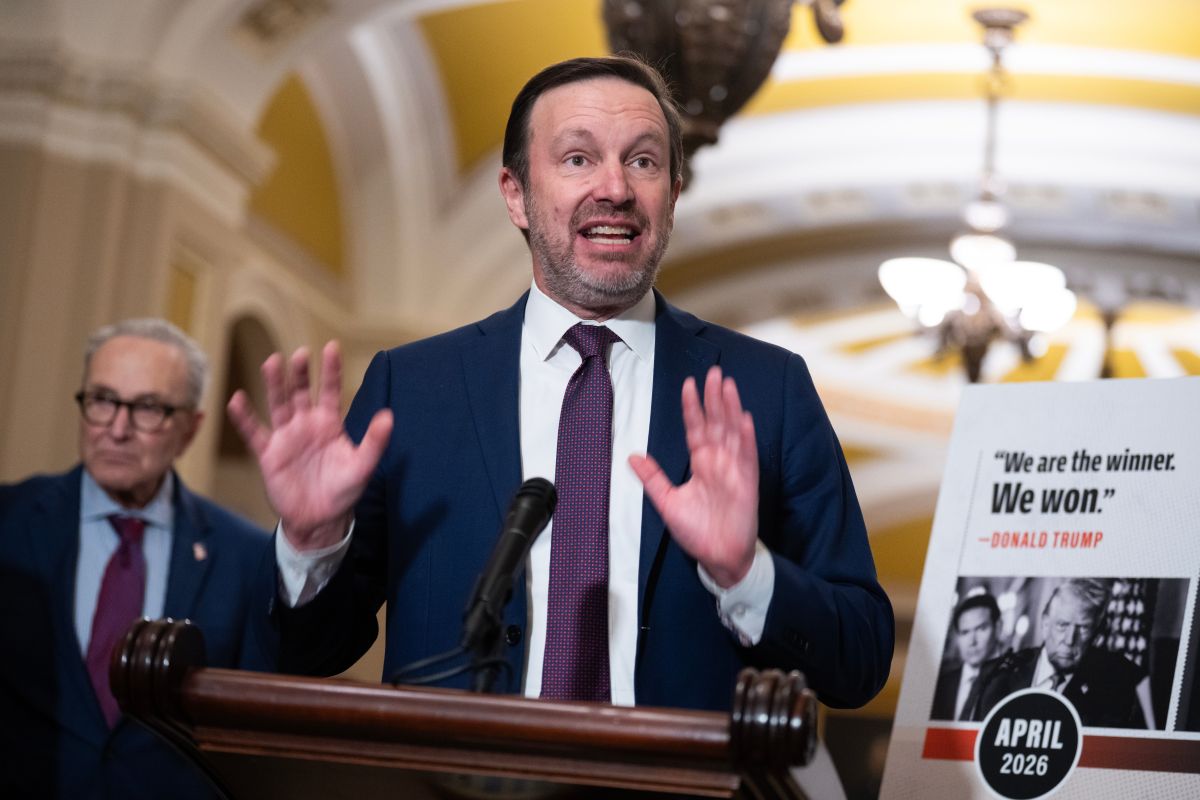
Senator Chris Murphy argued Sunday that an increase in the federal minimum wage could be the key to rebuilding the Democratic coalition, including winning back working-class voters who supported President Donald Trump in the last election.
During an interview on NBC News' Meet the Press, the Connecticut Democrat pointed to his proposal to raise the federal minimum wage to $25 an hour, calling it a “unifying issue” that could resonate across party lines.
"I think we have to understand that people do not believe that this version of capitalism has worked. And frankly, it hasn't worked," he explained. "You have 40 percent of Americans today that are working full-time and don't have enough money saved up in the bank for an emergency car repair."
The federal minimum wage has remained at $7.25 an hour since 2009. Murphy’s push highlights an ongoing debate within the Democratic Party over how to balance progressive economic policies with broad electoral appeal ahead of upcoming election cycles like this year's midterms.
Murphy defended his newly introduced legislation, the “Living Wage for All Act,” which would gradually phase in the $25-an-hour baseline over several years. Under the plan, large employers would be required to meet the benchmark sooner than smaller businesses. Specifically, large corporate employers would be required to implement the $25 wage floor by 2032, while smaller businesses would have an extended runway until 2039 to fully comply.
To bridge the gap between the current floor and the ultimate target, the legislation mandates a first-year jump, raising the federal minimum wage from $7.25 to $12 an hour upon enactment.
Currently, no U.S. state has a $25 minimum wage. The highest state-level mandates sit around $17 per hour, led by Washington state, while many others remain bound to the federal baseline.
“There’s plenty of economic analysis to show that if you gradually raise the minimum wage to $25 an hour, you’re going to create more jobs than you’re going to lose,” the senator said Sunday, dismissing concerns over potential job cuts.
He added: “If you ask Democrats what they think the minimum wage should be, they say about $27. If you ask Republicans and independents, they say about $26. You know why? $25 is just the minimum wage you need to pay your bills in this country...This is the kind of idea that brings Trump voters over.”
Meanwhile, some economists and business groups warn that a rise to $25 an hour carries substantial risk. Critics argue it could lead to reduced hiring, increased automation, and higher consumer prices as companies attempt to offset labor costs. Small businesses with narrow profit margins could face layoffs or closures.
Research on these effects is mixed, however, with some studies finding only limited impact on employment depending on how large and how quickly the wage increase is implemented. The proposed bill also ensures the target isn't a permanent ceiling; once the $25 baseline is universally met, the federal minimum wage would index each year to equal two-thirds of the national median wage, locking future increases to broader economic growth.
Murphy's proposal comes as Democrats evaluate strategies to reclaim working-class voters who migrated to the Republican column under Trump in the 2024 election. Murphy suggested these voters are motivated by economic frustration rather than rigid partisan ideology.
“There are a lot of Trump voters who believe that the economy is rigged, and they mistakenly thought that Donald Trump was going to unrig it,” Murphy said. “They now see him as a fake populist. They are open to listen to a Democratic Party that is for increasing the minimum wage, breaking up concentrated corporate power, [and] bringing back the strength of labor unions."
Murphy urged Democrats to focus heavily on bread-and-butter economic issues, such as wage increases and union strength, while remaining flexible on social issues to expand the party's reach.
“We have to accept into the coalition people that may have voted for Donald Trump,” he said, noting that those voters may not fully align with the Democratic platform on issues like gun control, climate change, or abortion.
"We should give them a place in our party," the senator said. "I think the only way that we give them that place is by being stronger in the way that we confront the consolidation of corporate power in this country."
Murphy also rejected calls for Democrats to embrace socialism more, despite polling showing growing support for the idea among some Democratic voters.
“No,” he said when asked whether the party should adopt the label. Instead, Murphy said Democrats should embrace "common good capitalism.”
The legislative push arrives amid a prolonged cost-of-living crisis for American households, where the price of essentials like housing and food has frequently outpaced typical wage growth.
According to data from the Urban Institute, U.S. home prices have surged 81 percent since 2017, while rents have climbed 54 percent. Data from Habitat for Humanity indicated the median U.S. home price reached approximately $412,500 in 2024, demanding an annual income of roughly $126,700 to comfortably afford—well above the typical household income.
Food costs have also compounded the strain, rising about 3.2 percent in 2025, according to the U.S. Department of Agriculture. While overall inflation has moderated to an annual rate of about 4.2 percent, expenditures on shelter and food continue to consume a disproportionate share of lower- and middle-income budgets.
Murphy argued that the widening gap between wages and basic living expenses makes aggressive economic intervention necessary.
“In the most affluent, most powerful country in the world, if you work full time, you should be able to pay your bills,” Murphy said.
The bill faces steep political hurdles in a divided Washington, where congressional Republicans have consistently warned that massive wage mandates damage economic growth and fuel inflationary pressures.
Contact Newsweek editors for this story: Steve Mollman and Anthony Murray.