
A good – and bad – week for Italy's art police and museum security
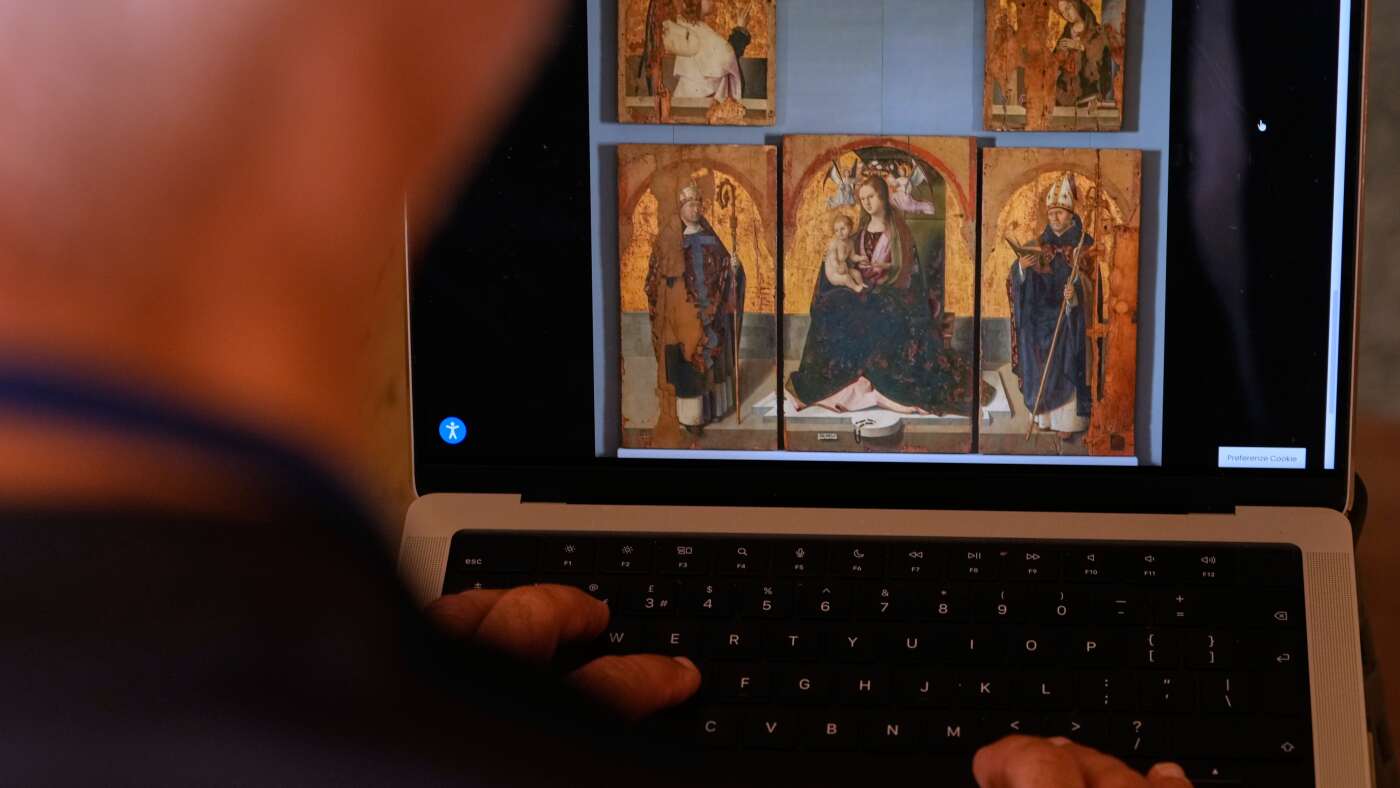
A journalist browses the Messina museum website showing a picture of the Early Renaissance painter Antonello da Messina's artwork, multiple pieces of which were stolen from the Sicilian museum on Aug. 15, 2026. Gregorio Borgia/AP hide caption
In late March, a gang used a tractor to batter down a fence before two masked burglars broke into the Magnani Rocca Foundation, a private museum about 12 miles from the northern Italian city of Parma. They climbed in through a window door, and grabbed three paintings off the wall before disappearing – the whole operation caught on camera, yet completed in under three minutes.
The roughly $10 million haul included Cézanne's Still Life with Cherries (worth an estimated $7 million), Renoir's Les Poissons (with an approximate value of $3.5 million) and a Matisse aquatint, Odalisque on the Terrace ($23,000). It was the latest in a run of high-profile thefts that have hit museums and galleries across Europe.
This past Friday, officials said the paintings had been recovered during some searches that prosecutors had ordered. That investigative effort was led by the Italian police branch known as the carabinieri, working alongside a specialist team focused on cultural heritage protection.
Yet authorities gave few further details, and the investigation remains open.
In this picture made available by the Italian Carabinieri in Parma, northern Italy, Friday, Aug. 14, 2026, Carabinieri pose near three artworks recovered following a police operation. Italian Carabinieri/AP hide caption
The following night, a Saturday, was an Italian holiday known as Ferragosto, when much of the country was out celebrating. In the Sicilian city of Messina, a major religious festival held every August 15, called La Vara, had also drawn thousands to the streets.
While attention in the city may have been elsewhere, thieves got past the alarm system at Messina's Museo Interdisciplinare Regionale (MuMe), and broke open a security case. They soon left with four wooden panels by the city's famed Renaissance painter, Antonello da Messina.
Antonello, born around 1430 and trained in Naples, absorbed influences from Provençal and Flemish painting styles that remained visible in his own work.
In Saturday's heist, thieves made off with three of the five surviving panels from an altarpiece by Antonello known as the Polittico di San Gregorio. The work originally had six panels, but one was destroyed along with the monastery that housed it in the 1908 Messina earthquake. It was the only work by the artist that had never left his home town.
The thieves also purloined a small double-sided painting, with the Virgin and Child on one side and Christ on the other, that the Sicilian regional government had bought from the auction house Christie's back in 2003.
Antonello's work is highly prized in his home country. Just this February, the Italian government spent $14.9 million at a New York auction to bring another Antonello work, called Ecce Homo, back home. That portrait of the suffering Christ is believed to date to around 1460, and was purchased at Sotheby's. It will be housed in a museum in Abruzzo, on the mainland.
Giving further details on the March theft, authorities explained that nine people of Moldovan nationality have been placed under investigation. They had experience in stealing, police said in a statement, but knew too little about the art market to sell the works.
The two incidents highlight a recent spate of art thefts across Europe.
More than a dozen major art heists have been recorded since January 2025 alone – prompting the International Council of Museums to team up with Interpol in response.
Among them: an October 2025 raid in which thieves spent less than eight minutes stripping the Louvre's Apollo Gallery of jewels worth more than $100 million, an incident whose fallout eventually pushed out the museum's director.
And earlier, in January 2025, a gang had used explosives to blast apart a door at the Netherlands' Drents Museum, before stealing a loaned 2,500-year-old Romanian gold helmet. The national heirloom was only returned to the Romanian authorities 14 months later.
Late last year, Interpol's Stolen Works of Art database contained more than 57,000 listed items, and the agency itself has warned that plenty of stolen art never makes it into that count at all.