
A SpaceX rocket slammed into the moon this month — and a NASA spacecraft has spotted its lunar grave (photos)
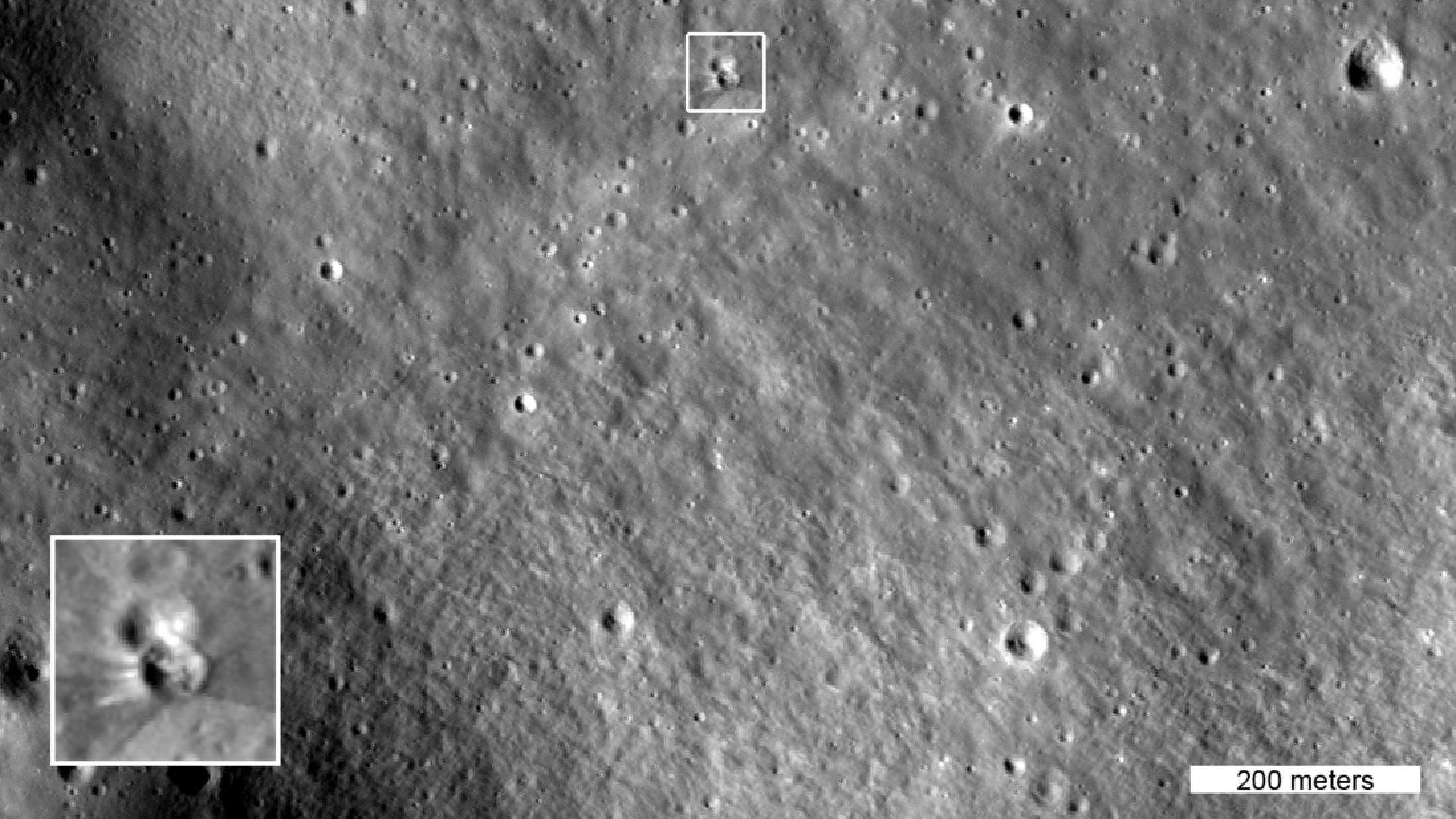
NASA's veteran moon-circling spacecraft, the Lunar Reconnaissance Orbiter (LRO), has imaged the impact site of that errant Falcon 9 upper stage.
The photos were taken on Aug. 11 and Aug. 12, just a few days after the SpaceX rocket body slammed into the moon near Einstein Crater at 5,400 mph (8,690 kph).
LRO's high-resolution camera system, known as LROC, got good views of the aftermath from a variety of angles, snapping away every 117 minutes, the time it takes the orbiter to circuit the moon.
According to LROC Principal Investigator Mark Robinson, who's based at the Houston company Intuitive Machines, the newly formed impact crater is about 60 feet (18 meters) wide and appears to be less than 10 feet (3 m) deep.
"The distinctive V-shaped ejecta pattern on the south side of the crater is consistent with natural impactors hitting the moon at low angles relative to the surface," said Robinson.
The sixth (and final) image in LROC's sequence of the new crater, he added, was acquired with the largest slew angle (68 degrees), presenting a view similar to what an Artemis astronaut would see looking out his or her Orion spacecraft window toward the lunar horizon.
To capture imagery of the impact site, LRO operators tilted the spacecraft so its cameras would point toward the target region each time the spacecraft passed about 60 miles (97 km) above the moon. In doing so, researchers could see the crater under multiple lighting conditions that revealed impact features.
According to NASA, the LRO imagery shows bright and dark rays stretching out from the crater.
"The darker streaks are made of surface dust and rocks altered over a long time by solar wind, galactic cosmic rays, and micrometeorite impacts. This weathered material was excavated by the collision," with the brighter streaks near the crater rim formed by "fresh material excavated from deeper underground," NASA officials said in an Aug. 18 statement.
The site of the Aug. 5 crash was imaged earlier by the Korea Pathfinder Lunar Orbiter, also known as Danuri. That mission team used Danuri's high-resolution Lunar Terrain Imager to spot the new crater. After capturing images of the impact zone, the Danuri mission sent updated crater coordinates to the LRO team to help refine their follow-up imaging sequence, NASA officials said.
Wandering through space for over a year and a half, the leftover Falcon 9 upper stage had sent two robotic landers — Firefly Aerospace's Blue Ghost and Resilience, built by the Japanese company ispace — toward the moon back on Jan. 15, 2025. Blue Ghost succeeded in its lunar touchdown, but Resilience crashed during its attempt.
Please logout and then login again, you will then be prompted to enter your display name.
Leonard David is an award-winning space journalist who has been reporting on space activities for more than 50 years. Currently writing as Space.com's Space Insider Columnist among his other projects, Leonard has authored numerous books on space exploration, Mars missions and more, with his latest being "Moon Rush: The New Space Race" published in 2019 by National Geographic. He also wrote "Mars: Our Future on the Red Planet" released in 2016 by National Geographic. Leonard has served as a correspondent for SpaceNews, Scientific American and Aerospace America for the AIAA. He has received many awards, including the first Ordway Award for Sustained Excellence in Spaceflight History in 2015 at the AAS Wernher von Braun Memorial Symposium. You can find out Leonard's latest project at his website and on Twitter.