
Africa's Lake Chad has shrunk by 90% since 1960, now the government is paying $50 billion to redirect water from the Congo River Basin into the lake
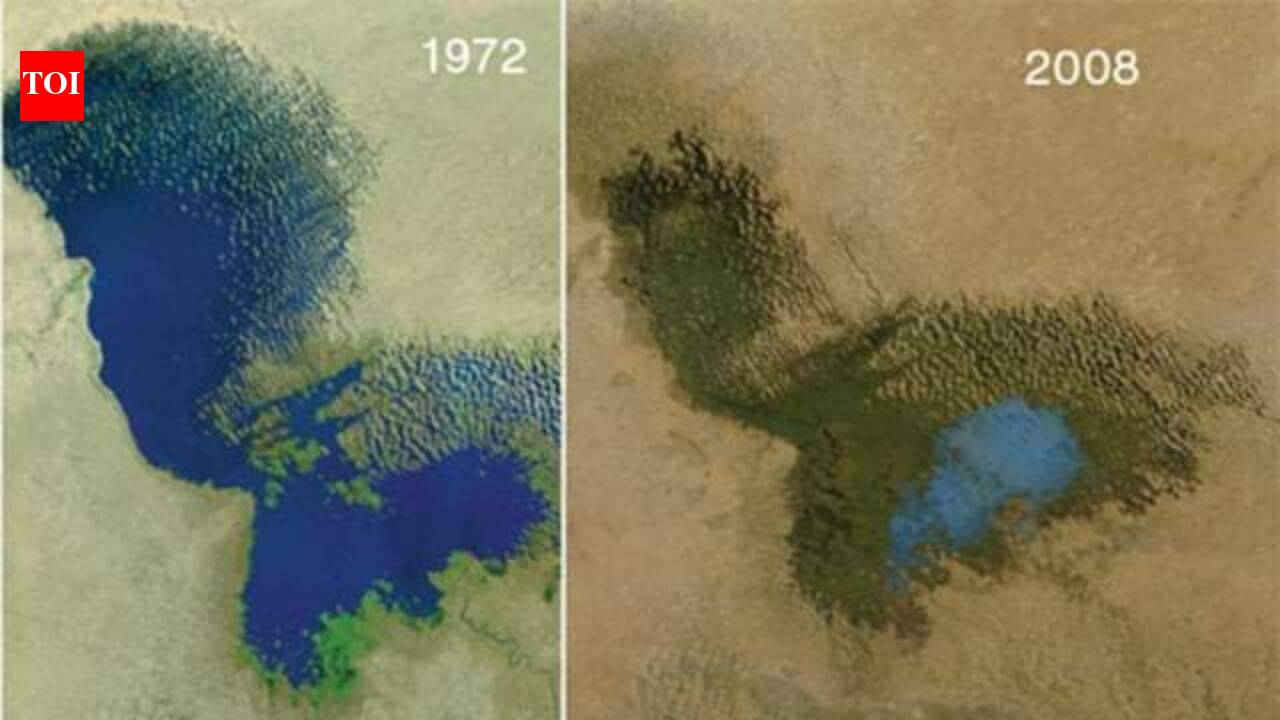
In 1823, British explorers Hugh Clapperton, Dixon Denham and Walter Oudney were some of the first Europeans to document the lake and the surrounding kingdoms. He was struck at the sight of one of Africa's largest inland lakes. But two centuries later, about 905 of the lake's surface area has shrunk, leaving only a sliver of what was previously an ever-flowing water body covering roughly 25,000 square kilometres.
The loss of this lake not only threatens a water source for people but also the livelihoods of about 50 million people in four countries, Cameroon, Chad, Niger and Nigeria. This is why the government has launched a $50 billion ambitious Trans Aqua project that proposes to redirect water from the Congo River Basin to Lake Chad.The reason behind this transformation is climate change which has intensified the pressure on the lake.
With rising temperatures, prolonged droughts and changing rainfall patterns, water availability reduced, while population growth and expanding irrigation increased demand. Consequently, fish production declined, farmland disappeared and competition for water and grazing areas intensified. Now, the economic damage is impacting more than just ecosystems, it has weakened household incomes, threatened food security and increased reliance on humanitarian support.Billions poured in for restorationAfrican governments and development institutions have begun funding smaller and more immediate interventions.
In May 2026, the African Development Bank, the Lake Chad Basin Commission and its five member states launched a $10 million technical assistance programme, PARFEBALT. The initiative will improve water data, strengthen regional governance and prepare larger investments to restore the lake’s ecological and economic functions.Previously, the World Bank approved $346 million in 2020 for two regional programmes supporting livelihoods, cooperation and resilience across Cameroon, Chad, Niger and Nigeria.A separate $170 million Lake Chad Region Recovery and Development Project has supported climate-resilient agriculture, reopened markets and expanded employment.
By October 2025, it had improved livelihoods for about 1.5 million people and directly assisted more than 434,000 residents.Additionally, the World Bank approved another $170 million in February 2025 to improve transport, logistics and regional value chains in Chad. The programme is expected to benefit 3.8 million people and finance major road connections.The African Development Fund has also committed $17.97 million to stabilisation programmes in Cameroon and Chad, targeting about 125,200 people.The Transaqua optionIn 1982, Italian engineering company Bonifica Spa proposed Transaqua, a plan to build a 2,400-kilometre canal from Congo River tributaries to the Chari River, Lake Chad’s main water source.
For decades, the proposal remained just a concept due to the large scale, cost and need for cooperation across several countries.But it gained regional attention after the 14th Summit of Heads of State and Government of the Lake Chad Basin Commission in April 2016. Following the summit, the commission signed a memorandum of understanding with POWERCHINA International Group Limited to support plans to transfer water from the Congo Basin to Lake Chad.
POWERCHINA vice-president Tian Hailua said the company would provide technical and financial assistance and committed US$1.8 million to support preparatory work on the proposed transfer.Supporters state that the proposed US$50 billion Transaqua project, which is being coordinated by the Lake Chad Basin Commission on behalf of participating governments, could:restore water levelsgenerate electricitysupport agricultureaid in transport and industrial developmentCurrently, the project remains a proposal rather than an approved construction project, with its cost, environmental risks and the need for agreements among multiple governments delaying progress.Why is urgent action vital?Lake Chad's shrinking has coincided with poverty, unemployment and insecurity across the basin.
Although the environmental decline did not create the region’s conflicts, the loss of fishing grounds and farmland has reduced economic opportunities.Boko Haram and other extremist groups have exploited unemployment, weak state presence and social frustration across north-eastern Nigeria and neighbouring countries.
More than 77,500 people were displaced across the basin between January and July 2026, increasing pressure on governments to restore livelihoods and strengthen local economies.Thus, millions are dependent on urgent action by governments of all regions to protect livelihoods and secure the region's future.