
After Venezuela’s Earthquakes, Neighbors Dig Through Rubble for Survivors
Follow this section to personalize your feed and get instant alerts.
Follow this tag to personalize your feed and get instant alerts.
Follow this author to personalize your feed and get instant alerts.
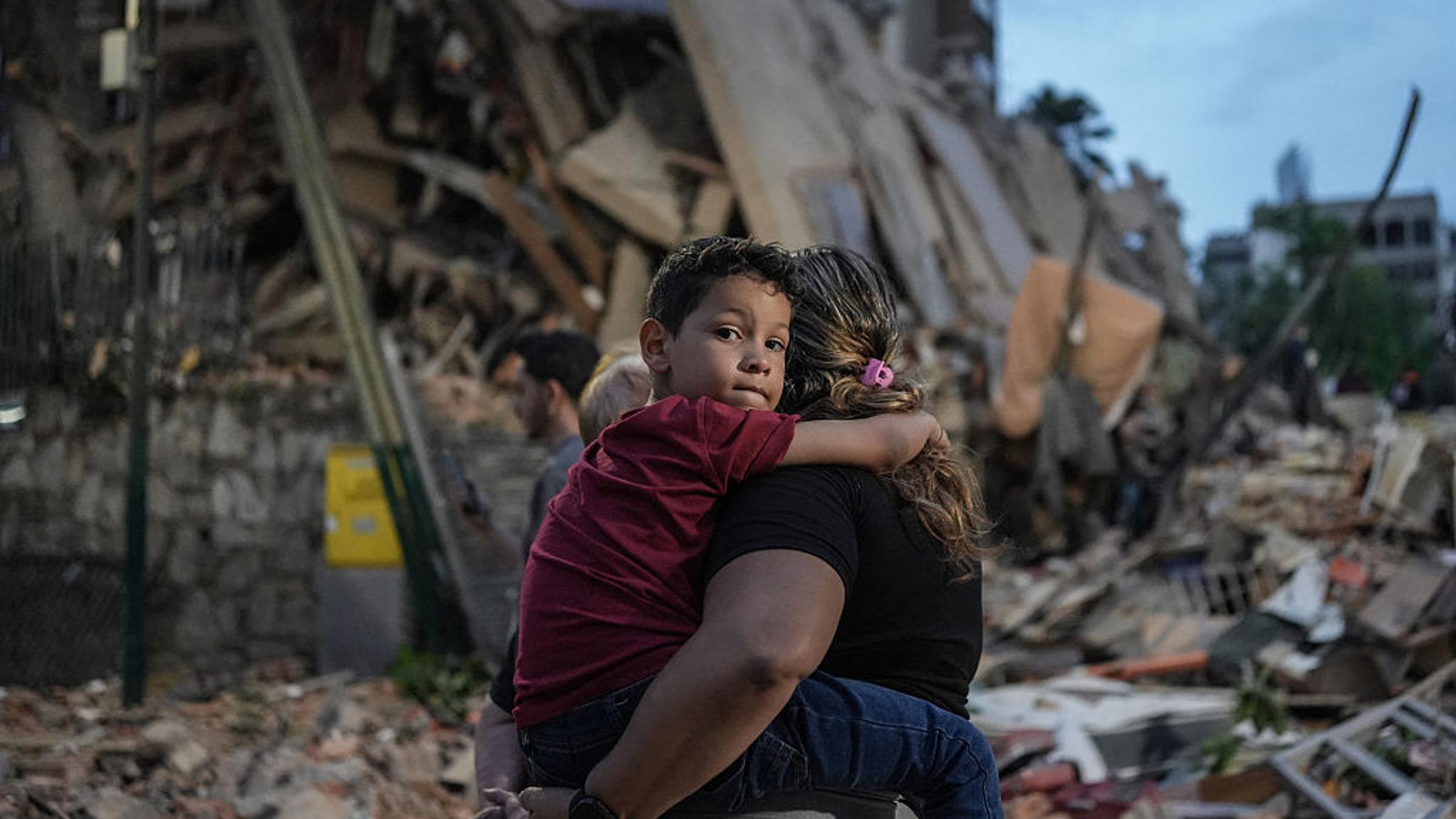
People walk past a collapsed building in Caracas after powerful twin earthquakes struck Venezuela on June 25, 2026.
Follow this author to personalize your feed and get instant alerts.
Maria was in the living room of her third-floor apartment in Caracas when the walls began to move. The television shook. Furniture crashed to the floor. In the bathroom, the quake tore a water heater from the wall, sending water rushing across the apartment.
Maria, 32, grabbed her phone and ran down the stairs barefoot. Within minutes, the electricity was out. The phone signal had gone dark. No one around her knew how much of the city had been damaged, or how many people were already trapped.
“I didn’t start to panic, not immediately,” said Maria, who asked TIME not to use her real name for fear of government retaliation. “I just asked, ‘What do we need to do?’”
Within hours, the answer would take her across Caracas on a motorcycle, from one damaged building to another, checking on friends’ relatives, and hauling more than 120 buckets of rubble with other residents before they helped pull a middle-aged man alive from a collapsed building.
“As we walked, we started to see…entire walls on the floor, and entire buildings destroyed,” she recounted. “Family members of people who used to live there were screaming names.”
But by the next day, the disaster had become personal. A family member called to say that no one could reach Maria’s cousin in Caraballeda, a coastal town in La Guaira state that had been hit especially hard by the twin earthquakes.
Maria drove for hours toward the coast. When she reached the building where her cousin had lived, it was so badly damaged that she had to ask neighbors whether she had found the right place. Aftershocks rattled what remained of the structure.
The search ended when the sky went dark and her flashlight died. Nearby, bodies that neighbors had already pulled from the debris lay in the open. Maria put on a mask against the putrid smell and lay down on the ground.
“There was nothing left that we could do,” she said. “We couldn’t see anything.”
Then a group of professional rescue workers from Spain arrived with acoustic detection devices and a trained dog. They searched for about 20 minutes before telling Maria and the neighbors that they had found no signs of life. Her cousin, they said, would have to wait.
One of the rescue workers gently explained that, with the possibility of survivors still trapped elsewhere, the team had to focus first on people who might still be alive.
“You guys are important. Your families are important. Your cousin is important, and I'm so sorry for saying this, but you are not the priority right now, because the priority is to rescue people who are still alive,” Maria recalled him saying.
One of the volunteers picked up a prayer card that he found on the ground and began reading it out loud. Realizing that there was nothing left for her to do, Maria said she prayed and told her cousin that she’s sorry, that she did everything she could to find him, and that she hoped he was at peace. She broke down into tears, crying until she couldn’t anymore, then she stopped.
“And then I said, okay, let's go. We need to go. We need to help.”
For Maria, the words marked a stark dividing line in the aftermath of Venezuela’s earthquakes: between the living who might still be saved, and the dead who could not yet be reached.
“If somebody hugs me, I'm gonna cry, so I don't want anybody to hug me right now,” she said.
At least 1,450 people have been killed and more than 3,200 injured since two powerful earthquakes struck Venezuela last week, devastating parts of La Guaira state and damaging Caracas, the capital.
The U.S. Geological Survey estimated that the death toll has “a substantial probability” of exceeding 10,000, as collapsed apartment buildings, severed power lines, and overwhelmed rescue systems deepened a humanitarian crisis in a country already strained by years of political and economic turmoil. The instability has been compounded by a lack of coordination from the interim government, residents argue, which was disrupted by the arrest of former President Nicolás Maduro.
International rescue efforts from 24 countries are beginning to reach affected areas—but time is running out for people still feared trapped under the rubble. Aid agencies consider the first 48 to 72 hours the critical window for finding survivors alive.
For many Venezuelans, the first days of rescue efforts have depended as much on neighbors improvising as on aid arriving from outside. “We are just supporting,” Maria said. “We don't know anything about rescue. We need help.”
Some of the rescue volunteers, she discovered, walked 90 kilometers (55 miles) from Caracas to help after seeing the severity of the damage on social media.
The lack of government coordination became increasingly clear. Maria said she and her neighbors noticed Venezuela’s National Guard moving through the wreckage—not to dig, but to rifle through the purses and wallets scattered in the debris. Some guardsmen, she claimed, fought with one another over Venezuelan cash worth the equivalent of about $2. TIME could not independently verify the claims.
“We were just in shock. You are the Army, and you're fighting with your own guys just for two dollars,” Maria said.
An aerial view shows destroyed buildings in Caraballeda, Venezuela, after powerful earthquakes struck La Guaira state on June 28, 2026. Miguel Medina—Pool/AFP/Getty Images
The devastation has been especially severe along Venezuela’s coast. La Guaira, one of the areas hit hardest, saw dozens of buildings collapse, Venezuelan President Delcy Rodríguez said in a televised address. Simón Bolívar International Airport, which serves Caracas and is located close to the city of La Guaira, was closed for days after suffering heavy damage.
As volunteer groups and concerned family members head toward the affected areas, heavy traffic has clogged the highway, preventing ambulances and rescue crews from reaching those in need. Officials later restricted access and set up a permit system for entry, but residents say bottlenecks have continued.
Rayner Vasquez, a resident of La Guaira, said the constant motorcycle traffic has also made rescue work harder by drowning out sounds from the rubble. The noise, he said, has made it nearly impossible to hear cries from people who may still be trapped beneath collapsed buildings. The traffic has also contributed to fuel shortages in the area, with some people waiting in line for hours to refuel.
Residents say the city is running short of several supplies needed to care for survivors and recover the dead.
“We need bags for the bodies. We need machines to locate the other bodies, and we need shelter for the people who are still alive,” said Kelvin Padilla, a 28-year-old resident of La Guaira. “We need food for the people that don't have anything and have lost everything.”
Still, help has begun to arrive. Padilla said he has seen rescue teams from across Venezuela and around the world enter the area, while he and Vasquez have received and distributed food and water donations.
Back in Caracas, Maria has also received thousands of dollars in donations from people all over the world after her video from the scene went viral. She said she wants to use the money to buy a Starlink antenna, hoping it will help reconnect people who are still searching for their loved ones.
But even as aid arrives, the scale of what Venezuela has lost remains difficult to comprehend. For Maria, that uncertainty surfaced as she shared food with neighbors after hours of digging through the rubble.
“I asked them, ‘how are we as a nation going to get over this? How we're going to endure this?’” she said.