
AI data center war: Where Democrats, Republicans in key Senate races stand
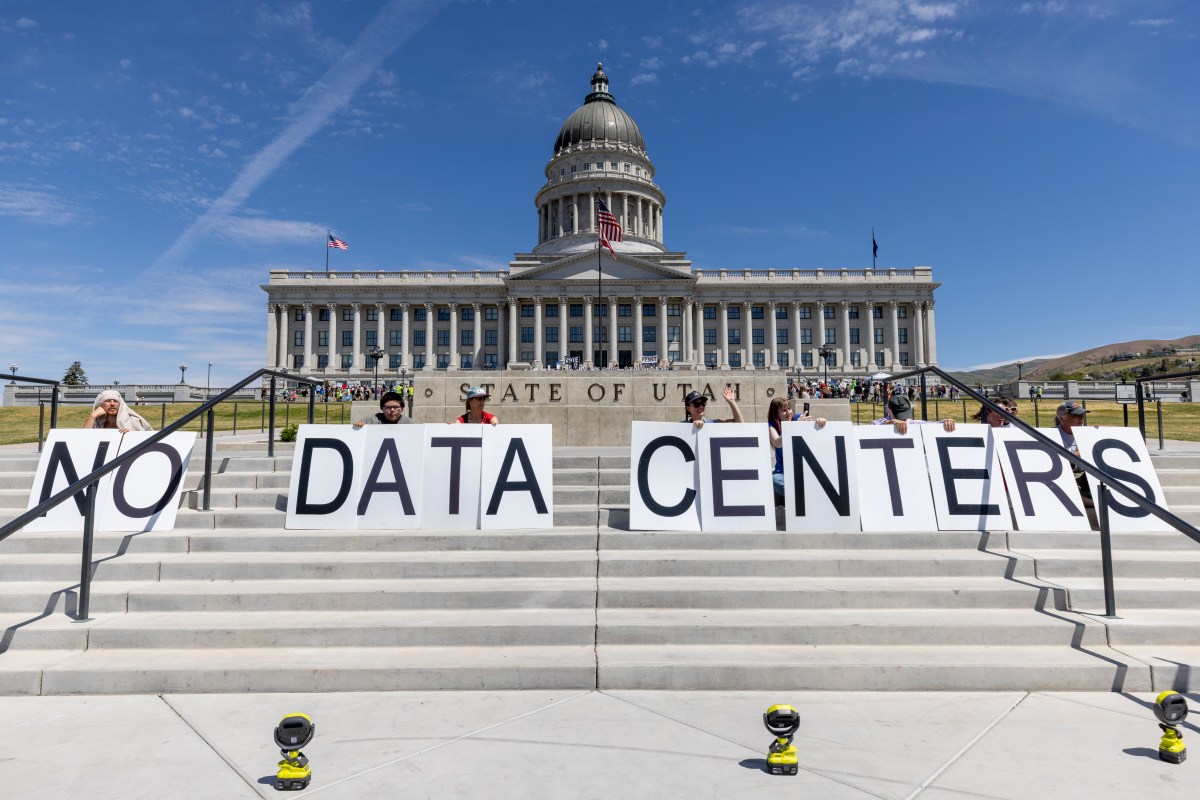
Data centers have become one of the most unpredictable issues of the 2026 midterms, cutting across party lines in ways few other topics do.
Polling from the Annenberg Public Policy Center found 61 percent of Americans oppose new data centers in their area, including 69 percent of Democrats and 54 percent of Republicans. Echelon Insights found voters would rather have a nuclear plant in their community than an AI data center.
That backlash is now playing out directly in the six Senate races the Cook Political Report rates as toss-ups heading into November.
Newsweek reached out to all 12 candidates in these six races for comment.
Michigan has become ground zero for the issue. El-Sayed has spent months hammering data centers on the trail, telling one crowd that "people really effing hate data centers." His campaign has proposed "terms of engagement" requiring developers to cover rate increases, guarantee grid reliability and use closed-loop cooling systems, and he has said he will not support new projects until Washington sets federal guardrails.
Rogers held a different position for most of the race, favoring state and local control over federal intervention. That changed this week. After The Lever reported Rogers had raised nearly $150,000 from donors with AI and data center investments, including $14,000 from Trump-aligned investors Cameron and Tyler Winklevoss and $34,500 from seven Blackstone executives, Rogers reversed course and endorsed a one-year statewide moratorium. He has argued the decision belongs to local communities, not "Washington, D.C."
A person on El-Sayed's campaign team told Newsweek: "Abdul El-Sayed has long called for terms of engagement for data centers that put Michiganders in the driver's seat, giving communities the power to decide what is best for them. He supports state and local elected officials' efforts to implement moratoriums until federal guardrails are in place."
A Politico/Public First poll in July found support for data center construction dropping sharply among Michigan voters, particularly Democrats. El-Sayed leads Rogers in state polling, and Democratic Senator Chris Murphy has already dismissed Rogers' moratorium pledge as a "farce."
Ohio's race may be the clearest test case of whether data centers can decide an election. Brown has made opposition to the facilities central to his campaign, running ads tying Husted to his 2019 defense of a $43.5 million Google tax break in New Albany. Husted's campaign has collected roughly $69,750 from PACs and employees connected to Google, Amazon, Microsoft, Oracle, American Electric Power, Duke Energy and Vistra.
The pressure has reached national Republicans. In a memo obtained by Axios, the National Republican Senatorial Committee warned AI companies that "data centers are the anchor hanging around Husted's neck," adding that a Husted loss would teach politicians nationwide "they will not go near the next one." Brown outraised Husted more than two to one in the second quarter, pulling in $14.1 million to Husted's $3.4 million in direct donations. A person on Sherrod Brown's campaign team told Newsweek Husted has become known as "the face of data centers" in Ohio.
Polling from Wedgewood Polls in mid-August had Brown at 48 percent to Husted's 44 percent.
Talarico has built part of his campaign around cracking down on data centers, calling for developers to fund their own infrastructure upgrades, pay their fair share of taxes and get community buy-in before breaking ground. He has pointed to an estimated $3.2 billion in state tax breaks for data center companies as money that could instead lower housing, child care and prescription drug costs.
Paxton has been slower to define a position, calling the issue "complicated" in a May podcast appearance and citing the need to compete with China on artificial intelligence. His campaign has said a formal policy is coming "shortly." Paxton has received roughly $400,000 from data center-connected donors, according to a NOTUS analysis of Federal Election Commission filings.
But Talarico has taken in far more, in excess of $11 million from donors tied to the industry, including hundreds of thousands from Nvidia and Lone Pine Capital figures, a contrast on which Paxton's campaign has seized, calling Talarico "a hypocrite and a liar."
Zillow data cited by Talarico's campaign found rents in the data center hub of Abilene rose $825 in a year.
The race has tightened, with three late-July and early-August polls showing Talarico ahead by 2 to 5 points. An August Emerson College poll found Paxton narrowly ahead, 47 percent to 46 percent. The latest Texas Tribune tracker showed Paxton ahead by 1 point.
Jackson has staked out the more aggressive position, pledging to regulate data centers within his first 100 days in office and requiring developers to build and supply their own power. His campaign, powered largely by small donors rather than corporate PACs, has framed the issue as part of a broader critique of Collins as beholden to entrenched interests.
Collins has taken a more cautious line. She has said she shares "the concern of data centers gobbling up too much energy and putting stress on the cost of energy," while touring a former paper mill site with Energy Secretary Chris Wright, both of whom praised data center redevelopment projects as economic opportunities. Collins has simultaneously blamed Democratic state leaders, including Governor Janet Mills and Jackson himself, for rising energy rates.
The Bangor City Council has already passed its own moratorium on data centers, and rural Maine has emerged as a hub of local opposition. A Hart Research poll commissioned by the Senate Majority PAC found Jackson leading Collins 49 percent to 45 percent.
More than a dozen Iowa counties, including Linn, Dubuque, Johnson, Woodbury and Sioux, have passed data center moratoriums this year amid concerns over water use, power demand and lack of transparency. Turek has framed his campaign broadly around standing up to "billionaires and large corporations" rather than issuing a detailed data center platform, though he has embraced the populist mood driving local moratoriums.
Hinson, a member of the House Select Committee on China, has emphasized the need for American leadership in AI development to compete with Beijing, a more traditionally hawkish Republican framing than the skepticism now common among Midwestern GOP candidates.
Recent polling has shown the race within the margin of error, with an Emerson College survey giving Hinson a narrow 48-45 edge.
Data centers have not dominated the Alaska race the way they have in Ohio or Michigan, but the issue is present. Sullivan has actively petitioned to bring data centers onto Air Force and joint military installations in the state. A $500 million North Slope data center proposal from Stak Energy, powered by natural gas, has drawn both interest and skepticism, and an Alaska bill requiring data centers to cover their own grid costs died in committee in May. Peltola has centered her campaign on affordability and energy costs generally rather than data centers specifically and Cook Political Report and Decision Desk HQ both see the race as a toss-up.
Few issues in 2026 cut this evenly across party lines. Annenberg researcher Shawn Patterson told Newsweek that the 12-point rise in opposition to new data centers this year was "not confined to a partisan subgroup," while Brookings senior fellow Darrell West said voters "see their electric rates increasing and little transparency in the negotiations with local communities."
That dynamic has scrambled traditional alliances. Republican governors including Greg Abbott in Texas have ordered new scrutiny of data center projects, while House Speaker Mike Johnson has warned that moratoriums risk ceding ground to China in the AI race. President Donald Trump has argued that rejecting the facilities means being "left behind." Meanwhile, Democratic candidates in multiple states are attacking opponents over data center ties, even as some, including Talarico, take substantial industry money themselves.
The anger has also moved beyond campaign ads and zoning hearings. In April, a 20-year-old man traveled from Texas to San Francisco and threw a Molotov cocktail at OpenAI Chief Executive Sam Altman's home, setting a gate on fire before threatening to burn down the company's headquarters. He was later charged with attempted murder.
In May, Saline Township Treasurer Jennifer Zink resigned in tears at a public meeting in Michigan, citing death threats over a 1.4-gigawatt Oracle and OpenAI data center project in her rural community. In June, the FBI disrupted an alleged plot to attack a UFC event on the White House South Lawn using explosive-laden drones and gunfire. Court filings cited data centers "taking up all the water in communities" among the grievances motivating the group.
Yannick Veilleux-Lepage, political scientist at the Royal Military College of Canada who studies political violence, told Newsweek the pattern reflects a "substitution effect." As tech executives harden their security, he said, violence can shift toward "softer, more accessible targets" such as local officials who approve data center projects. Their home addresses are public, they have no security detail and they work in the communities where opposition is organized, he said.
Gary Marcus, an artificial intelligence researcher and professor emeritus at New York University, told Newsweek the backlash reflects a public that believes AI is enriching a small number of people while offloading the costs onto everyone else through job losses and environmental strain. He said AI investors are "pouring hundreds of millions in to try to shape the narrative," while politicians should represent constituents who want "an AI that is in the interest of society, not just a scam for the wealthy."
Natalie Kerby of AI Forensics, a research group that tracks opposition to data centers, told Newsweek the movement is not confined to the United States, pointing to organizing in France, the Netherlands and Chile. Data centers, she said, "bring together a series of concerns, such as the environment, energy costs, and economic factors," giving people something concrete and local to rally against rather than an abstract debate about algorithms.
The result is a political backlash that increasingly crosses traditional party lines. With control of the Senate potentially decided by a handful of these races, both parties are discovering that a technology debate once confined to Silicon Valley boardrooms now runs through kitchen-table conversations, and in some cases through threats against the people making the decisions, in Michigan, Ohio, Texas, Maine, Iowa and Alaska.
Contact Newsweek editors on this story: Jason Lemon and Edward T. Cummins.