
America@250: The United States of Anxiety
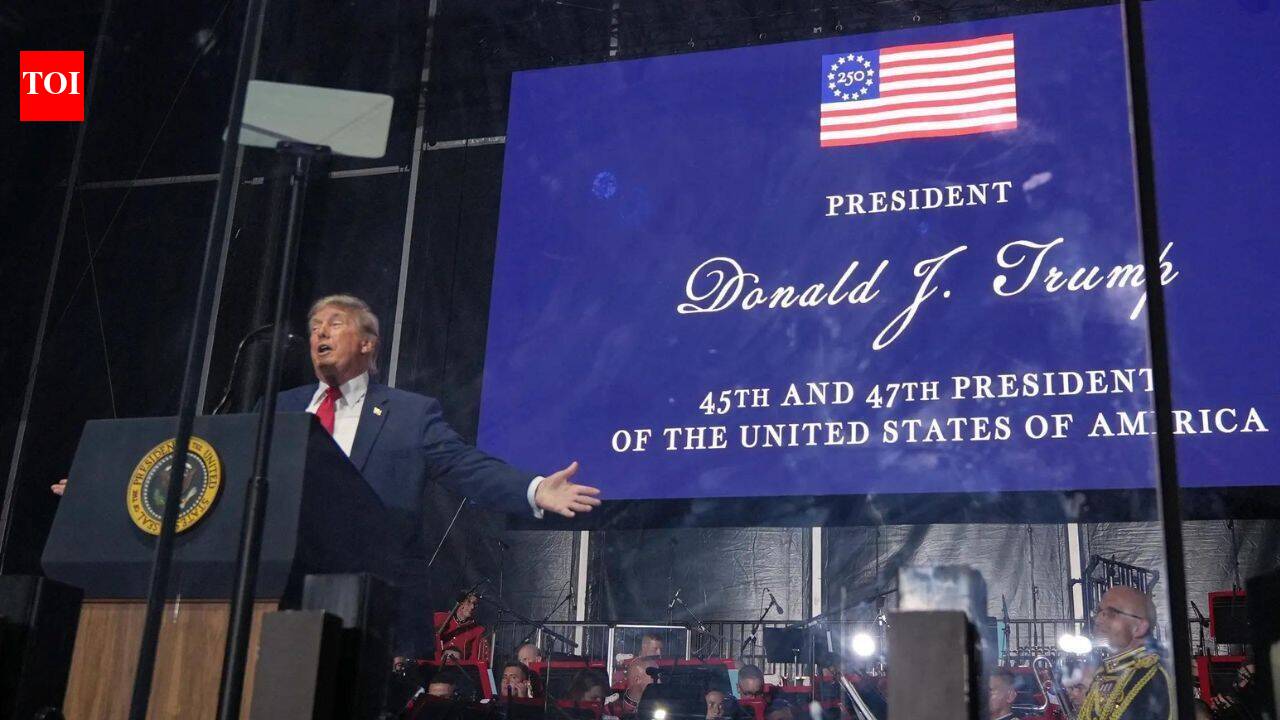
TOI correspondent from Washington: When President Donald Trump asserted repeatedly in recent months that the United States has become the “hottest country in the world” little could anyone have imagined he meant it literally although some of his supporters attribute magical qualities to him.In record temperatures across parts of America, including his own anticipated 107F (42C) in the nation’s capital on July 4, the MAGA supremo has promised an extra-long speech on the occasion of the country’s 250th anniversary – except there may be few people to hear him in person, particularly since his grievance-laden speeches have now hit exhaustion point even among many supporters.Trump’s "Great American State Fair," where he is to ply his greatest hits, was intended to showcase the nation's diversity through exhibits from all 50 states.
Instead, the heat wave has turned parts of the celebration into an endurance test. State pavilions are struggling with embarrassingly sparse crowds, visitors are seeking refuge under misting stations, and vendors are selling more bottled water than souvenirs or nostalgia. As fireworks are ready to crackle across the skies to celebrate America@250 later tonight, the United States arrives at its semiquincentennial in decidedly lukewarm mood, the heat dome notwithstanding: sketchily self-confident, scarily indebted, economically resilient, culturally exhausted, and politically combustible – all amid growing doubts about its future.
If nations could be compared to people at a birthday party, America@250 is the wealthy uncle who insists he has never felt better while discreetly asking others how he looks even as he brags about the stock market and his own wealth. The more consequential numbers, however, lie not on thermometers or in market indices but in government ledgers.
America's national debt is closing in on $ 40 trillion, up from just $71 million in the republic's infancy. It has financed wars, depressions, pandemics, financial crises and tax cuts, while becoming almost as permanent a feature of Washington as partisan gridlock. The debt has grown so large that it has entered the realm of abstraction: $ 40 trillion is less a number than a geological formation.Washington continues to borrow with remarkable ease because the dollar remains the world's dominant reserve currency and Treasury securities remain the safest asset in global finance.
But interest payments are consuming an ever-larger share of federal spending, prompting economists across the ideological spectrum to warn that today's political comforts may become tomorrow's fiscal straitjacket. While America's credit card still enjoys the world's highest limit, the monthly statement is becoming increasingly difficult to ignore.Meanwhile, one of the more sobering portraits of the country comes not from Wall Street but from the newly released "State of the States" report by the bipartisan State of the Nation Project.
Drawing together scholars associated with think tanks spanning the political spectrum -- and advisers to presidents from Bill Clinton through Trump -- the study examined 31 indicators across every state. Its conclusion borders on a paradox: Americans have become richer, but have not become happier.Not a single state recorded improvement in overall life satisfaction.
Minnesota, frequently mocked by Trump and his MAGA faithful as a socialist rip-off, ranked first overall, followed by New Hampshire, Iowa, Vermont and Massachusetts. At the bottom were mostly red states – Louisiana, New Mexico, West Virginia, Nevada and Mississippi. That does not make Democratic states utopias or Republican states dystopias.
But it complicates one of modern American politics' favorite narratives: that prosperity alone tells the national story.Even so, decline is hardly the whole picture. Violent crime has continued to fall nationally from its pandemic-era spike, according to FBI and independent crime analyses, with murders dropping sharply in many major cities over the past two years.
Inflation has eased from its 2022 peak and unemployment remains historically low. Innovation in artificial intelligence, biotechnology and energy continues to attract global capital at a pace unmatched by most competitors. America resembles a patient whose blood pressure is alarming but whose running times remain excellent.International perceptions are equally nuanced.
Surveys by the Pew Research Center have found that while confidence in American leadership has declined, favorable views of the U.S itself remain substantially stronger than opinions of many rival powers. Many allies worry about American political polarization while simultaneously relying upon American military power, technological innovation and financial markets.
In short, the world has become accustomed to viewing America as simultaneously indispensable and exhausting.Historians have long cautioned against mistaking turbulence for terminal decline. The late David Brion Davis observed that American history is marked by repeated cycles of crisis and reinvention.
Jill Lepore has argued that the country's defining characteristic is not perfection but its perpetual argument over what its founding ideals require. Gordon Wood, one of the foremost scholars of the American Revolution, has noted that Americans have repeatedly believed their republic stood on the edge of collapse – only for institutions to prove more resilient than contemporaries imagined.
America@ 250 therefore remains a study in glorious contradiction: richer yet less content, stronger than its critics admit yet more divided than its fans acknowledge.Catch the latest world news and top headlines. Download the TOI App.