
America’s civil war over USS Lincoln: 'Grow a pair' vs 'bring them home'
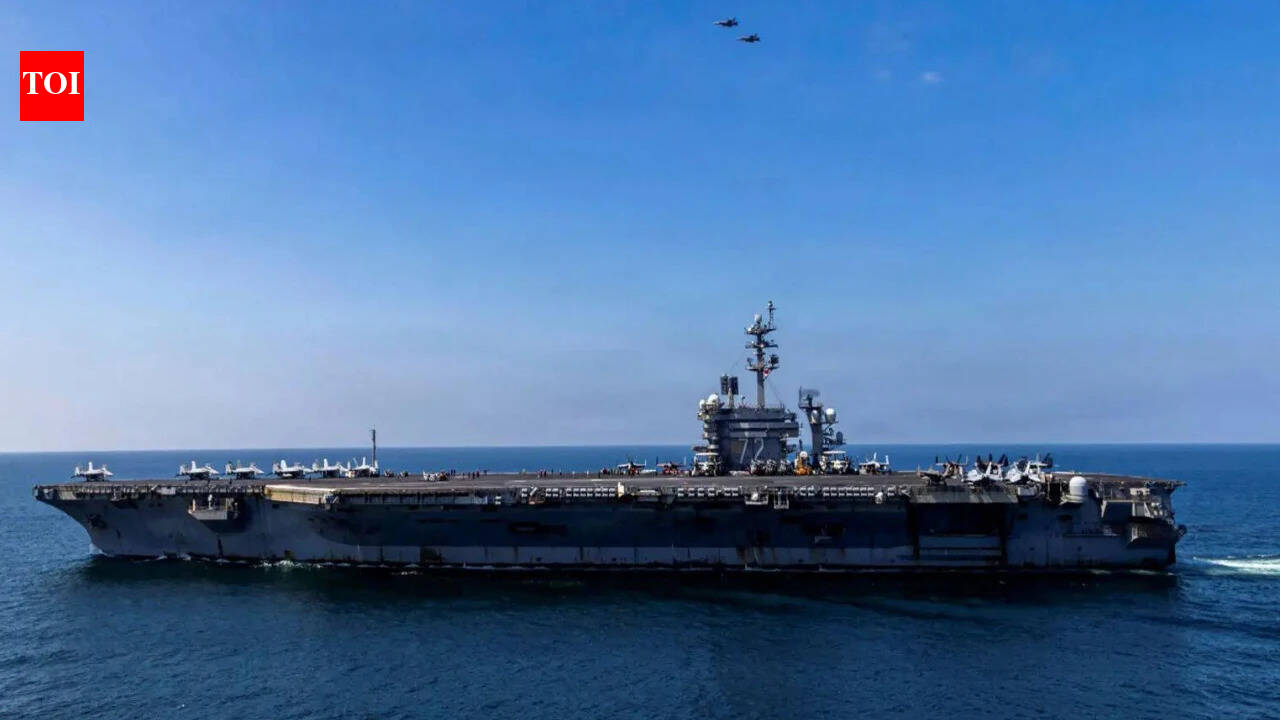
TOI Correspondent from Washington: A furious war of words has broken out in the United States over the deployment of a warship in the Iran conflict: whether sailors of the USS Abraham Lincoln are displaying extraordinary endurance under tough conditions or whether complaints about nine months at sea are little more than “snowflake” whining in uniform.President Donald Trump himself gave the controversy its sharpest political edge Friday when he was asked whether the aircraft carrier had been deployed too long.
“No, not nearly long enough,” Trump said, adding that the USS George Washington will soon relieve Lincoln.Defence Secretary Pete Hegseth similarly rejected accounts of a crisis aboard the Lincoln, accusing “the reckless & shameless American media of completely & intentionally misrepresenting facts.” He praised the sailors for operating in “austere conditions” with few port calls, arguing that their resilience was precisely what the Navy demanded in wartime.The official narrative is colliding with a very different account from many sailors' families.
At a San Diego meeting attended by roughly 200 relatives, they are reported to have confronted Acting Navy Secretary Hung Cao with complaints about food, mail, sanitation, mental-health pressures and the absence of a clear homecoming date. Families describe an increasingly grim combination of exhaustion, uncertainty and deteriorating amenities: mould and mildew in showers, broken toilets, shortages of soap and other personal-hygiene supplies, degraded food choices, disrupted mail and limited hot water.Some families have also reported sailors suffering acute mental-health crises, including attempts to jump ship.
The Navy says it has not observed an increase in suicide tendency on the ship, while declining to release details because of privacy and operational-security concerns.The emotional meeting underscored the unusual nature of a dispute in which the people complaining are not sailors refusing orders, but relatives asking whether the orders remain sustainable.
One sailor’s wife lashed out at the President in the media, telling him, "Have some sympathy, some empathy. Take accountability for what's going on with your military, your ships, in your war.”"You're stuck in a floating metal prison, essentially, in the middle of the water, eating prison-like food with the same people in the same bunk beds in the same small quarters for 200 days, 250 days; you start to go a little insane working 12 hours, getting four or five hours of sleep," she raged.The nuclear-powered Lincoln, carrying roughly 5,000 sailors and Marines, left San Diego on Nov 21 for what was expected to be roughly a seven-month deployment.
The ship has now spent more than 260 days deployed and more than 200 consecutive days without a meaningful port call — a modern record for an American aircraft carrier. The Navy's own Optimised Fleet Response Plan is designed around a seven-month deployment, explicitly balancing operational demands against sailors' quality of life and long-term fleet sustainability.
The Lincoln, at more than eight-and-a-half months at sea, has therefore substantially exceeded the nominal target, even though wartime extensions are not unprecedented.One explanation for the crisis, according to some accounts, is that Iranian missile and drone attacks have damaged the US Navy's long-established logistics hub in Bahrain and other Gulf hubs, forcing the Pentagon to shift the supply logistics to Diego Garcia in the Indian Ocean.
While the 4000 km distance from Iran offers protection from missile and drone attacks, it complicates the delivery of food, spare parts and other supplies to forces operating near the Gulf.The controversy also has a larger strategic dimension. The deployment to the Gulf of George Washington, until recently operating with the US Seventh Fleet in the Philippine Sea, leaves the western Pacific without a US aircraft carrier -- an uncomfortable development for the US and its allies as China expands its naval presence around Taiwan and the South China Sea.China already possesses the world's largest navy by number of battle-force ships: more than 370, compared with 296 US battle-force ships in 2024, according to the Congressional Research Service.
The US retains a major qualitative advantage in nuclear-powered aircraft carriers, global bases, logistics and combat experience, but China's numerical advantage is increasingly important in waters close to its shore, which is why the Lincoln dispute is about more than mouldy showers, meagre meals, or missing soap.Catch the latest World News and Live updates.
Download the TOI app.