
America's scientific elite is fueling China's military machine
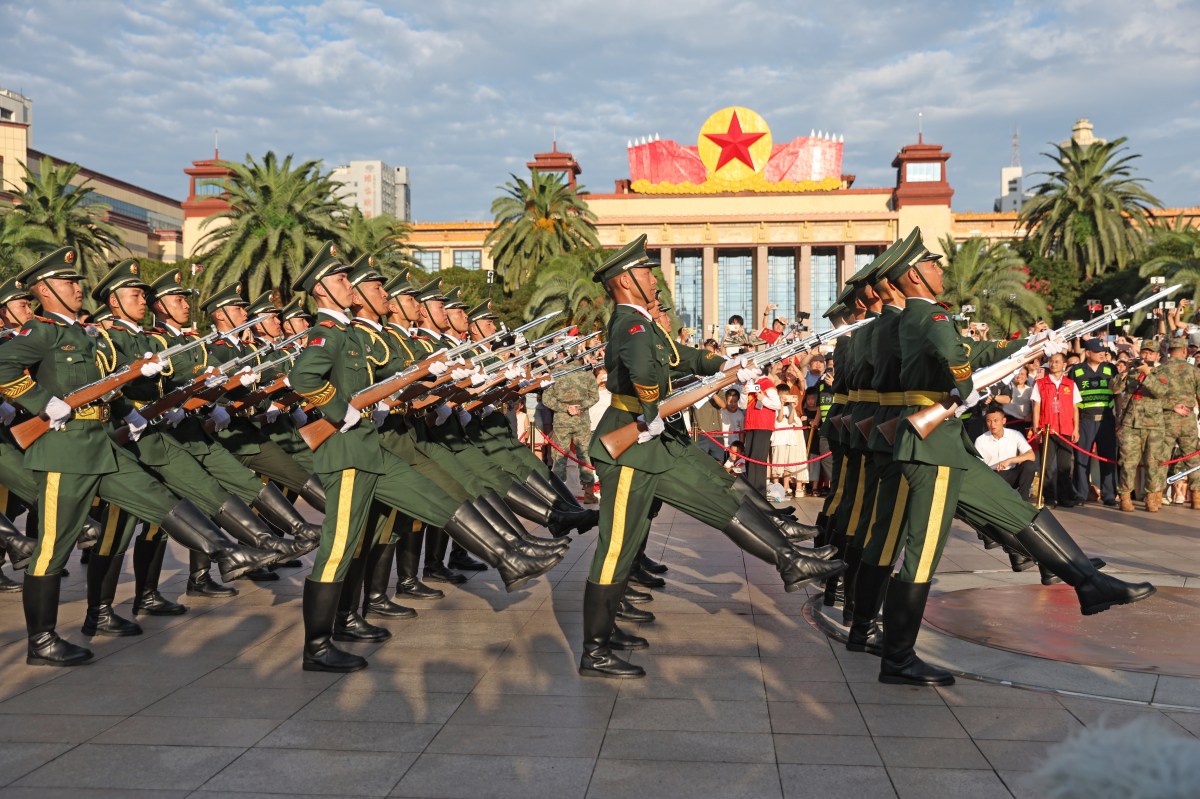
Scientists at U.S. institutions continue to co-author thousands of papers with Chinese military researchers and China’s defense-industrial base, despite growing efforts by the U.S. government to stop the loss of its innovation ecosystem to China, according to exclusive data obtained by Newsweek.
The collaborations include those with researchers at China’s nuclear weapons development complex and two elite groups of military-affiliated schools known as the "Seven Sons of National Defense" and the "Seven Sons of Ordnance Industry," as well as other People's Liberation Army institutions including medical ones and state-owned defense companies, the new data that tracks activity between January 2025 and the present shows.
U.S. and Chinese researchers published a total of 3,763 such co-authored papers over the last year and a half, according to Jeffrey Stoff, a leading research security investigator and the founder of the Center for Research Security and Integrity, who compiled the up-to-date figures.
The numbers do not include papers by U.S. scientists and Chinese military researchers that involved researchers from third countries, meaning they present a highly focused picture of U.S.-China collaboration. Adding third parties took the total to 5,750.
The data was raw so there were non-military applications to some of the research, especially in the medical field. Yet, "the vast majority of this is knowledge and technology transfer to enable the PLA to dominate in critical technologies," Stoff said.
Ninety-nine papers were published over the last year and a half with researchers from the China Academy for Engineering Physics (CAEP,) China’s nuclear weapons research and development institute that is a conglomerate of a dozen institutes headquartered in Mianyang in Sichuan Province, with lesser-known branches elsewhere in the country including in Beijing.
Stoff, a veteran researcher and Chinese linguist, drew on nearly two decades of experience analyzing China’s science and technology enterprise for the U.S. government including at the Department of War to construct a granular picture of the current situation.
Institutional affiliations can be opaque in China due to state information control that sharply reduces visibility. But Stoff has been able to identify lesser-known institutes that are subdivisions of major outward-facing institutes to build a fuller picture. One example is the Beijing Computational Science Research Center, a subdivision of CAEP. The bibliographic data was drawn from the science publications database Dimensions.
A total of 2,620 papers were published bilaterally between the U.S. and Chinese researchers at the two "Seven Sons" school networks, a total of 12 universities that includes Beihang University in Beijing and the Harbin Institute of Technology in the northeastern province of Heilongjiang. Two universities appear on both lists.
The schools are important contributors to China’s military buildup, spanning fields where civilian research can also have military applications or so-called "dual-use technologies" including engineering, advanced materials, robotics, aerospace and semiconductors.
There were 777 bilateral papers published over the same time frame at other PLA-affiliated entities such as military hospitals, medical academies, and army research institutes. Frequent research partners for U.S. scientists in that category include the PLA General Hospital and the Academy of Military Medical Sciences.
A total of 144 papers were published with Chinese defense state-owned enterprises, for example in space and aviation, electronics, and shipbuilding. Key companies in that category include the China Academy of Space Technology (CAST), China Electronics Technology Group Corporation (CETC), and China State Shipbuilding Corporation (CSSC).
Brown University and the University of Texas at Dallas are two of many across the U.S. that appear in the newest data as having conducted recent research with Chinese military institutions. In each case, the collaborating partner was working at a center belonging to CAEP, China's nuclear weapons research and development institute.
"We work diligently to monitor for and address risks, protect American interests and support collaborations that are essential to scientific discovery, including in an environment where federal policy and guidance evolves quickly and varies across different funding agencies," Brian E. Clark, Vice President for News at Brown, told Newsweek. Clark did not address the specific case raised by Newsweek.
The University of Texas at Dallas did not respond to a request for comment.
The joint research took place even as the U.S. government increasingly seeks to end the outflow of sensitive research to China, fearing it is losing its global leadership after decades of open bilateral cooperation and deep knowledge and technology transfer.
Despite that effort, "Collaboration continues extensively," said Stoff.
"The data shows universities have not taken national security seriously, because why else would they be continuing to collaborate with these highest-risk Chinese entities?" he said.
"One of the challenges is that the universities take a legalistic approach," Stoff said. "Their main concern is compliance, not safeguarding national security and our innovation ecosystem. They will work with CAEP and the PLA unless it is explicitly outlawed."
In response, the Pentagon has put rules in place to nix its funding for U.S. institutes that research with Chinese counterparts that are on American government "entity," or sanctions lists. Stoff said that should apply more widely to federal funding.
Increasing the pressure, last Monday, the Pentagon announced an audit of 30 U.S. universities, without naming them.
Asked to comment on the situation, an official at the Department of War told Newsweek: “We refer you to our recent release on research security audits" and highlighted the tight deadline—August 31—and the demand for termination of problematic partnerships, among other things.
The new data also comes as two congressional committees published an investigation accusing Harvard University of deferring to the interests of the Communist Party of China (CCP) in multiple ways, including by publishing increasing numbers of papers with the Seven Sons system.
The hard-hitting report out last week, Compromised Independence: CCP Influence at Harvard University, alleged Harvard showed "deference to CCP interests overrides American economic, technological, and national security interests. This is not confined to a single individual, but instead pervasively corrupts the organization’s integrity."
Harvard’s policies and procedures did not meaningfully prevent CCP influence from affecting the entire organization including through research priorities and funding, it said.
Harvard told Newsweek that it disagreed with the investigation’s characterization of the university.
"Harvard shares the Committees’ concern about geopolitical risks, including threats posed by the Chinese Communist Party, and is committed to continuing to conduct research and academic programming with protections that prioritize U.S. interests and national security," said spokesperson Sarah Kennedy-O’Reilly.
The congressional report contained a chart that purported to show that collaboration with Seven Sons institutions was at a high by 2025, with over 20 joint papers published.
Kennedy-O’Reilly did not respond to Newsweek questions about that, nor about another chart in the investigation that showed that Harvard had received more money from China than any other U.S. university. Second was New York University, according to the chart.
Updated at 08:00 ET on August 21, with additional material and specifics on U.S. research collaboration with Chinese military research institutes, and at 11:00 ET with Department of War comment. Updated at 03:30 ET on August 22 with comment from Brown University.