
America’s troubling patriotism polarization
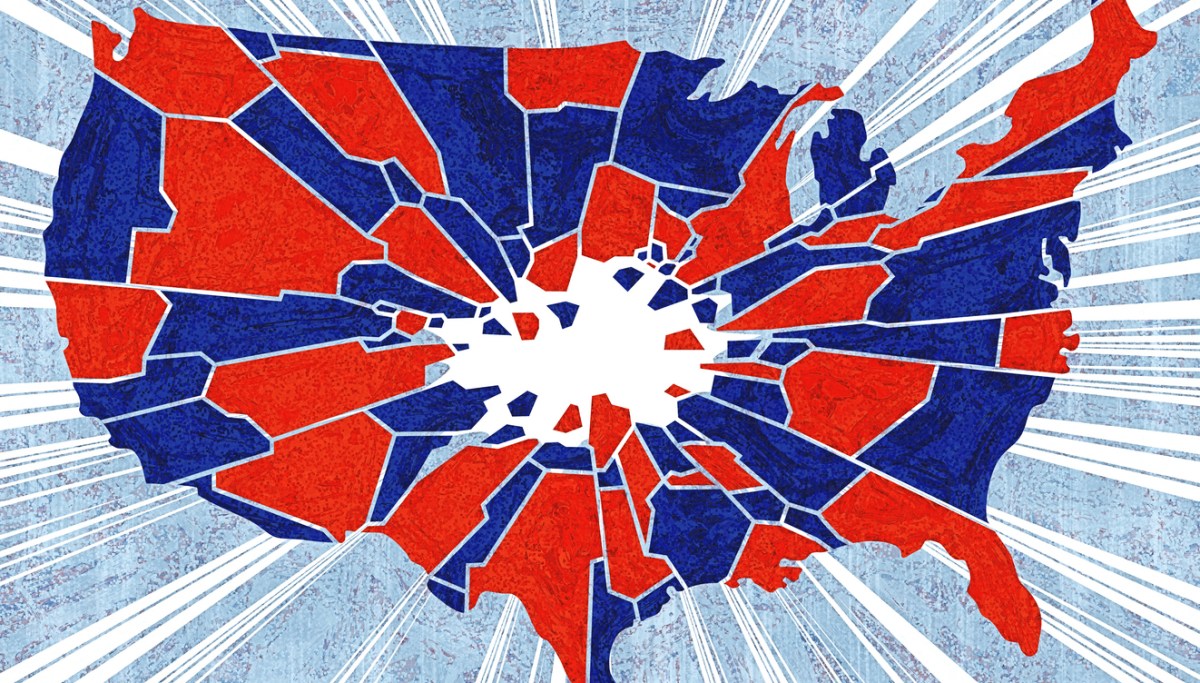
America’s 250th birthday is fast approaching, accompanied by a proliferation of patriotic polarization. A new national survey from NBC News finds self-described Democrats aren’t in much of a star-spangled mood, with just 29% of that group identifying as “extremely” or “very” proud to be American. By comparison, 25 years ago, that number among Democrats was 85%.
This finding broadly aligns with a raft of polling data in recent years, with Democrats and “progressives” reporting very low levels of national pride. This has been true even when their political coalition was in power, so the phenomenon is not exclusively driven by opposition to President Donald Trump, though that is certainly an exacerbating factor.
Young people broadly reflect the Left’s dim view of the country, as a paltry 36% of 18-to-34-year-olds categorize themselves as “extremely” or “very” proud Americans.
At the other end of the spectrum are senior citizens, 75% of whom are extremely or very proud, and Republicans, at 90%. These data constitute a 39-point patriotism gap separating the youngest and oldest voting demographics, and a whopping 61-point canyon between Republicans and Democrats.
Not long ago, Democrats would indignantly assail anyone they perceived to be questioning their patriotism. “How dare you?’ Today, antipatriotism seems to be the default position among the party faithful. “No, we should not be proud of this awful place.”
Within the overall U.S. population, patriotic sentiment remains a dominant majority position. Fifty-six percent of respondents told NBC’s pollster that they fit into the “extremely” or “very” proud columns, compared to only 21% who said they land in either the “only a little” or “not at all” categories of U.S. pride.
The latter group very disproportionately overlaps with political leftism. Indeed, a survey published this month by Elon University found that an outright majority, 55%, of Democrats would prefer to live in a country other than the United States.
A new Reuters-Ipsos poll measures how Americans conceive of the Fourth of July itself. The pollster asked whether the holiday is rooted in celebrating America or is more about spending time with friends and family. Two-thirds of Republicans chose the former option.
Less than a quarter, 24%, of Democrats did the same, with a large plurality cutting America out of America’s birthday.
A Gallup survey asked people whether they would display the flag on July 4. As a baseline, in the summer of 2001, just prior to 9/11 but after the controversial 2000 election, there was virtually no partisan gap between Republicans and Democrats on this question, with roughly two-thirds of each group responding in the affirmative.
Today, while GOP identifiers held steady on this point, the number among Democrats has cratered to just 27%.
Harry Enten, CNN’s data guru, marveled at this phenomenon during a recent on-air report. Of these statistics, he notes that Republicans are “basically where they were” a quarter-century ago, compared to Democrats’ pro-Old Glory sentiment “absolutely plummeting.”
When Texas Democrats’ Senate nominee, James Talarico, calls our flag a “complicated symbol,” he’s undeniably speaking the language of his base. Bridging the aforementioned 35-point “American pride” gap are the just over one-fifth of respondents, 22%, who classified themselves as “moderately proud” to be Americans.
In the long term, it will be interesting to see how Democrats seek to persuade the broader public to entrust them with power to govern a country that they don’t particularly like and many of them actively revile.
That characterization is not an exaggeration. One of the most prominent left-wing influencers on the scene today, who is increasingly being recruited as a campaign surrogate for “progressive” Democratic candidates, is a man who has openly declared that “America deserved 9/11.”
That’s quite a slogan ahead of the quarter-century anniversary of the jihadi attack that slaughtered nearly 3,000 people. The same man has openly lavished praise upon America’s enemies, praised the Chinese Communist Party, lamented that the U.S. won the Cold War, and boasted about his lack of patriotism for the country that has made him wealthy and famous.
For most of our citizens, it’s hard to fathom feeling ambivalent about, or hostile to, celebrating our country’s founding in 1776, let alone tolerating or endorsing the notion that our nation had it coming in 2001.
Yet that’s where much of the energy resides in one of our two major partisan tribes. The glorious, unprecedented success of the American experiment, including our myriad improvements and innovations forged over the years, should be a source of immense pride and gratitude across the ideological spectrum. It’s a precious inheritance for people of all stripes.
Those who reject that inheritance are entitled to their morally warped, historically obtuse ingrate status. But we grant them the authority to govern the rest of us at our own and our nation’s peril.