
Andy Burnham appoints John Healey as Chancellor
Follow along live as we bring you the latest updates from Westminster on the transition from the Starmer era to the Burnham era. The NS politics team will be regularly updating this page as we get more news and intel about the formation of the new government, so keep refreshing.
The first minister sent out to defend the Burnham administration on the morning rounds was newly re-appointed Business Secretary, Jonathan Reynolds. Asked by the Today Programme’s Nick Robinson about how the government’s new plan to cut energy bills will be funded, Reynolds said the allocation for digital ID was £1.8bn over 3 years and pointed out that it had been scored by the Office for Budget Responsibility. “It’s a pressure that is within the system that is being removed in order to make this decision on reducing energy bills for people,” Reynolds said. The policy is set to cost £850m for the rest of the year.
Less than 24 hours after he was sacked by Burnham, former chief secretary to the Prime Minister, Darren Jones is already causing trouble for his party’s new leader. In a said it was good news that the government will cut VAT on electricity bills but added: “the Digital ID program was unfunded. The government will have to set out how it pays for its new policies at the budget”.
The first of a series of policy announcements trailed by Burnham in his first speech on Downing Street as Prime Minister was announced this morning. The government plans to remove VAT from domestic energy bills from 1 October, in time to impact the next Ofgem price cap. It is expected to remove around £45 a year and the government said it will be funded from the scrapping of the Digital ID programme.
In the latest round of cabinet announcements, both Heidi Alexander (Transport Secretary) and Douglas Alexander (Scotland Secretary) have been re-appointed to their roles. Ellie Reeves – sister of the outgoing chancellor, Rachel Reeves – will attend Burnham’s Cabinet having been appointed Attorney General (replacing Lord Hermer, who announced his departure earlier today).
Stephen Kinnock – son of the former Labour leader Neil Kinnock and a former social care minister under Starmer – has been appointed Wales Secretary, replacing Jo Stevens. Emma Reynolds, the former Environment Secretary, returns to the Treasury where she becomes Chief Secretary (Reynolds was formerly Economic Secretary to the Treasury between January-September 2025). Angela Smith will remain as Lord Privy Seal and Leader of the House of Lords, while Alan Campbell remains Leader of the Commons.
Kanishka Narayan – who was appointed AI Minister under Starmer – has been re-appointed to the role and has now been invited to join cabinet meetings. Burnham’s decision to scrap the Department for Science, Innovation and Technology means there is no longer a dedicated technology secretary, however, Narayan’s invitation as to join cabinet as AI Minister is likely intended to fill that gap.
Elsewhere, Hamish Falconer (son of Tony Blair’s justice secretary, Charlie Falconer) has been reappointed to a role in the Foreign Office but will now take on a new brief covering Intergovernmental Relations and European Relations (his brief previously covered the Middle East). His role will sit both in the Foreign Office and the Cabinet Office.
Wes Streeting has been appointed Defence Secretary in Burnham’s new cabinet. The MP for Ilford North -who suggested earlier this year that he may run for the Labour leadership himself – resigned from his position as health secretary in Starmer’s government earlier this year. He replaces Dan Jarvis, who had been in the role for less than six weeks.
Lisa Nandy – a close ally of Burnham and the MP for Wigan, which neighbours his Makerfield constituency – has been re-appointed as Culture Secretary. However, Nandy takes over a newly re-named department: the Department for Digital, Culture, Media and Sport.
Elsewhere, former home office minister Alex Norris has taken over from Lammy (who resigned earlier today) as Lord Chancellor and Secretary of State for Justice. Angela Eagle replaces Emma Reynolds as the Environment Secretary. And following the departure of Hilary Benn, former trade minister Chris Bryant takes over as Northern Ireland Secretary.
Miatta Fahnbulleh – a close ally of Miliband and a former energy minister – replaces her old boss as Energy and Net Zero Secretary. The MP for Peckham has been working closely with Burnham on his policy agenda for government and, before she entered parliament, was the chief executive of the New Economics Foundation. Fahnbulleh was one of the first ministers to resign from Starmer’s government following Labour’s damaging set of local election results in May. Her appointment suggests the Burnham government will likely maintain Miliband’s work on the clean power agenda.
Angela Rayner has been re-appointed to her former role as Housing Secretary. After resigning from the role last September, Rayner has spent almost a year on the backbenches. Previously thought to harbour her own leadership ambitions, Rayner made a tacit pitch for a return to her old department in a speech to the New Economics Foundation earlier this month. The Ministry of Housing, Communities and Local Government includes responsibilities for councils and devolution – a major part of Burnham’s programme for government.
Another minister to be re-appointed to their old department is former chief whip Jonathan Reynolds, who will now lead the Department of Business, Innovation, Science and Trade. Reynolds’ department has been re-named, and will now include responsibilities which previously fell under the Department for Science, Innovation and Technology (previously led by Liz Kendall, who resigned earlier today). This confirms briefings that Burnham plans to scrap the technology department.
Reynolds has been replaced as Chief Whip by Anneliese Midgley. The MP for Knowsley, who was elected in 2024 and has not previously held a government position, was instrumental to Burnham’s Makerfield campaign. A former political director for both Unite the Union and the TUC, Midgley is known to be a formidable organiser.
The Deputy Leader of the Labour Party, Lucy Powell, has been appointed Education Secretary. Another close Burnham ally, Powell was previously shadow education secretary under Jeremy Corbyn between September 2015 and June 2016. Powell was appointed leader of the House of Commons in 2024, but was reshuffled following Rayner’s resignation last September. She subsequently won the election to replace Rayner as deputy leader with 54 per cent of the vote. Powell replaces Bridget Phillipson, who will remain in cabinet as the Minister for Women and Equalities.
Pat McFadden will remain as Work and Pensions Secretary after he was re-appointed to the role by Burnham this evening. In the role, McFadden was overseeing the government’s welfare reforms and is viewed as a safe pair of hands in the government.
Meanwhile, after Miliband was appointed Foreign Secretary by Burnham, Yvette Cooper has been moved to the Department of Health and Social Care. In his acceptance speech as Labour leader, Burnham said he would work to “fix social care” as Prime Minister – a policy area which falls under Cooper’s new brief. She takes over from James Murray, who held the role after Wes Streeting resigned earlier this year. Murray has not made an announcement about his position.
Burnham has appointed Ed Miliband as his Foreign Secretary, leaving his energy and net zero brief. Shabana Mahmood is staying on at the Home Office to pursue her immigration reforms. And as Ailbhe reported earlier, Louise Haigh, former transport secretary, rejoins cabinet in an enhanced role as Chancellor of the Duchy of Lancaster, First Secretary of State and Minister for the Cabinet Office. Haigh is now at the very heart of the Burnham government after her loyal backing for the former Manchester Mayor.
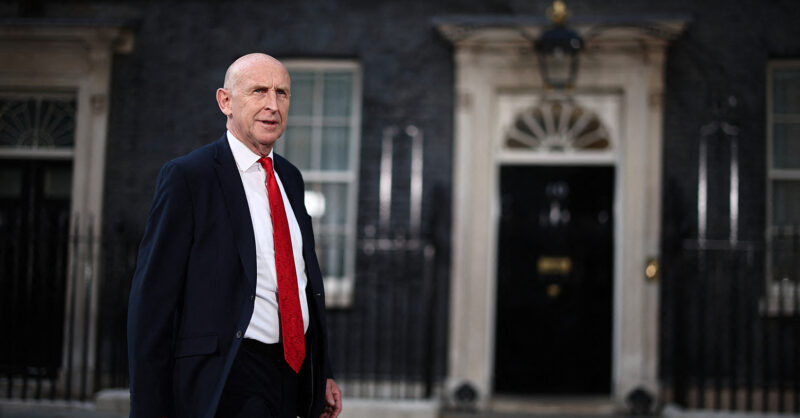
John Healey, the former defence secretary who resigned from Starmer’s government, has been appointed as Burnham’s Chancellor of the Exchequer. Healey was the first person touted for a cabinet position to enter No 10, but he was not thought to be in the running for the role. He has previous experience as a junior minister in the Treasury having served as economic secretary to the Treasury between 2002-2005 and financial secretary to the Treasury between 2005-2007.
Shabana Mahmood and Ed Miliband – the two front-runners to take over from Reeves in No 11 – entered Downing Street together shortly after Healey. Miliband could be seen putting his arm around Mahmood before the pair entered No 10.
What does Healey’s appointment mean? He is seen as non-factional, having served in both Starmer’s government as well as Jeremy Corbyn’s shadow cabinet before that. He has been touted as a potential leadership contender himself.
Healey resigned earlier this year over the government’s Defence Investment Plan. In his letter of resignation to Starmer, he said: “You have been unable, and the Treasury has been unwilling, to commit the resources that the nation needs to defend the country at this time of rising threats.” Will a Healey chancellorship mean more money for defence?
For more insight into Burnham’s new Chancellor of the Exchequer, read Ailbhe’s profile from earlier this year.
Cabinet Minister Nick Thomas-Symonds has been sacked by Burnham. A long-time ally and friend of Starmer, Thomas-Symonds had been overseeing work on the UK-EU reset. He said in a letter to Burnham: “I will support the new team of Ministers from the backbenches and continue to serve the people of my home constituency of Torfaen, who, as always, remain my top priority.”
Louise Haigh is to be appointed Chancellor of the Duchy of Lancaster and First Secretary of State, . Haigh – who was formerly transport secretary under Starmer but resigned – is seen as Burnham’s right-hand woman in parliament. She has been attending access talks with the civil service alongside Burnham and a handful of other senior figures. As Ailbhe points out, First Secretary of State is a position formerly held by figures such as George Osborne, William Hague and John Prescott and is seen as a “right-hand” style role. Haigh will be the first woman to occupy the role since the late Barbara Castle.
Northern Ireland secretary Hilary Benn announced in a statement on social media that he will not be continuing in his cabinet role. Benn wished his successor “all the very best” before adding, “the Prime Minister will have my full support from the backbenches.”
The decision to sack Benn means Burnham will be the first Labour Prime Minister not to have a member of the Benn family in his cabinet.
A close friend of Keir Starmer, the international development minister Jenny Chapman announced in a statement online that she will not be returning to her ministerial position. Chapman said: “I’m disappointed to be leaving but wish the Prime Minister and his new team every success.”
Shortly after taking office, Burnham phoned Trump. Burnham began by congratulating the US president on a successful world cup before setting out his vision as the UK’s new Prime Minister. According to a Downing Street spokesperson, Burnham told Trump he would be focused on ensuring “reindustrialisation up and down the country to ensure good growth in every postcode”. Burnham also used the call to underline his commitment to defence and security. Trump then updated Burnham on the situation in the Middle East. “They looked forward to speaking again soon,” the spokesperson said.
Interestingly, other than Burnham’s commitment to “reindustrialisation up and down the country”, there does not seem to have been an explicit mention of North Sea oil and gas. In a post on Truth Social on the eve of Burnham’s appointment, the US president appeared to suggest that Burnham would open oil fields “all the way”. Burnham has previously insisted that he will maintain the pledge in Labour’s 2024 manifesto not to issue new licences. Nothing has been announced yet.
Jo Stevens, the secretary of state for Wales, has resigned from the government bringing the tally of departing ministers to seven. In a statement, Stevens said “serving as the Labour Party’s first female Secretary of State for Wales for the last two years has been a privilege and an honour” and wished her successor the very best. Labour sustained a major defeat in the Welsh elections earlier this year, losing control of the Senedd to Plaid Cymru. Whoever replaces Stevens will have a lot of work on their hands.
The chief secretary to the prime minister, Darren Jones, has been sacked. Jones – another Starmer loyalist – was rumoured to be considering a run for the leadership himself. In a statement posted to his X account, Jones said Burnham had called him to tell him he “won’t be part of his new cabinet”. He said: “I wish him and his team every success.” Jones, who had been working on a programme of civil service reform, will return to the backbenches.
Liz Kendall, the Science Secretary, has also left government. Kendall was previously the Work and Pensions Secretary who presided over the disastrous welfare cuts programme of spring 2025. She said Burnham, whom she ran against in the 2015 Labour leadership contest, “will take this country from strength to strength”.
Richard Hermer, perhaps Keir Starmer’s closest cabinet ally and a close friend, has also left government in an unsurprising development. The top barrister, who took a place in the House of Lords to serve as Attorney General, says he will now go to the back benches and support the Burnham government. On BlueSky he writes: “I will continue to support this Labour government from the backbenches, as it delivers the change this country desperately needs. Andy and his team know they have my utmost support, and I wish them nothing but success.”
Rachel Reeves said it was the “privilege of my life” to serve as the first woman chancellor. Despite speculation she could stay in government after an offer of a more junior role, Reeves is preparing to return to the back benches. She said: “I wish the very best of luck to my successor, Andy and his cabinet. You have my full support, and I will continue to play my part in helping this Labour government deliver the change the country needs.”
Meanwhile David Lammy also leaves government, despite a desire to stay. “I would have been proud to continue serving in Cabinet. But a new Prime Minister is entitled to build his own team, and I wish Andy Burnham and the new Cabinet every success,” he said on X.
No 10 has confirmed what was first reported by the Telegraph‘s Washington bureau, that the new PM’s first phone call in the job was with President Trump. We await a fuller readout of what the pair discussed but the issue of North Sea Oil, over which Trump hammered Starmer, is likely to have been discussed alongside pleasantries and international affairs. Over the weekend Trump used his Truth Social platform to claim: “The People of Aberdeen, in Scotland, are dancing in the streets because the new Prime Minister, Andy Burnham, has stated that he will be opening up, all the way, the invaluable North Sea Oil!”
As we eagerly await appointments to the new cabinet, some Starmerites are jumping early. Lord Timpson, the Prisons Minister, stepped down this morning and now Steve Reed, the Housing Secretary, has left cabinet by the now traditional means: a PDF letter to the PM posted to social media. Reed’s resignation letter contains a zinger aimed at Andy Burnham over the value of loyalty. It also tries to make a virtue of his dogged defence of Starmer’s government right to the end (which now puts him out in the cold with much of the Labour party).
“Keir Starmer showed loyalty to me by appointing me to his Cabinet,” he writes, “I make no apology for returning that loyalty. It’s what is expected of functioning teams, and I hope those who did not show loyalty to Keir will show it to you. I’m proud I acted with integrity at every step over the turbulent past few months.”
Only a few weeks ago the president of the United States was referring to Andy Burnham bemusedly as “a mayor of a town”. Now world leaders are quickly getting up to speed as they offer their welcome the new Prime Minister. So far there have been congratulatory messages to Burnham on social media from: Volodymyr Zelensky of Ukraine, Emmanuel Macron of France, Friedrich Merz of Germany, Ursula von der Leyen of the European Commission, Shehbazv Sharif of Pakistan, Ilie Bolojan of Romania, Edgars Rinkēvičs of Latvia, Mohamed bin Zayed of the UAE, Nato Secretary General Mark Rutte and many more. But we wait to see what the reaction to this new govenment will be from Britain’s most important ally, the United States. Burnham has reportedly taken his first phone call as Prime Minister with President Trump. Trump sounded friendly towards Burnham on social media earlier this week, largely because he thinks the new Prime Minister will open up North Sea oil and gas.
Before walking into No 10 for the first time as Prime Minister, Andy Burnham said his inaugural instruction would be to “end rough sleeping in our country”.
This is a significant and ambitious pledge from the new Labour leader. Burnham made a similar promise – to end rough sleeping by 2020 – when he was elected as the Mayor of Greater Manchester in 2017.
According to figures released by the Greater Manchester Combined Authority, between 2017 and 2021 the number of rough sleepers dropped – from 268 to 89. But in the four years since then the numbers have begun to rise again. There were 197 rough sleepers counted by the GMCA in 2025.
This is not the first time that a government has pledged to end rough sleeping. The promise was included in the Conservatives’ 2019 manifesto (they failed to meet their target of ending it by 2024). Starmer’s government promised – and delivered – a long-term homelessness strategy. But they did not maintain the Conservatives’ pledge.
Jeremy Corbyn – the former leader of the Labour Party and now independent MP – made a similar pledge in 2018, when he was leader of the opposition.
Burnham’s speech also included hints at an imminent announcement on council house building which is perhaps intended to tie in with this pledge. Is it wise for Burnham to promise something he has already failed to deliver on a local level? Or is this a sign of the new Prime Minister’s ambition? Only time will tell.
The newly appointed Prime Minister made his first speech on Downing Street, forgoing a lectern in a break with convention. Burnham pledged to “change politics” with a new political and economic model for Britain. He will set out a new ten-year plan for Britain later this year but, in the meantime, we can expect some announcements starting from tomorrow to give “people breathing space now”.
The new Prime Minister said his first instruction on entering No 10 will be to “end rough sleeping in our country”. Ending his speech, Burnham said: “Let us make this the moment that Britain starts to believe again.”
Among the crowd of supporters gathering on Downing Street to meet the new, proudly Everton-supporting PM is former Everton midfielder Peter Reid, a small herald of the regional change in this new Labour government from the south east (Starmer was famously an Arsenal supporter) to the north west of England. Other Burnham allies like Steve Rotheram, the Liverpool City Region mayor, are waiting for the new PM’s arrival at No 10.
And just like that we have a new Prime Minister. The Palace has now released images of Burnham’s audience with the King. From a distance it would be hard to distinguish these images from those we got half an hour before, but the man in the dark suit and spectacles is a whole new man and the Labour Party will be hoping he will lead very differently from his predecessor.
Andy Burnham and his wife Marie-France van Heel have arrived at the Palace and will now make their way to the Chinese Dining Room for an audience with the King in which he will ask Burnham to form a government.
So there we have it. The Palace has now released photographs of Starmer’s audience with the King, which lasted around 20 minutes. He has now officially resigned as PM and the post is vacant until Burnham arrives and accepts the King’s request to form a government. The Starmer era is over after two years and 16 days. That gives him a longer length of service than Anthony Eden and Rishi Sunak, but he is still in the bottom rung of PMs in terms of length of service.
Starmer has arrived at the Luggage Door of Buckingham Palace to offer his resignation to the King (a departing PM would usually use a more ceremonial entrance but there are renovation works currently underway at the Palace)
Starmer gave a short speech in which he gave his “full support” to Andy Burnham. He also emphasised the work he had done over the past two years, saying he is “confident” the country is in a better place now than it was in July 2024.
Keir Starmer has emerged from the black door of No 10 with his wife Victoria. The street is filled with advisers, loyal ministers and friends and family. The Prime Minister has appointed renowned children’s entertainer Mr Blobby to the Treasury. Insiders say this may have consequences for the bond market.