
Antoni Gaudí, Modern Architecture’s Master of Synthesis and Glory
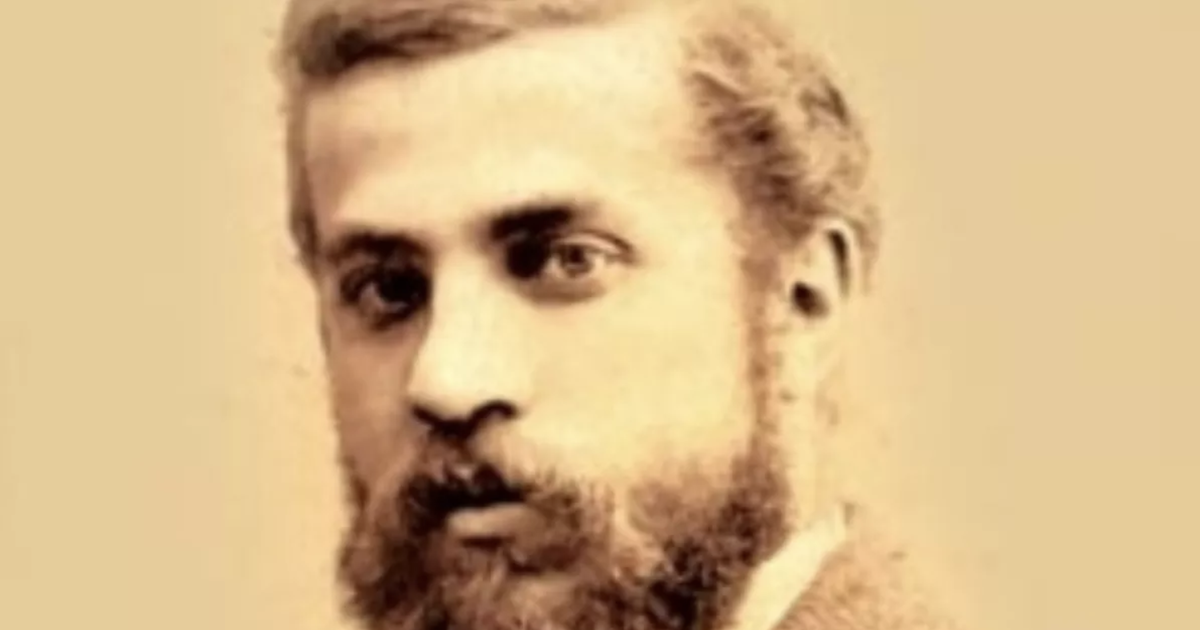
When Elies Rogent handed him his architecture diploma in 1878, the eminent figure was recognizing a brilliant junior colleague. But this Catalan equivalent of Viollet-le-Duc (designer of the bank, the university and the port warehouses of Barcelona, restorer of the cloister of Montserrat and, a decade later, director of works for the Universal Exposition) could not help wondering. Was this unflappable Antoni Gaudí i Cornet—still a student at 26, yet enough of a dandy to design his own business card and office furniture in cedar and wrought iron—“a madman or a genius”?
By instinct, the young man had already imagined restoring the Cistercian monastery of Santa Maria de Poblet. At school, he had successfully designed a university amphitheater. Outside the academy, he was already creating elements of urban furniture and even collaborating on the development of the park that was to replace the demolished citadel in the city center. Faced with such productive power, and above all with such originality combined with deep culture, Rogent’s perplexity was that of the old before the modern, of the established world confronting the one to come.
Madman or genius? Both, and perhaps more, today’s historians readily answer, although in the end they have few personal testimonies on which to rely. Gaudí had few friends. This native of Tarragona, reserved by nature and raised in the countryside between Riudoms and Reus, never wrote about himself. He left behind only sketches and fragments of models as archives.
A century after his death, it is therefore above all his methods and innovations, as well as projects once barely begun and now largely completed (when Gaudí was struck by a tram in 1926, only one of the 18 towers of the Sagrada Família had been finished), that are the best way to understand the man. For a long time, the creator-servant of this “cathedral of the poor” was regularly criticized. The many caricatures published in newspapers bear witness to that. The avant-garde (with the exception of Dalí and Miró) considered him compromised by big capital. Traditionalists found him revolutionary. Thus the man eludes easy categorization.
What remains is his glory. It is multifaceted, with no fewer than seven of his creations listed as UNESCO World Heritage Sites. Through them, one can first say that he was a modern architect in the sense that he used the most innovative technologies of his time. For the Sagrada Família, for example, reinforced concrete. More than that, he was a radical inventor, notably surpassing the centuries-old art of Gothic architecture by applying the physical principle of the inverted catenary arch. This simple method makes it possible to design structures without buttresses or flying buttresses through the force of gravity alone. Thus the man who would become an increasingly fervent Catholic, eventually ending his life as a mystic and hermit within the construction site of his “Expiatory Temple of the Holy Family,” found his path by reading Newton. He used the universal law of gravity to determine load-bearing structures—a technical leap forward of nearly eight centuries.
By what means? One recalls the amazement of visitors to the major retrospective organized at Paris’ Musée d’Orsay in 2022. They lingered before a strange model: that of the church for the social colony envisioned by his principal patron, textile industrialist Eusebi Güell. It foreshadowed the now-lost model of the Sagrada Família. Made entirely of strings and small weights, it resembled a cluster of stalactites formed from cotton cords and lead weights. Directly beneath it, a mirror revealed its inverted form: the schematic shape of the House of God.
“Gothic is a dead system,” the master had declared, unafraid of offending his most devout patrons. Like a Leonardo da Vinci whose boldness sometimes unsettled the Church, he never ceased observing nature in order to learn from it. What a repertoire the animal and plant kingdoms offered! From the rocky formations of Montserrat—the sacred mountains of Catalonia, shaped like fingers pointing toward the sky—to the fractal growth of a fern, he was inspired by everything around him. Even fish scales, in which he saw roof tiles. Even the leaves of the ordinary fan palm, which suggested a motif for a gate.
In the nave of the Sagrada Família, his combination of elliptical arches and slanted pillars supports its immense canopy-like vault. One feels there as if in a rainforest. Or beneath the sacred tree of Avatar, James Cameron’s eco-psychedelic film. Within this hallucinatory branching structure, gargoyles and other fantastic creatures flourish. These biomorphic columns, each different from the next, create precipices, promontories and hollows. As for the walls, since they are not load-bearing, they are pierced by windows and rose windows. Some 800 openings for light in total. Together with the stained glass and colored ceramics, the whole structure shimmers like water, granite or the stars of the cosmos.
With such a sense for the organisms of nature, Gaudí also possessed another gift inherited from his father’s family. Three generations of coppersmiths had passed on to him the ability to visualize in three dimensions. “The coppersmith is a man who must create volume from a flat sheet. Before beginning his work, he must already have seen the space,” he explained.
Finally, he belonged fully to his era: that of Art Nouveau. From the English Arts & Crafts movement to Vienna’s Jugendstil, from the Glasgow Style to the School of Nancy, and even to Hector Guimard’s Paris Métro entrances, the movement signified total art, with nature reigning supreme even in the heart of the city. Through photography, the child of Reus also became familiar with the widest variety of buildings—not only from the West but from across the world. His style absorbed Rococo and Viollet-le-Duc, but also the Alhambra and all the treasures of Arab-Andalusian art (his Villa Quijano is flanked by a multicolored minaret), as well as those of sub-Saharan Africa (the Great Mosque of Djenné in Mali, for example), along with İznik ceramics, Pharaonic, Ottoman and Mamluk Egypt, Angkor, Chinese and Japanese pagodas, and all the marvels of the Silk Road.
In 1894, eleven years after taking the reins of his magnum opus, Gaudí experienced an existential crisis. Was it the result of the deaths of his father and his beloved niece Rosita? Of increasingly severe rheumatism compounded by brucellosis, then known as Malta fever, which brought on depression? Or perhaps of romantic disappointments, after two broken engagements in quick succession? Whatever the cause, prayer now replaced social life, structured his daily routine and fueled his work ethic. Güell died in 1918. By then, Gaudí had already entered this active retreat, multiplying fasts, meditative walks and coordination meetings. A strict vegetarian, abstinent in all things except his health-giving walks, he had found his vocation at age 31: this church whose decorative abundance seemed to thank working-class neighborhoods for their sacrifices. Even before its construction, it included schools for their children.
Gaudí lived on-site, sleeping in the middle of his workshop—a place destroyed during the Spanish Civil War by fire. The Orsay retrospective temporarily reconstructed it. Computer-generated imagery magically resurrected this lair, half Saint Francis of Assisi’s cave at La Verna, half alchemist’s laboratory. Like Rodin’s studio at Meudon, it housed some 10,000 fragments of decoration and sculptural pieces.
Ultimately, the man who rests forever beneath the Sagrada Família was neither deranged nor, still less, a misanthrope. He was a man of synthesis, combining a sincere concern for social issues with an elitist paternalism. For him, true modernity could not exist without a complete knowledge of his art, its history and its many solutions. Politically as well as aesthetically, Gaudí was both revolutionary and conservative, materialist and man of faith. He was one of those who succeeded in bridging the divide opened since the Enlightenment.
For Élise Dubreuil, curator of the Orsay exhibition, the architect was also “deeply loved and popular in Barcelona during his lifetime, then forgotten; refined and austere, proud and humble.” She could have added functional and spiritual, abundant and rigorous, extravagant and restrained. To redeem a world he believed had been corrupted by the Industrial Revolution, he paradoxically sought a rational structure rather than magical thinking. His Sagrada Família rose according to the scientific laws of living things far more than through traditional craftsmanship. “I calculate everything,” the master declared. “To do things well, two elements are necessary: first love, then technique.” He added that discovering these laws of nature was equivalent to discovering divinity.
His church carries an ideal vision of the world; it embodies harmony in the sense that “all the elements are different from one another and yet together they form a harmonious construction.” Moreover, because Gaudí knew from experience that perfection does not exist in this world, he wanted it to be infinite, like a house forever in the process of becoming. “Creation continues, and the Creator uses His creatures to continue it,” he told the crowds of his followers.
While presenting the construction site to a papal nuncio, he heard himself described as the “Dante of architecture.” Beneath his white beard, did his cheeks blush? No one knows. But the Catalan architect, whose beatification process has been underway since 2003, may one day, if the procedure succeeds, become a saint. He would then be only the second artist to receive that distinction, after another great son of Florence: Fra Angelico, known as “the painter of angels.”