
Bangladesh: A year after deadly jet crash, families demand answers
It was a normal day for sixth-grade student Nure Jannat Yusha when suddenly, a Bangladeshi air force jet crashed into her school in the capital, Dhaka, killing 36 people - most of them children.
Within minutes, Milestone School and College, a private institution buzzing with student activity, was transformed into a scene of chaos and raging flames.
It was the deadliest aviation disaster the country had seen in decades.
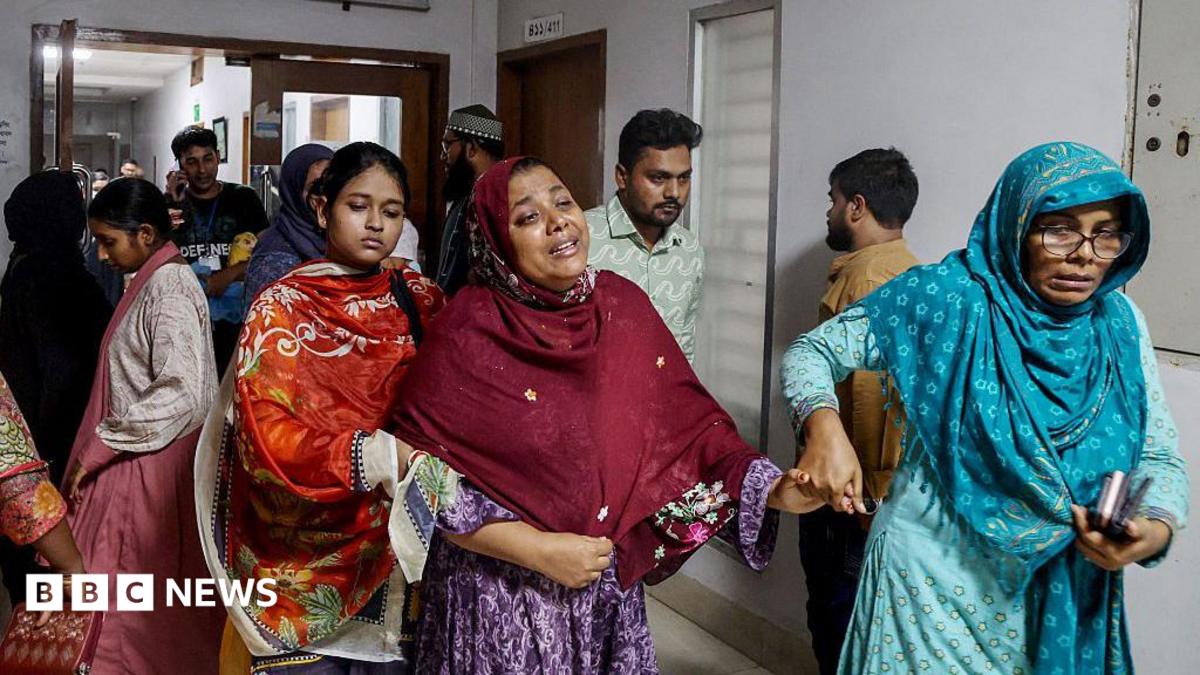
Earlier this week, families and survivors gathered to mark one year since the incident - many of them students who say they are struggling to return to normal life, Yusha among them.
"Even now, if I go to school and see a plane, I feel afraid. I can't sleep at night. In my dreams, someone is throwing me into the fire," she told BBC Bengali.
She was one of more than 160 people who were injured in the crash at Milestone School - and among those at the memorial held at a hospital in Dhaka on Tuesday, where the families of some victims say they are still waiting for answers about the deadly crash.
Yusha's mother Yasin Akter says her child had once dreamt of becoming a dancer - an aspiration that has since faded.
"My daughter screams all day and is afraid," she says, adding that Yusha has become paranoid about planes falling from the sky.
"Earlier she was interested in studies. Now she does not want to study any more."
On 21 July 2025, a training aircraft took off from a Bangladesh Air Force Base in Dhaka at around 13:00 local time (07:00 GMT) and crashed soon after in the Uttara neighbourhood.
Images from the scene hours after the crash showed scores of emergency service workers sorting through charred rubble in an attempt to find survivors.
Authorities announced that an investigation commission had been formed to investigate the crash, but in the days that followed, hundreds of student protesters took to the streets, clashing with police as they demanded accountability over the disaster and changes to training flights regulations.
The committee's findings, which it reportedly submitted to the government last November, have not yet been made public.
According to a copy of the full report obtained by BBC Bengali, it highlighted issues like Milestone School's lack of compliance with building codes. It also found more than 600 buildings - including schools and hospitals - located near Dhaka's international airport that had violated height restrictions.
The report also found that the pilot lacked sufficient flight training and proper ground supervision. And there was no technical fault with the aircraft, the report said - contradicting an early statement by the Bangladeshi Armed Forces that the jet had experienced a mechanical fault after taking off.
The Bangladesh Armed Forces did not respond to a request for comment.
"No one can give a guarantee that another plane will not fall onto this school in the future," Mansur Helal, the husband of one victim, told the crowd during the memorial, referencing a recent BBC documentary on the committee report.
"This is truly a horrific situation. Every day around 2,500-3,000 students go to that school."
Helal's wife, schoolteacher Mahreen Chowdhury, had died in hospital from extensive burns she had suffered while rescuing students.
"The building in which this accident happened had only one door. How can there be only one door for 800-900 students?" Helal added.
Helal and others are calling for the government to release the full report.
They are also urging better government support for survivors undergoing treatment, as well as compensation for them and victims' families - which was recommended in the investigative committee report but yet to be implemented.
Images from the scene hours after the crash showed scores of emergency service workers sorting through charred rubble
Health Minister Sardar Sakhawat Hossain, who was at the event on Tuesday, said the government would support survivors who require further medical treatment. And Zubaida Rahman, the wife of Prime Minister Tarique Rahman, hailed the courage shown by survivors as "a source of inspiration for the nation".
But many of the students who attended the memorial this week, sporting burn scars, are still grappling with their new reality.
Mehreen, who's in the fifth grade, says she is no longer able to go to school because of her injuries.
"If I get a little sunlight, my whole body burns. For that reason, I do not go to school any more."
It has also affected her sleep and learning ability: "Earlier, if I read something, I would memorise it in two minutes. Now I can't memorise a line in two hours.
"I can't sleep at night. When I do sleep, I often have strange dreams. I still can't forget that incident."