
Bigfoot-Like Ancient Apes Might Have Been Closer to Humans Than We Realize
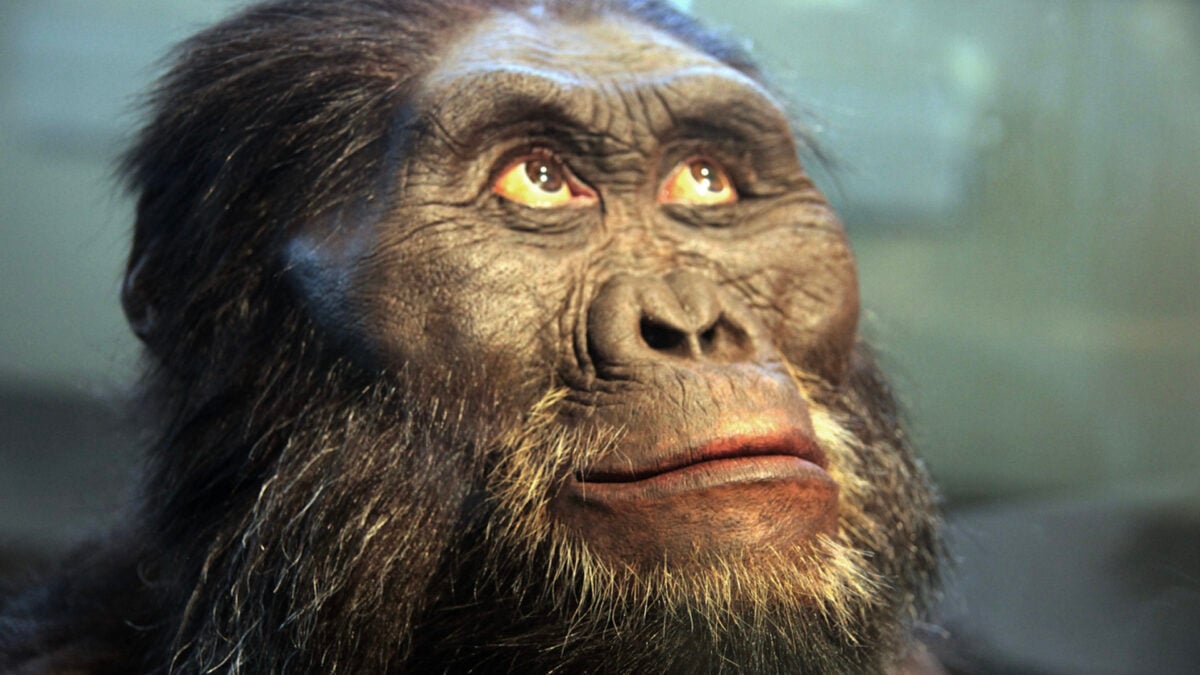
Decades of paleontological work across southern China exploded into a wave of serious interest in famous cryptids, like Yeti and Bigfoot, after zoologist Wladimir Tschernezky first published his analysis of a mysterious footprint in the journal Nature in 1960. Tschernezky’s paper floated the idea that this footprint, alongside local Yeti reports from the surrounding Himalayas, pointed to the continued existence of a “very huge, heavily built bipedal primate” likely similar to the ancient Gigantopithecus fossils then emerging from those China dig sites.
To the ongoing consternation of joyless scolds, Tschernezky’s hypothesis has forever linked his study’s “Abominable Snowman” and America’s legendary Sasquatch to Gigantopithecus—the quite literally gigantic genus of great ape that made Asia its home from about 2 million to 200,000 years ago. In the intervening 76 years since Tschernezky’s paper, anthropologists, paleontologists, and experts in primate anatomy and genetics have since learned a lot more about Gigantopithecus and related prehistoric primates, like Paranthropus and Australopithecus.
Now, a new study published Tuesday in the American Journal of Biological Anthropology argues that several of these groups ought to be recategorized into the genus Homo, alongside Homo Sapiens like us.
“These groups do not necessarily represent distinct evolutionary branches, or ‘clades,’ and differences in behaviour and ecology once used to distinguish them have also become increasingly difficult to maintain,” Ian Towle, a research fellow at the Monash Biomedicine Discovery Institute and author of the study, explained in a statement.
The fossil record on several genera of extinct ape, he writes in the paper, have shown these primates to display smaller and more human-like canine teeth, among other dental similarities; and those cases included specimens from the genera Indopithecus, Ouranopithecus, and (Bigfoot suspects themselves) Gigantopithecus.
“The more we learn about our ancestors and close fossil relatives, the more we realise how complex and non-linear our family tree is,” according to Towle, whose early work focused on dental evidence from fossil hominins, a broad category that includes humans and chimpanzees.
To make his case, Towle focused particularly on the increasingly arbitrary and messy distinctions now used to maintain the boundary between Homo and Australopithecus as distinct genera over recent decades.
Originally, for example, the genus Homo was defined in part by its larger brain size, until a variety of ancient primate fossils beginning with Homo habilis in 1964 were formally folded into the group. Still more modern additions, including Homo floresiensis and Homo naledi, have brain sizes roughly equivalent to those of Australopithecus, the researcher noted.
Another key trait once limited to humanity’s closest relations, the use of tools, is now widely acknowledged as a much more common skill across primate species than people once assumed. The genus Paranthropus, Towle noted, had previously been presumed to lack the aptitude for tool use—until around 2023, when their 2.6-million-year-old fossils started popping up alongside ancient tools at dig sites in Kenya and Ethiopia.
“It has become increasingly clear that ‘wastebasket’ taxa defined by one or a few traits, such as brain size, locomotion, or tool use, do not map neatly, or even plausibly, onto phylogenetic reconstructions of homininans,” Towle wrote in the new study.
While Towle stops short of suggesting that some of these primates, like Gigantopithecus and Ouranopithecus, should actually be folded into genus Homo, he does advise that something like this should occur for Paranthropus and Australopithecus. (Nevermind, for the moment, that some scholars have recorded close similarities between Gigantopithecus and Australopithecus.)
“The central argument of this paper is not that the specific taxonomic solution proposed here is necessarily the best one,” Towle admitted, “but rather that the current treatment of homininan genera is increasingly difficult to justify.”
In other words, a fairly obvious conversation needs to be had to resolve over 150 years of species categorization that has not exactly modernized alongside all the scientific methods used to study these living and once living things.
“Modern taxonomy, the science of naming and classifying organisms, increasingly aims to reflect genuine evolutionary relationships, grouping species according to their shared ancestry,” Towle noted. “But when it comes to our own evolutionary history, scientists have been slower to make the transition.”
Whether your budget is $10 or $1,300, we've got tech and gear recommendations that will make the new semester more productive and entertaining.
And she might not have been a shaman, either.
Researchers working with the Smithsonian pored over 10,061 artifacts and other elements to determine whether tiny ‘Homo floresiensis’ used fire or hunted big game.
The ancient hominins were likely more diverse and lived in well-connected communities, a new study suggests.
An international team in South Africa has pinned the earliest known use of fire by Homo erectus back to between 1.07 and 1.79 million years ago.
New research provides a deep dive into the ancient and modern day microbes that call Ötzi home.