
Bison rams elderly man in Yellowstone, flinging him into the sky
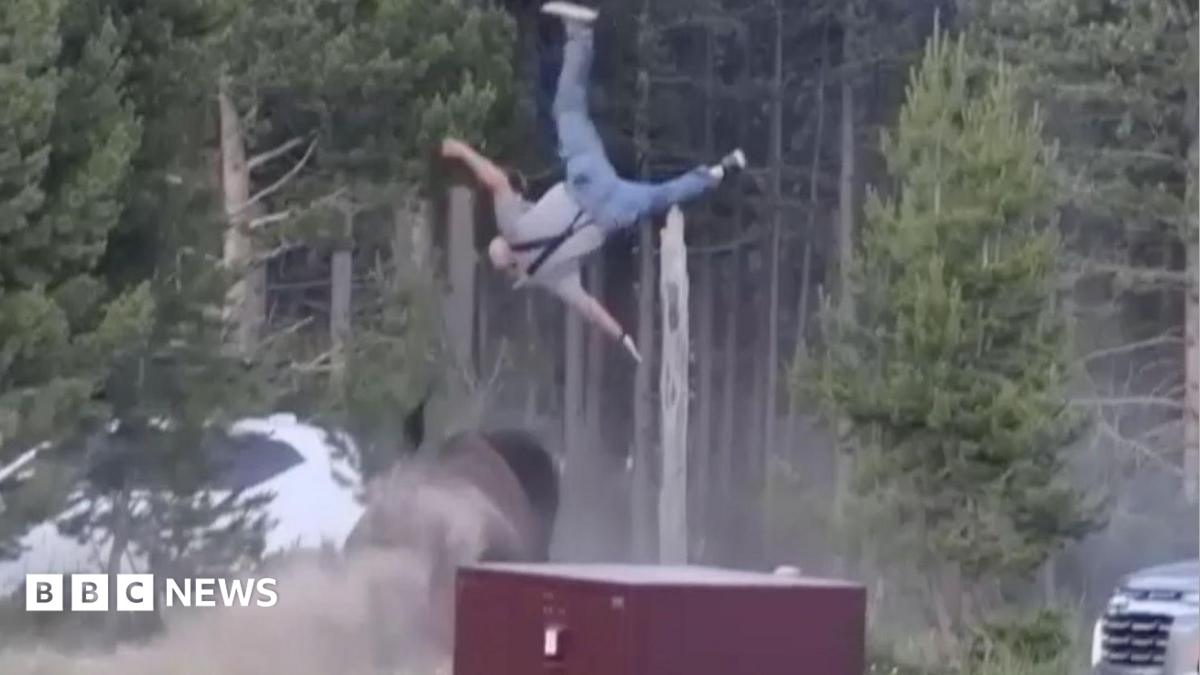
A bull bison, reportedly weighing 2,000lb (900kg), sprinted towards an elderly man, ramming him with its head and knocking him into the air in Wyoming's Yellowstone National Park.
Viral footage of the incident shows a boy and his grandfather snap a picture of the bison as it lies in the grass, before the massive animal jumps to its feet and chases after them.
The man, who has been identified by US media as 65-year-old Carl Isom-McDaniel, sustained multiple injuries and was described by witnesses as "in a lot of pain".
He was sent to hospital, according to the New York Times. The National Park Service (NPS) has not released any information about the attack.
"Bison may appear tranquil, but these large animals have injured more people in Yellowstone than any other animal," the organisation says on its website.
"They can run 3x faster than humans, making it very important to give them plenty of space."
The NPS advises Yellowstone visitors to remain at least 25 yards (23m) from bison at all times and to "never approach a bison to take a photo".
The incident occurred on Friday evening at Bridge Bay Campground near Yellowstone Lake in the final hour before sunset.
Isom-McDaniel and his grandson appear a good distance away from the animal as their walk slows to a halt and they raise their cameras to take a picture.
The bison then repeatedly flops on its side in an agitated fashion before hopping to its feet.
A white truck slowly approaches the scene, but after the bison charges the truck the driver speeds off. The animal continues forward, leaving a cloud of dirt in its trail as it barrels towards Isom-McDaniel and his grandson.
The pair try to evade the bison by running through a thicket of trees, but the animal eventually caught Isom-McDaniel.
"The bison hooked him with his left horn on his hip and tossed him in the air," Mike Macleod, who recorded the incident, told the Cowboy State Daily, a local paper. "He made a perfect flip and landed on his side."
Mcleod continued: "He was in a lot of pain with his leg, and otherwise he was conscious the whole time, in good spirits, joking."
Summer is the busiest season in Yellowstone, according to the NPS. Nearly 60% of annual visitation occurs solely during the months of June, July and August.
July happens to overlap with the animal's mating season - the "peak breeding" period where testosterone levels among bulls are heightened, Jennifer Barfield, the scientific lead at Colorado's Laramie Foothills Bison Conservation Herd, said.
"That's really going to drive their behaviour, and they're going to be potentially more unpredictable than at other times of the year," the Colorado State University professor said.
Barfield said her team stays away from the bison during mating season, except for when making observations from the safety of a vehicle.
For those on foot, she said: "It's always good to keep in mind that 25 yards is a minimum distance for safety."