
Caernarfon teen's ovarian cancer put her in menopause overnight
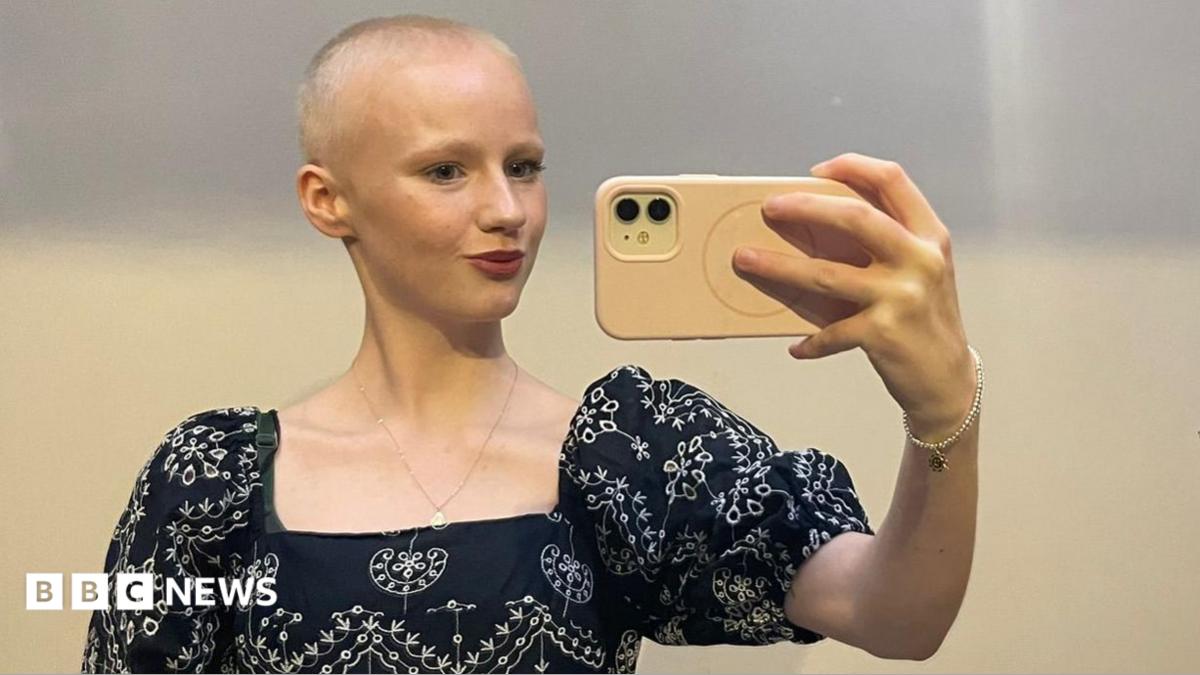
When Enlli Thompson's periods changed and she began experiencing excruciating pain at 19, she was told by doctors there was nothing wrong.
Her stomach issues and headaches were blamed on a bug or a urinary infection - even anxiety.
It was only after Enlli had further tests when a scan showed a cyst in her pelvis that the teenager from Caernarfon, Gwynedd, was given the devastating news she had ovarian cancer.
She would need a full hysterectomy to remove her womb, which would put her into immediate menopause, and means she is not able to have children.
But Enlli said her life had changed for the better.
"I used to be quiet and shy, but now I feel like I'm in a really good place," she said.
Since entering surgical menopause, Enlli experiences symptoms including hot flushes, brain fog, joint and muscle pain and fatigue
Enlli started experiencing problems in 2024.
"My periods were changing, I was experiencing severe pain, but I was still being told I was fine," she said.
She described being "completely at a loss" and felt like she was "losing the plot".
But the pain became too much, and she visited A&E at Ysbyty Gwynedd in Bangor.
Scans revealed what was believed to be a cyst in her pelvic area, and she was placed on a medical plan to carefully monitor her condition, while continuing to work as a trainee mechanic.
"I was taking painkillers and working through the pain," Enlli said.
She then received a call from the hospital to return for further scans, and admitted: "My mind went straight to cancer."
Her worst fears were confirmed, and she was told she had stage 3 ovarian cancer, , externalwhich meant it had spread beyond the pelvis.
"Being told that I wouldn't be able to have my own children, I broke down and cried," she said.
"I had so much support, but it was so difficult hearing those words."
But Enlli said: "In a strange way I was kind of relieved when they told me I had cancer.
"Just because then I had an answer, I had a treatment plan, I was going to get better."
Enlli received fertility treatment, and seven of her eggs were frozen.
She finished chemotherapy in September 2025, and passed her driving test a week later.
Enlli now experiences hot flushes, brain fog, joint and muscle pain and fatigue, and says it can be hard to identify which are from the menopause or effects of the chemotherapy.
"My memory is absolutely awful," she said.
Enlli believes her age meant ovarian cancer wasn't initially suspected, and while she doesn't blame doctors as it was such a rare case, she hopes lessons can be learnt from her story.
Every year, about 120 young women are diagnosed with ovarian cancer in the UK, and about one in 10,000 women experience the menopause in their teens.
"I want something to be done and for things to change so this doesn't happen to other young women, who are often not listened to, leading to important things like this being missed," she added.
Her cancer battle has given her a new sense of purpose and confidence, and Enlli raises awareness on social media as well as speaking publicly.
"I can't sit still, I love helping others and I'm much more confident than I was before," she said.
Enlli has also decided on a change of career and wants to work in cancer care to help others.
She decided to embrace her new look, by shaving her head after she lost some of her hair from chemotherapy.
"I may wear a wig if I'm dressing up, but usually I don't, and I get so many lovely compliments."
Enlli said she is "much more confident" since her cancer diagnosis and took part in a fashion show for the charity, Tenovus Cancer Care
Enlli's case is a "rare phenomenon", according to GP Dr Rebeccah Tomlinson.
She believes ovarian cancer can be hard to diagnose because the symptoms can be "vague".
"As a medical specialist, I would always say bloating is my red flag feature," she said.
"If somebody mentions bloating to me, I'm going to want to investigate because that is one of the most common signs of ovarian cancer and it often gets put down to irritable bowel syndrome because that's common."
Most people diagnosed with ovarian cancer are in their 50s or older, but it's becoming more common in teenagers and younger people, according to the Teenage Cancer Trust.
Cancer Research UK said about 120 young people aged 15 to 24 are diagnosed with ovarian cancer in the UK each year, and about five in Wales.
Dr Tomlinson added: "It is sometimes possible to treat ovarian cancer without a full hysterectomy, depending on how quickly it's picked up and also what type of tumour it is.
"But unfortunately in younger people, sometimes cancers are more aggressive, so catching them early can sometimes be a lot more complicated."
Menopause, external is typically caused by a fall in hormone levels and usually affects women between the ages of 45 and 55, but it can happen earlier.
It is a natural biological stage where menstrual periods stop naturally.
According to Menopause Support, one in 10,000 women will experience menopause under the age of 20.
In Enlli's case, it was because she had a hysterectomy, a surgical operation to remove the womb, and results in the end of periods and fertility.