
China
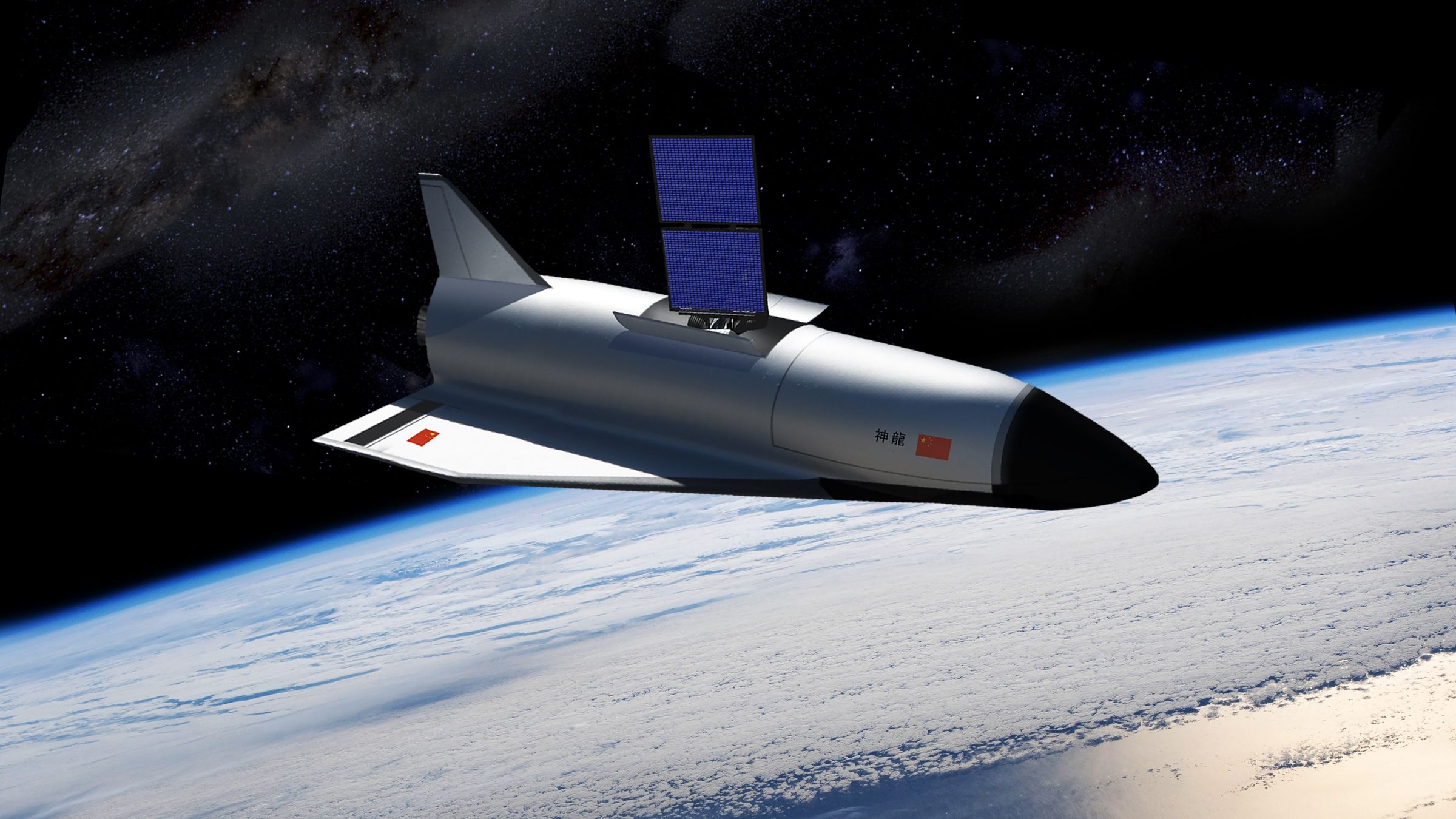
China's top-secret space plane just released another unknown object over Earth, raising concerns about exactly what the mysterious vehicle is up to. The clandestine spacecraft has now deployed at least nine payloads around our planet since 2022 — and we don't know what any of them really are.
The Shenlong, or "divine dragon," space plane is a reusable, robotic spacecraft that China has repeatedly launched into low Earth orbit (LEO) on board vertical rockets, before reentering the atmosphere for a horizontal runway landing — similar to the iconic spacecraft from NASA's now-defunct Space Shuttle program.
The space plane has never been photographed by otuisde nations, so we have no clear idea what it looks like or how large it is. Officials from China's space sector have yet to reveal any meaningful information about its design or purpose.
Shenlong first launched into space on a two-day mission in September 2020, before completing an eight-month stint in LEO between August 2022 and May 2023, and a nine-month spaceflight between December 2023 and September 2024. It released its first payload shortly after the launch of its second mission and deployed seven more objects during its third mission, six of which were ejected simultaneously.
The space plane's fourth and ongoing mission began on Feb. 7 when it launched atop a Long March 2F rocket that lifted off from China's Jiuquan Satellite Launch Center in the Gobi Desert, according to Live Science's sister site Space.com. And to date, there has been no news of its current activities.
American space exploration company LeoLabs was the first to detect the new object after it was deployed by the Shenlong space plane.
But on June 22, the private space surveillance firm LeoLabs, which specializes in tracking spacecraft in LEO, detected "an unknown object in the vicinity [of the spaceplane]," according to a post on X. The mystery payload was initially picked up by one of the company's radars in New Zealand and did not match any other object in the company's catalog.
Later on the same day, LeoLabs representatives added in an update to the post that, following additional observations from across the company's radar network, they had "independently cataloged this object and assessed with high confidence that it was released from the Chinese space plane."
Get the world’s most fascinating discoveries delivered straight to your inbox.
On June 23, Jonathan McDowell, an astronomer and satellite tracking expert at Durham University in the U.K. and previously with the Harvard & Smithsonian Center for Astrophysics, confirmed in another X post that the new object originated from Shenlong and was being tracked by the U.S. Space Force.
McDowell also speculated that it could be a "cubesat" — a small, often box-like satellite frequently deployed as a secondary payload alongside larger spacecraft. However, as with the previously released objects, it is unclear what its purpose might be.
Shenlong likely shares some key design aspects with the U.S. Space Force's X-37B space plane.
Space News previously reported that Shenlong's primary goal might be to conduct rendezvous and proximity operations with other spacecraft and that its payloads may be targets for it to practise flyby maneuvers in orbit.
Others have speculated that the mystery objects could be covert surveillance satellites or possess anti-satellite weaponry, according to Gizmodo. However, to date, there have been no reports of any spacecraft being sabotaged by the space plane or its payloads.
Shenlong has now spent nearly 700 cumulative days in LEO. During that time, amateur photographers snapped some blurry shots of light reflecting off the mysterious space plane. The most intriguing image, captured in August 2024, revealed a bright appendage extending from the main spacecraft. This was most likely a solar array, experts speculated, which is unsurprising considering that most spacecraft are at least partially powered by sunlight.
China is not the only country with a secretive space plane. The U.S. also has its own version, the X-37B, whose two operational models have collectively spent more than 4,200 days in LEO since 2010. However, American officials have been much more forthcoming in revealing information about their space plane's design, mission parameters and research goals.
Harry is a U.K.-based senior staff writer at Live Science. He studied marine biology at the University of Exeter before training to become a journalist. He covers a wide range of topics including space exploration, planetary science, space weather, climate change, animal behavior and paleontology. His recent work on the solar maximum won "best space submission" at the 2024 Aerospace Media Awards and was shortlisted in the "top scoop" category at the NCTJ Awards for Excellence in 2023. He also writes Live Science's weekly Earth from space series.
Please logout and then login again, you will then be prompted to enter your display name.