
China becomes first to recover orbital rockets using two methods: How Zhuque-3 works
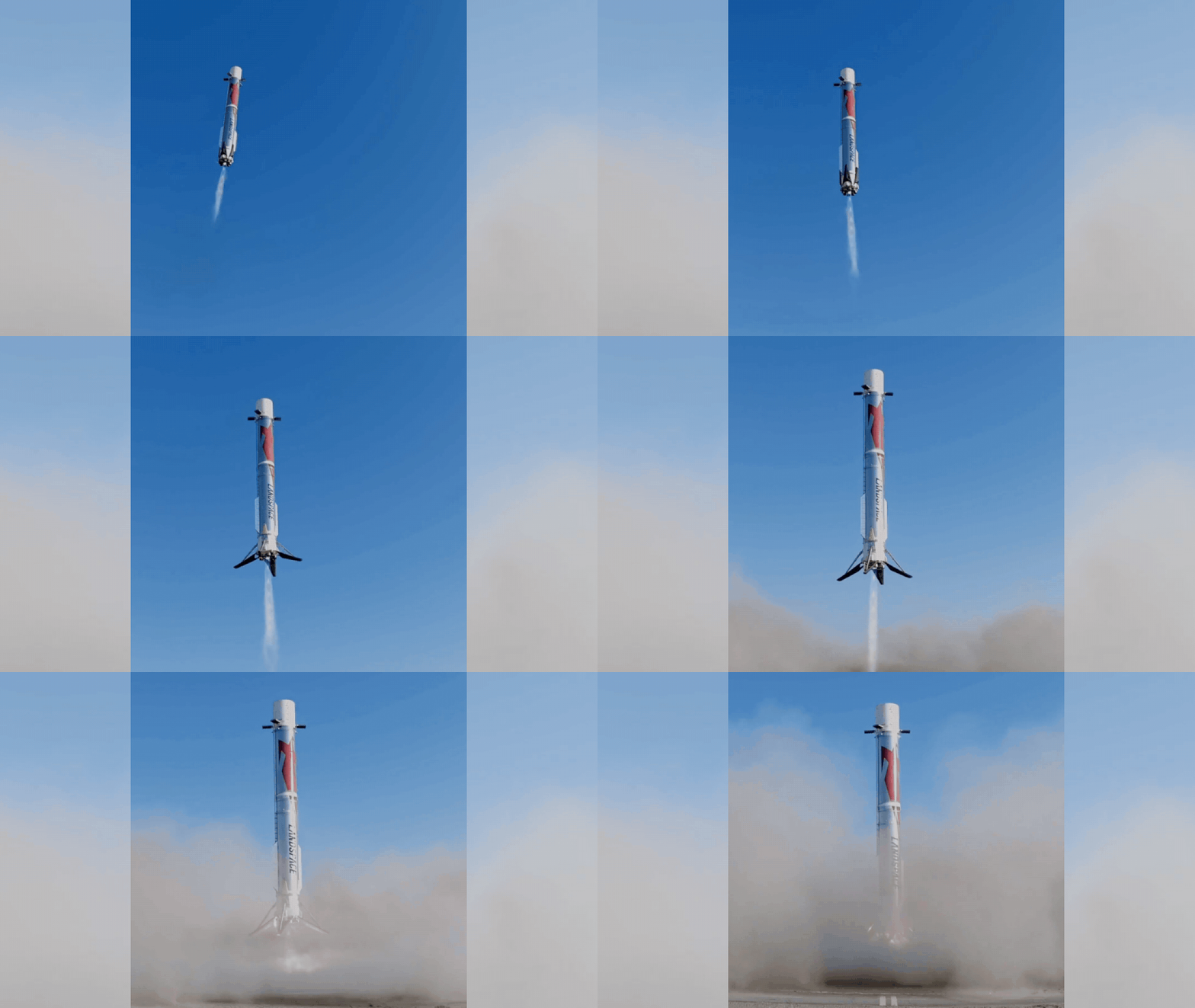
China has successfully recovered the first stage of an orbital rocket on land for the first time, marking a major step in Beijing’s efforts to develop reusable launch technology and reduce the cost of putting satellites into space.The milestone was achieved on Wednesday by Chinese private space company LandSpace, which successfully landed the first stage of its Zhuque-3 rocket after launch, according to state media and company statements.The achievement makes LandSpace one of only a handful of companies globally to demonstrate controlled recovery of an orbital-class rocket booster.The 66-metre Zhuque-3 lifted off from the Jiuquan Satellite Launch Centre in the Gobi Desert at around 7.35 am local time and delivered a Honghu-3 internet satellite into its designated orbit.Its nine-engine first stage then returned to Earth and landed vertically at a recovery site in Minqin county in Gansu province, around 390 km southeast of the launch site, the South China Morning Post reported.China's state news agency Xinhua described the recovery as a “major breakthrough in the country's reusable rocket technology” and said it was the country's first successful land-based recovery of an orbital rocket's first stage.Why reusable rockets matterRecovering and reusing rocket boosters can dramatically reduce the cost of space launches because expensive hardware does not have to be discarded after every mission.That technology has been pioneered by SpaceX, whose Falcon 9 rockets routinely return their first stages to Earth for reuse.
Blue Origin has also demonstrated reusable orbital-class rocket technology.China has now demonstrated two different approaches to recovering orbital rocket stages.In July, the state-owned China Aerospace Science and Technology Corporation recovered the first stage of a Long March-10B using a large net on an offshore platform.Wednesday's Zhuque-3 mission used the more conventional approach of deploying landing legs and bringing the booster down vertically on land.That makes Wednesday's achievement particularly significant because it demonstrates a technology closer to the recovery model used by SpaceX.China's answer to Falcon 9?Zhuque-3 is being positioned as a potential Chinese rival to SpaceX's Falcon 9.
The rocket is powered by liquid methane and liquid oxygen, while Falcon 9 uses liquid oxygen and kerosene.LandSpace says Zhuque-3's stainless-steel construction could help lower manufacturing costs. The material also offers strong heat resistance, an important advantage when a rocket stage has to survive atmospheric re-entry.The rocket can carry around 21 tonnes to low Earth orbit in an expendable configuration, while its reusable configuration has a lower payload capacity.
LandSpace aims for the booster to be reused as many as 20 times, according to Reuters.By comparison, SpaceX's Falcon 9 can carry about 22.8 tonnes to low Earth orbit in a one-way configuration, according to figures cited by Reuters.But the technological gap remains substantial. SpaceX has already carried out hundreds of successful booster recoveries and routinely reuses Falcon 9 first stages, while LandSpace has only just completed its first successful land recovery.Second attempt succeeds after dramatic failureThe successful recovery came on Zhuque-3's second orbital mission.During its maiden flight in December, the rocket's second stage successfully reached orbit but its first stage failed during the final powered descent and erupted in a fireball.LandSpace subsequently modified the rocket, including changes to its landing-engine configuration, autonomous safety-control system and thermal protection for re-entry, the South China Morning Post reported.The successful landing now gives the company an opportunity to move from demonstrating the technology to actually reusing the recovered booster.LandSpace said the recovery would lay the foundation for future maintenance and reuse flights and help improve China's ability to provide “low-cost, high-frequency and highly reliable space transport capabilities.”Why this matters for China's satellite ambitionsThe biggest commercial prize could be China's rapidly expanding satellite-internet ambitions.Beijing is developing large broadband constellations such as Guowang and Qianfan, each ultimately envisioned to comprise more than 10,000 satellites.Launching thousands of satellites would require a huge number of rocket missions.
Reusable boosters could therefore become critical to keeping launch costs manageable and allowing China to put satellites into orbit at a much higher frequency.SpaceX's Starlink provides the clearest example of what reusable rockets can enable. The company has already deployed more than 10,000 operational satellites and built a large commercial broadband network.China's satellite constellations remain far smaller, with Guowang and Qianfan each having deployed only around 200 satellites, according to the South China Morning Post.The ability to recover and eventually reuse Zhuque-3 boosters could help Chinese launch companies increase their flight frequency and compete more aggressively in the global commercial space market.China is pursuing both state and private space programmesThe development also highlights China's two-track approach to reusable rockets.While private companies such as LandSpace are developing commercial launch vehicles, China's state-run space programme is simultaneously pursuing reusable rocket technology.The China National Space Administration said it helped coordinate the Zhuque-3 launch team and would continue supporting the development of reusable rocket technology.The July recovery of the Long March-10B and Wednesday's Zhuque-3 landing show that China is experimenting with different recovery methods rather than relying on a single technological route.But the real test now is reuse.Successfully landing a booster is only the first step.
The recovered stage must be inspected, refurbished and flown again safely and economically.If LandSpace can demonstrate repeated flights with the same booster, China would move closer to matching the operational advantage that SpaceX has built over the past decade.