
Clarence Thomas wants Supreme Court to revisit 66-year-old opinion
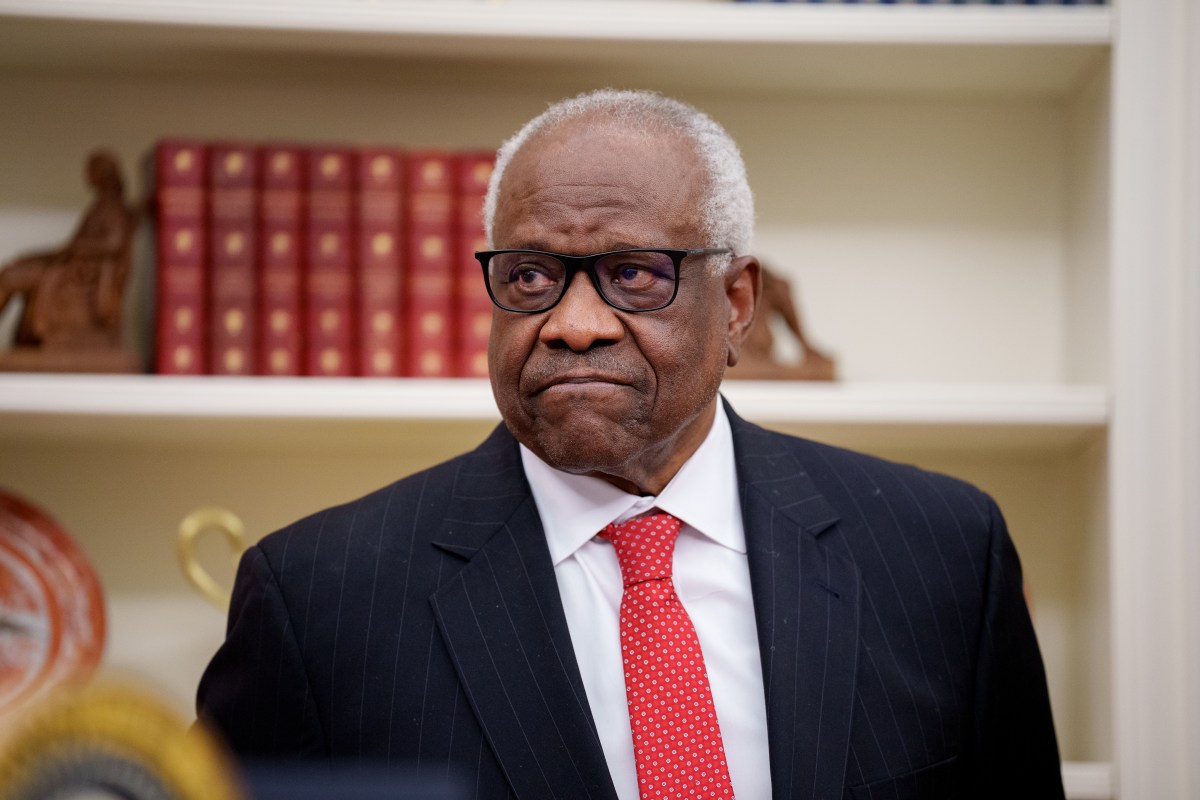
Supreme Court Justice Clarence Thomas on Monday called for the court to revisit a 62-year-old ruling that made it more difficult for public figures to sue over defamation.
The High Court declined to grant certiorari to lawyer Alan Dershowitz, who had sued CNN in 2020 for allegedly misrepresenting comments he made defending President Donald Trump during his 2020 impeachment hearing. While the justices declined to pick up the case, Justice Thomas said he believes the court should have done so, calling on the court to revisit its 1964 ruling in New York Times Co. v. Sullivan. The court doing so could upend defamation cases.
A CNN spokesperson declined to comment when reached by Newsweek. Newsweek also reached out to a representative for Dershowitz for comment via email.
The 1964 ruling fundamentally reshaped American defamation law, establishing the "actual malice" standard. Essentially, the ruling protects the press from being sued for defamation when publishing false information about public officials unless they are aware the statements are false or have reckless disregard for the truth.
It stemmed from a New York Times advertisement supporting Martin Luther King Jr. and criticizing Montgomery, Alabama police—but it included factual inaccuracies about the police. L.B. Sullivan, the Montgomery city commissioner, sued for defamation, and a state court agreed at first.
However, the Supreme Court ultimately decided that public officials must prove actual malice to win a defamation case.
"Thus we consider this case against the background of a profound national commitment to the principle that debate on public issues should be uninhibited, robust, and wide-open, and that it may well include vehement, caustic, and sometimes unpleasantly sharp attacks on government and public officials," the ruling reads.
Thomas wrote that the court should revisit that ruling.
"The ‘actual malice’ standard for public figures ‘bears ‘no relation to the text, history, or structure of the Constitution,’" he wrote.
In his view, "the founding generation believed that, if anything, public figures had stronger claims for damages when they were defamed," he wrote, noting that he and others have "thus called for reconsideration of the actual-malice standard for public figures."
He was joined by Justice Neil Gorsuch in the dissent.
Thomas previously discussed revisiting the case in a 2019 ruling.
"We did not begin meddling in this area until 1964, nearly 175 years after the First Amendment was ratified. The States are perfectly capable of striking an acceptable balance between encouraging robust public discourse and providing a meaningful remedy for reputational harm," he wrote at the time.
Overturning this decision would be "very significant," Paul Collins, professor of legal studies and political science at the University of Massachusetts Amherst, told Newsweek.
"It would make it much, much easier for public figures to succeed in defamation cases. Public figures would no longer have to show that media acted with ‘actual malice,’ which is a difficult standard to prove," he said. "Under the actual malice standard, a public person needs to show that a newspaper writer, for example, knew a statement was false, or harbored deep concerns about the accuracy of something they wrote."
Gorsuch joining the dissent indicates that he is on board to revisit the case, but Thomas seems to lack broader support, Collins said.
"Since Justice Thomas has been signaling his willingness to revisit New York Times v. Sullivan for seven years, I think today’s denial of certiorari suggests that a majority of the Court is not interested in taking another look at the case," Collins said.
The Dershowitz lawsuit stemmed from comments he made in January 2020 responding to a question from Senator Ted Cruz, a Texas Republican, about whether Trump's dealings with Ukraine represented a quid pro quo arrangement.
Dershowitz said Trump's actions did not constitute an impeachable offense because Trump believed it would help him get elected "in the public interest." However, Dershowitz claimed, had Trump acted in his own financial or political interest, those two motives would've been illegal.
"The only thing that would make a quid pro quo unlawful is if the quo were in some way illegal," Dershowitz said at the time. "Every public official that I know believes that his election is in the public interest, and mostly you're right—your election is in the public interest. If a president does something which he believes will help him get elected in the public interest, that cannot be the kind of quid pro quo that results in impeachment."
His lawsuit alleges that CNN commentators focused on the last sentence of Dershowitz's comments, making it seem like he was stating that the president could do anything to get reelected with no legal consequences.
"Following the airing of that clip over and over again, the hosts, together with their panel guests, including CNN employees and paid commentators, exploded into a one-sided and false narrative," the lawsuit said.