
Council begins process to shut smallest secondary in Dalry
A council has agreed to start the process to close Scotland's smallest secondary school despite pleas from parents plea to reject the move.
Dumfries and Galloway Council (DGC) will now begin the phased steps needed to close the site in Dalry for good.
It has capacity for 248 pupils but only eight are expected to attend when the new school year starts in August.
DGC's education committee has followed officer recommendations to begin the statutory consultation process which could lead to it being closed permanently.
Dalry Secondary provides education for S1 to S4 pupils before they transfer to Castle Douglas High School about 16 miles (25km) away for S5 and S6.
It has been at the centre of a lengthy battle over its future.
Parents celebrated a decision to halt the "mothballing" of any secondary school in the region in 2024.
However, pupils numbers have continued to fall and the council has now come back - following a consultation - with plans to shut it for good.
The school had 13 pupils in the 2025/26 academic year, but that number is forecast to fall to just eight as the majority of the pupils in the catchment area are sent elsewhere.
A report argued that sending the remaining children to another secondary could "provide access to a wider curriculum, larger peer groups and more sustainable staffing structures".
Parent Sarah Ade said the report did not take into account the council's commitment to support rural communities and avert rural depopulation.
"Also it does not consider the managed decline of the school over the last two decades," she added.
In a letter urging councillors not to start the closure process she said it "should not be an option for a remote rural school".
"Other options should be imperative to carry out, not just point out," she said.
She added that the community and parents wanted the school to go back to an "all-through" model from nursery to S4 or even S6.
Ade also criticised the failure to consider amalgamating Dalry and Kells primaries to help increase pupil numbers.
"These options should be the ones being chosen between - not discounted in favour of short-sighted financial gain through closure," she said.
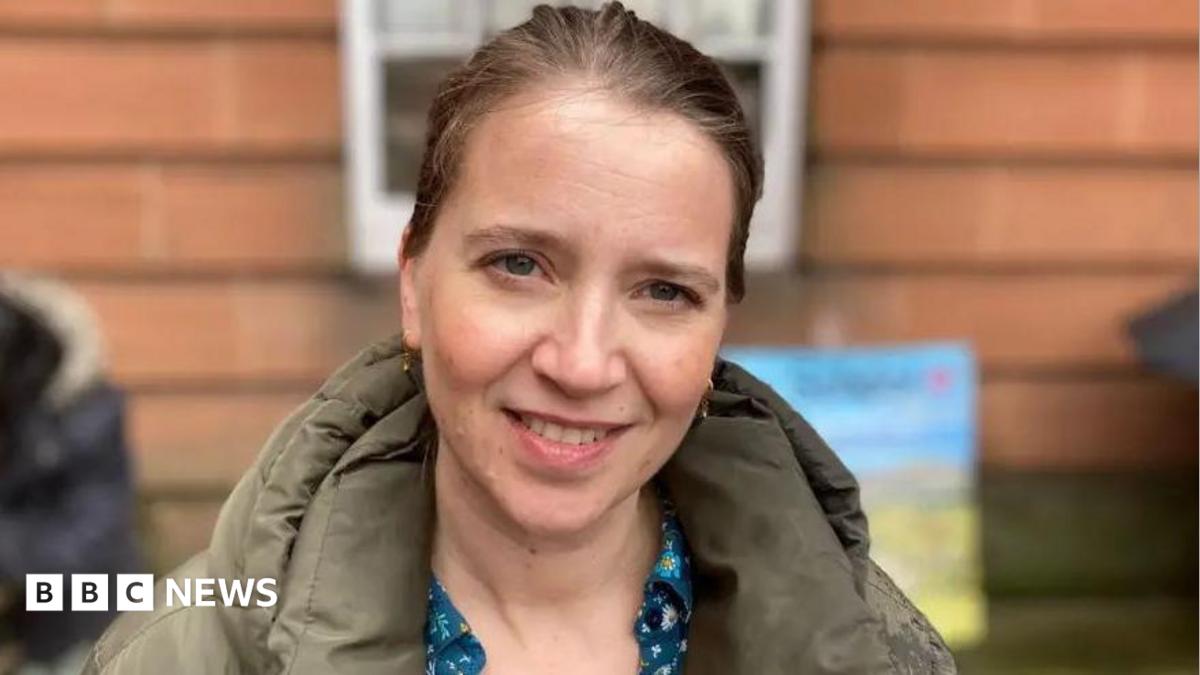
Parent Sarah Ade said the council should not shut the school for "short-sighted financial gain"
Anne McEwan, who chairs the parent council, said it was disappointed the recommendation for closure had been taken to councillors without any alternative proposals.
"The future of rural education in Scotland needs to be considered in a different way to non-rural education," she said.
"The current situation in Dalry gave DGC an opportunity to lead the way on what rural education can look like and be a real trailblazer.
"Instead we are left with closure as the only proposed way forward and none of the steps taken by the council previously which led to an early decline in pupil numbers are being considered or addressed."
The parent council had called on councillors to reject the closure move and find at least two "viable alternatives".
However, a report to the education committee said it had considered all "reasonable alternatives" and decided closure was the "most appropriate response".
It cited the fall in pupil numbers, limited opportunities for peer interaction and challenges in delivering a "broad and balanced curriculum" as issues facing the school - alongside high running costs.
The Schools (Consultation) (Scotland) Act 2010, external spells out what needs to be done in order to close a site.
In the case of rural school like Dalry the local authority has to identify its reasons for the move and decide whether or not closure is the most appropriate response.
Phase two sees the education authority consult on a proposal – for a minimum of six weeks, including at least 30 school days.
A paper is then taken to Education Scotland which must prepare a report on the educational impact within a maximum of three weeks.
The next phase - which has no specific timescale - sees the local authority publish a consulation report.
Then, a minimum of three weeks later, it should make its final decision and, if that is for closure, inform the Scottish government within six working days.
Ministers then have up to eight weeks to decide whether or not to "call in" the move for further scrutiny.
If they do, it heads to a School Closure Review Panel which has a maximum of 17 weeks to give its verdict.
In the event that it refuses consent no fresh attempt to close the school can be made within five years - unless there is a "significant change" in its circumstances.