
Dallas Cowboys player Marshawn Kneeland who died by suicide diagnosed with CTE brain disease
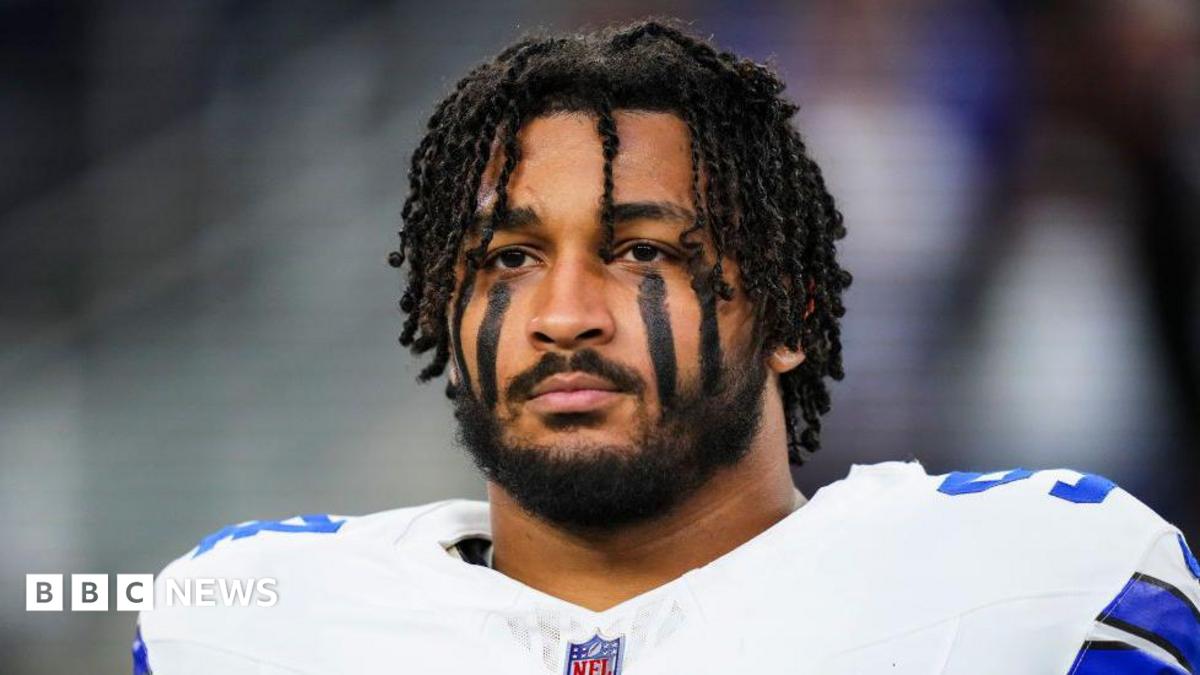
NFL player Marshawn Kneeland was suffering from stage 1 chronic traumatic encephalopathy (CTE) when he died by suicide last year, scientists have said.
Researchers at Boston University's CTE Center made the diagnosis through a postmortem brain tissue analysis of the Dallas Cowboys' defensive lineman, who died aged 24.
"Unfortunately, I was not surprised to find CTE in the brain of Mr Kneeland, because we have found this progressive brain disease in nearly half of the athletes we've studied who have died before the age of 30," said the centre's director, Dr Ann McKee.
Stage 1 is the mildest of CTE's four stages, in which headaches and loss of attention or concentration are common symptoms.
Kneeland's family said in a statement that the diagnosis provided "important context" about some of the struggles he was facing.
"We share this information to help people understand what NFL and other high-contact sport athletes might be struggling with," they said.
"We continue to remember Marshawn with compassion for the person he was, rather than defining him by the final moments of his life."
Kneeland died in November 2025 after a car chase with Texas State Troopers who said they tried to pull him over for a traffic violation. Police at the time said he crashed his car and then fled on foot. He was later found dead from a self-inflicted gunshot wound in the early hours of the morning.
Kneeland had been drafted by the Cowboys in the second round in 2024 and played 18 times for the team, including four starts. He started playing tackle football when he was seven years old and was on Western Michigan University's team before joining the Cowboys as a defensive end.
Research has shown that athletes in American football, rugby and combat sports have a significantly higher risk of developing CTE than the general population.
CTE can only be diagnosed after death. The disease, which is caused by repeated blows to the head, has been found in the brains of hundreds of former NFL players.
The Boston University CTE Center said, external in 2023 that it had diagnosed CTE in 345 of the 376 former NFL players it had studied.
The NFL has agreed a $1bn (£700m) settlement after being sued by a group of more than 5,000 former players. More than 21,000 ex-players could be eligible for compensation.
In the first stage of the disease, some people also experience short-term memory problems, depression, aggressive tendencies, and executive function issues, according to the CTE Society, a non-profit group.
In later stages, those problems grow stronger and others, such as mood swings and suicidal thoughts, can emerge.
In its final stage, a person can experience severe cognition issues and memory loss, as well as dementia, according to the CTE Society.
Boston University's CTE Center said the cause of suicide was complex and a CTE diagnosis was not known to be a risk factor for suicide.
But CTE researchers said the case showed not enough had been done to lower the risk of the disease for athletes.
"Mr Kneeland played in the modern era of concussion protocols and better helmets, and yet he still developed CTE," said Dr Chris Nowinski, co-founder and CEO of the Concussion & CTE Foundation.
"We have no reason to believe the current generation is at a lower risk of CTE than previous generations."