
David Crowley's chances of beating Tom Tiffany: First post-primary poll
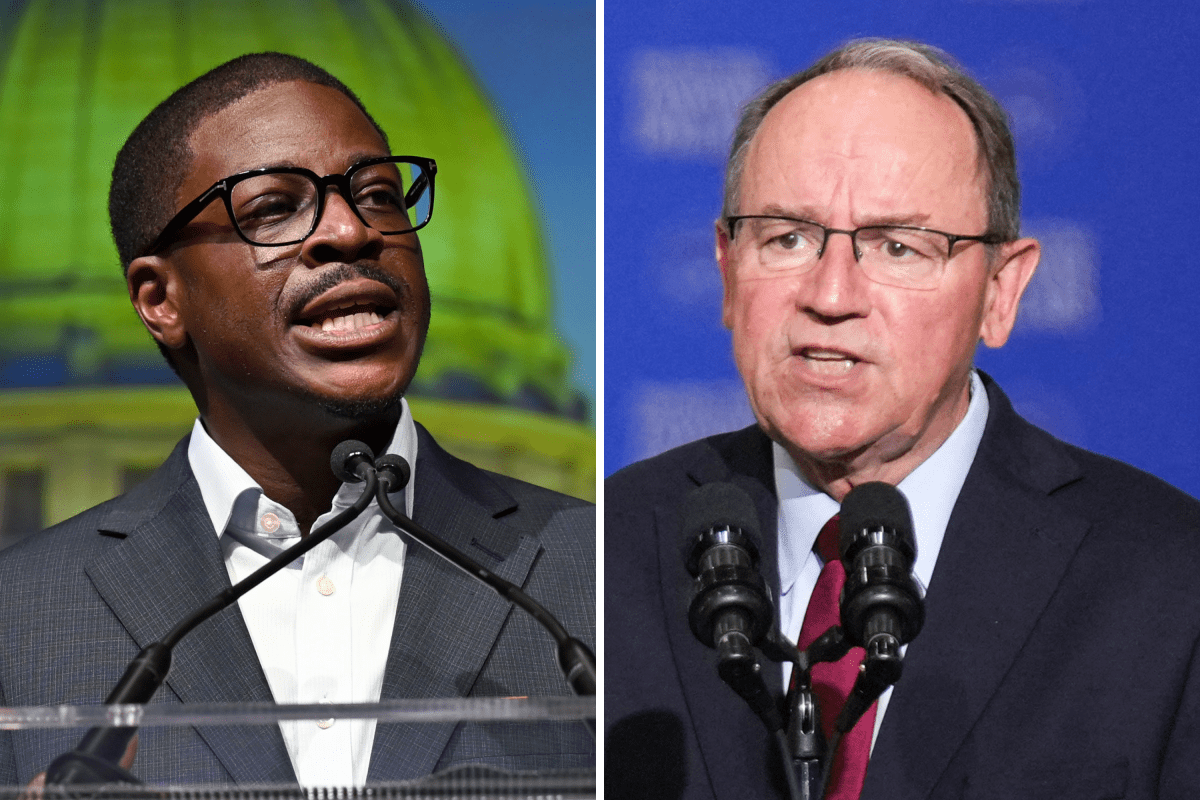
Democrat David Crowley held a narrow lead over Republican Tom Tiffany in the first poll of the Wisconsin governor race released since the two candidates won their primaries earlier in August.
Wisconsin’s gubernatorial contest is poised to be one of the most competitive of the 2026 midterm elections. Incumbent Governor Tony Evers, a Democrat, is retiring at the end of his term, leaving open a seat in one of the most closely divided swing states.
Tiffany, a congressman backed by President Donald Trump, easily won the GOP nomination—but Crowley, the Milwaukee County executive, narrowly eked out a victory over democratic socialist state Representative Francesca Hong in the Democratic primary.
The new poll from Platform Communications, first reported by Wisconsin Public Radio, showed Crowley up 4 points over Tiffany, 48 percent to 44 percent.
Wisconsin voters viewed Crowley more favorably, with a +17 net favorability rating: 43 percent viewed him positively and 26 percent negatively. Tiffany’s favorability sat at -5 points, with 38 percent viewing him favorably and 43 percent unfavorably.
The poll surveyed 500 likely voters from August 12-13, 2026.
The race is competitive, but Crowley has a slight advantage, Henrik Schatzinger, a professor of political science at Ripon College, told Newsweek on Tuesday. He said four points is a “lead” but “not a cushion.”
“Wisconsin is still closely divided, but Democrats have performed well in recent statewide races. Crowley starts the general election in a solid position,” Schatzinger said.
He said Democrats have handled the aftermath of the primary “quite well.”
“The Democratic primary was a roller coaster, but the general election began with something closer to a group hug. Now the question is whether Democrats can turn that hug into turnout. Hong has already helped Crowley build the bridge back to progressives. The question is whether her voters cross it in November,” he said.
Tiffany responded to the poll in a statement to Newsweek, writing that he is “focused on lowering taxes, cutting costs, and letting Wisconsin families keep more of their hard-earned money.”
“David Crowley nearly doubled Milwaukee County’s sales tax, raised property taxes, and oversaw spending that has left the county facing massive deficits. The more voters see his record, the clearer the choice becomes: he failed Milwaukee County, and we cannot let him fail Wisconsin,” he said.
Crowley, meanwhile, said in a statement that Wisconsin voters “agree that Congressman Tom Tiffany and his MAGA agenda are too extreme for the Badger State.”
“That’s why working families across Wisconsin are joining our movement to defeat Congressman Tiffany, who has spent nearly 20 years as a career politician trying to push our state backwards. We will continue meeting folks in every corner of the state and talk about how I will lower costs, fund our public schools, and build a brighter future for our kids and grandkids as the next governor of Wisconsin,” he wrote.
The new poll aligns with earlier surveys showing Crowley with a modest lead over Tiffany.
A GBAO poll, which surveyed 800 likely voters from July 30 to August 3 and had a margin of error of plus or minus 3.5 percentage points, showed Crowley up 3 points over Tiffany, 47 percent to 44 percent.
A separate poll from RMG Research and the Napolitan News Service showed Crowley up 3 points, 46 percent to 43 percent. It surveyed 800 registered voters from July 20-24, 2026 and had a margin of error of plus or minus 3.5 percentage points.
Crowley is favored in prediction markets, having a 75 percent chance of winning on Kalshi and a 78 percent chance on Polymarket as of Tuesday morning.
Prediction markets allow traders to buy and sell contracts tied to political outcomes and current events, aggregating real-money wagers into probability estimates. Prices fluctuate as traders react to polling, fundraising, candidate developments and broader political trends. They measure trader sentiment in the moment but do not always accurately predict the future.
A major issue in Wisconsin’s governor race is data centers, and Crowley is facing GOP attacks over his stance on the issue. Crowley told NBC News after his victory that he does not believe a moratorium on data centers would work in Wisconsin.
Schatzinger said data centers may be Crowley’s “clearest vulnerability.”
“Public opinion in Wisconsin has moved sharply against data centers, and Crowley's earlier comments about Wisconsin becoming a national or global hub give Republicans something very concrete to use against him. Crowley’s problem is that Republicans don’t have to explain his position on data centers. Tiffany can simply play the clip of him talking about Wisconsin becoming a national and global data-center hub, and he is already doing it,” he said.
Tiffany’s campaign released an attack ad against Crowley for his position on data centers, calling him “Data Center David Crowley,” highlighting his comments that Wisconsin could become a hub for AI and attacking him for supporting a tax incentive for data centers.
Crowley, meanwhile, has outlined his own plan on data centers. His campaign website says he would “let communities decide for themselves” whether they want to construct a data center. He also called for guardrails, including requiring 100 percent renewable energy, covering 100 percent of the costs of infrastructure and grid updates, and banning NDAs.
Tiffany previously voiced positive views on data centers in February, calling them an “exciting new technology,” but said ratepayers should not be harmed.
“It would be unfair to existing manufacturers, for them to pay much higher electricity rates just because a new industry came in. So we’re going to probably have to find a new template if AI and the data centers specifically come into Wisconsin,” he said, according to PBS Wisconsin.
In the primary, Hong drew national attention for calling for a moratorium on new data centers.
In the primary, Hong had carved out a substantial lead in the polls over Crowley, who exited from the race earlier in the summer but reentered amid concerns about Hong’s electability in the general election by some in the Democratic establishment. He narrowly won by less than half a percentage point.
His surge came after polling showing Hong trailing Tiffany in the general election resurfaced social media posts that drew negative attention to her campaign and raised anxiety among some Democrats.
In 2020, Hong said on Twitter: "Cancel Thanksgiving. Should have done this in 1621." She has since backtracked, saying recently: "I'm not going to cancel Thanksgiving," and "I will be celebrating Thanksgiving with my family this year."
Hong also struggled to win over endorsements from prominent progressives like New York Representative Alexandria Ocasio-Cortez and Vermont Senator Bernie Sanders.
Some prominent Democrats worried about Hong’s chances in a general election, worrying that past remarks like that and her identification as a democratic socialist could alienate moderate, independent voters in the state.
“The Dem race for governor in WI feels like a slow-rolling car headed for a cliff. If Dems there don't figure it out, they'll endanger a potential House pickup opportunity and risk installing as governor an election-denying, Freedom Caucus member just in time for the '28 election,” Democratic strategist David Axelrod wrote in a July 23 post on X.
Wisconsin is one of the nation's most competitive states. In 2024, Trump won 49.6 percent of the vote compared to former Vice President Kamala Harris’ 48.7 percent.
In 2020, former President Joe Biden won the state with 49.5 percent of the vote to Trump’s 48.8 percent, flipping the state after Trump won it in 2016. That year, Trump received 47.2 percent of the vote compared to former Secretary of State Hillary Clinton’s 46.5 percent.
The state's political geography has shifted significantly in recent years. Republicans have consolidated strength among rural, white working-class voters, many of whom previously supported Obama. Democrats counter this by maintaining high turnout in urban centers like Milwaukee and Madison, alongside growing margins in affluent suburban areas.
Wisconsin last elected a Republican governor in 2014, when former Governor Scott Walker won reelection. He lost reelection to Evers four years later in 2018.
The Cook Political Report views the race as a toss-up, while Sabato’s Crystal Ball gives Crowley an advantage, rating the race as Leans Democratic. Crowley and Tiffany will spend the coming months making their cases to voters to win in the deeply competitive state.
Contact Newsweek editors on this story: Jason Lemon and Sam Wilson.