
Disclosure Day's earnest hokum
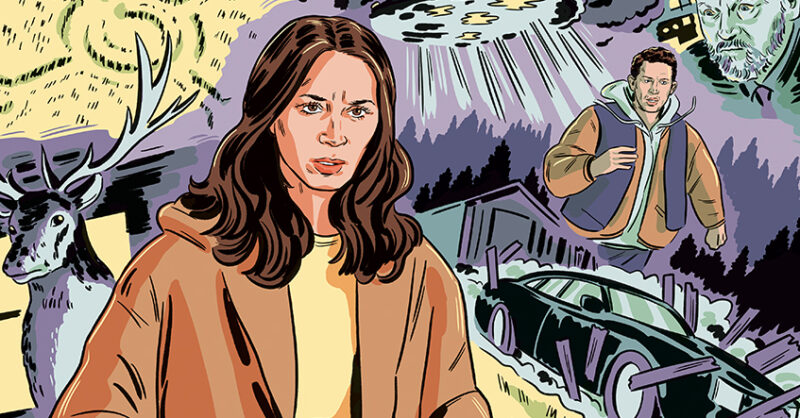
Steven Spielberg’s 37th feature as director is a corker, a proper summer blockbuster, a prime example of the genre he originally created with Jaws. Be warned of the trailers – the less you know in advance, the more you will enjoy it.
On we go, nevertheless. Disclosure Day is Spielberg’s fourth movie about aliens, or perhaps only his third, since he has said that The War of the Worlds of 2005 (the only one in which the aliens are hostile) was a metaphor for 9/11. Otherwise Spielberg has only been enchanted by aliens, as much as he is by children and toys: “I used to say to myself: wouldn’t it be wonderful if all of this turned out to be true?”
Promoting Disclosure Day, he has gone further: “I am much more inclined now than when I made Close Encounters of the Third Kind to really believe that we are not the only intelligent civilisation in the universe.”
In his latest, the truth about aliens has been ruthlessly suppressed for 79 years (ie dating back to Roswell), but not by the government. The secret organisation behind it, Wardex, is led by a twisted Englishman with a bouffant hairdo, Noah Scanlon (Colin Firth, the weakest casting). However, some of Wardex’s own more sympathetic employees have come together to get the truth out there, led by the wise and mystical Hugo (Colman Domingo).
Wardex’s security expert, Daniel (the likeable, self-depreciating Josh O’Connor), has just stolen not only data sticks containing all the evidence of alien life but also an actual TV-remote-sized alien device that confers remarkable powers. He was finally turned by a video of a suffering alien cruelly experimented upon under Scanlon’s direction (“No anaesthetic! Insert it now!”). It’s quite as bad as seeing a child tortured.
The film kicks off with a dynamic scene set at a mixed martial arts show. Sitting in the audience with his duffel bag, Daniel is attacked by the black-clad agents of Wardex, desperate to retrieve the data and device. But, this being the first scene, he escapes.
For nearly two hours, Disclosure Day then becomes a straightforward, wholly terrestrial Hitchcockian chase film (complete with MacGuffin). By my reckoning, there are no fewer than six attempts made by the Wardex operatives, zipping around in a fleet of big black cars, to take down Daniel and his sweet girlfriend – and former nun – Jane (Eve Hewson). Every time they get away, Scanlon tracks them down again, perversely using another of the captured alien devices to enter their minds, see what they see and control them.
Meanwhile, in a parallel narrative that steadily converges, we meet Margaret Fairchild, a glamorous weather girl for a Kansas City TV network, marvellously played by Emily Blunt, the film’s absolute star. When a bright-eyed cardinal (the bird, not the dignitary – the little grey aliens manifest as animals so as not to scare people) lands on her breakfast table one morning, she suddenly finds she has supernatural powers of empathy.
She can understand any language and read any mind, disarming adversaries by her instant understanding of their family sorrows, a perfectly Spielbergian superpower. To her confusion, she also finds herself telepathically in contact with Daniel, with whom she has much more in common than she knows. Coming together, fighting off Wardex, they race towards disclosure day, broadcasting to the phone-clutching world from Kansas City.
Disclosure Day is as brilliantly filmed as anything Spielberg has ever made: the camera moving us irresistibly through every scene; the lighting always emotive as only he knows how to make it; John Williams contributing a terrific 30th score alongside Spielberg, evoking sharks, dinos and wonder. The textural pleasure is so great, it’s easy to forgive the leisurely development and expository dialogue.
Spielberg is playing on the same yearning for there to be other life in the universe that made Dan Farah’s dim 2025 documentary The Age of Disclosure (2025), about the supposed suppression of the US government’s plentiful extraterrestrial evidence, such a hit. But Spielberg does it so much more dramatically, more artfully, more satisfyingly, from the ingenious inclusion of a nun giving a religious blessing to alien life to settling on the most familiar references and forms for the extraterrestrials.
Hokum has no more earnest exponent. Somehow, he makes wholly Hollywood films that are entirely his own. Scientists engaged in the search for extraterrestrial intelligence may have heard not a peep in 50 years; Elon Musk has pronounced consciousness “a tiny candle in a vast darkness”. Steven Spielberg, though, is still hoping for the best for us all.