
Does Scotland have the helicopters it needs to fight wildfires?
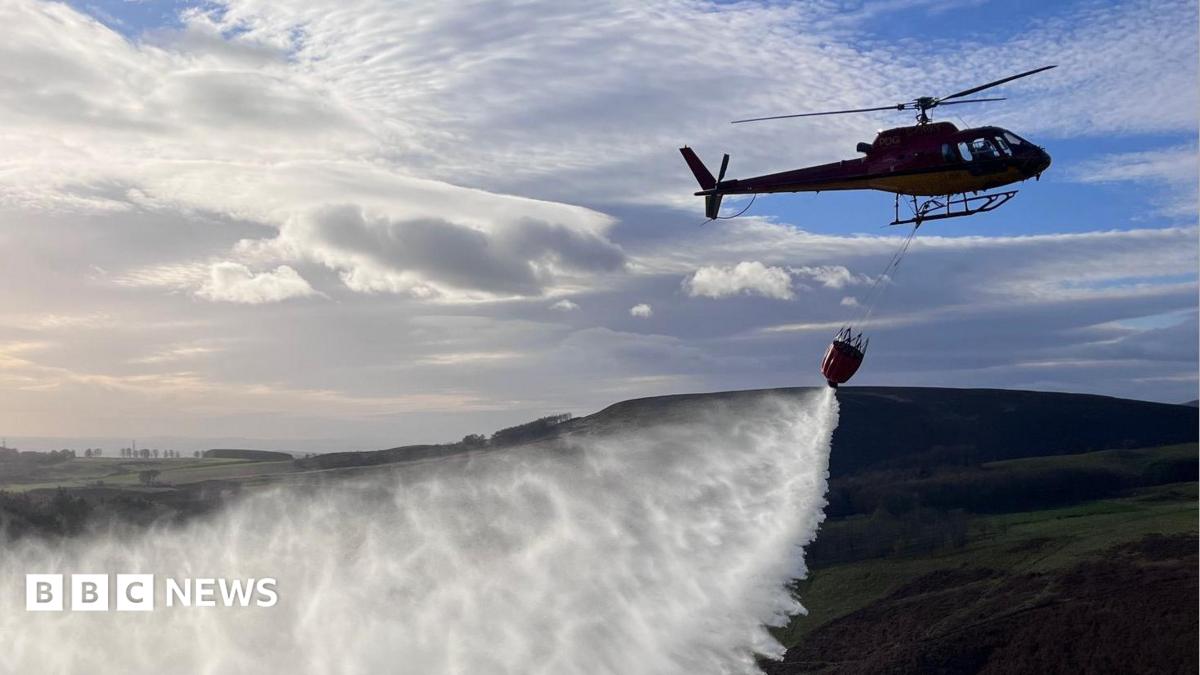
A devastating wildfire burning in the Cairngorms has entered its seventh day, as helicopters battle to stop the spread of the flames.
Two specialist helicopters have been "invaluable" for waterbombing hard-to-reach areas, the Cairngorms National Park Authority says.
But the flames were allowed to torch the landscape for nearly two days before they arrived on the scene around Glenmore Forest Park.
There's been vocal frustration from some local people, who believe the wildfire might have been brought under control if specialist air support had been called in sooner.
Why the delay? Do Scotland's firefighters have the aerial resources they need to tackle the growing threat of wildfires?
The official line from the Scottish Fire and Rescue Service (SFRS) is that the Cairngorms wildfire has been "appropriately resourced" from the start, with more than 100 firefighters involved.
They have also been helped by an army of gamekeepers, estate workers and volunteers from neighbouring estates.
The blaze started near Ryvoan Bothy, south of Nethy Bridge, last Wednesday and by the weekend the response was scaled up to include six fire engines, two all-terrain vehicles (ATVs) and a Wildfire Support Unit alongside the two helicopters.
But unlike the rest of these vehicles, the SFRS has no direct access to firefighting helicopters.
There are also only a small number of private companies with the helicopters and specialist equipment needed, as well as the pilots with the skills to fight the fires.
These aircraft can only be called in after approval by the fire service incident commander, and when the landowner has "contractual arrangements" in place to cover the costs.
On private land, this might require negotiations with insurance companies about whether a helicopter is necessary and whether the policy will cover the costs.
On public land, managed by Forestry and Land Scotland or NatureScot, costs of a helicopter callout would come out of the agency's funds.
The SFRS says that any request for helicopter support is a "multi-agency decision" which should be made at the "discretion of the incident commander" and their professional assessment of the fire.
Agencies involved might typically include Forestry and Land Scotland, Scottish government agency NatureScot, and private owners or land managers in the area under threat.
RSPB Scotland described the arrival of a helicopter as a "game changer" at its Loch Garten reserve in the Cairngorms last week.
SFRS deputy assistant chief officer Michael Humphreys said: "Helicopter support can of course be beneficial, and we will use them as and when they are available, however it is not always essential.
"Where a helicopter is not available, the tactical plan to fight the fire will always account for this.
"Aerial support complements the extensive work already being undertaken by firefighters and partner agencies on the ground and enhances our ability to limit the spread of fire where conditions allow."
Once a firefighting helicopter is available, the pilot will take instructions from the fire service's incident commander.
The pilots themselves bring with them experience and an airborne perspective which will carry significant weight in decision making.
A handful of commercial helicopter operators like Skyhook, based out of Fife Airport in Glenrothes, will provide this specialist response.
The firm has been leading the aerial efforts in the Cairngorms wildfire.
Skyhook says that during the summer months, pilots remain on "high alert for the danger of wildfires" and are ready to respond quickly.
It is an impressive and frankly dangerous task weaving through the hills - often with thick smoke rising - and largely, blindly, dipping large buckets in nearby lochs to scoop up a tonne of water at a time.
Just two years ago, firefighters from across the world, including wildfire hotspots like Australia, Portugal and Spain, gathered in Aberdeen for a conference to share the knowledge and techniques.
As part of that event, a helicopter was brought in to demonstrate close-up some of the methods used to dowse fires from the sky.
This was seen as particularly important and helpful to countries like Scotland, where the wildfire risk has been increasing with climate change.
Aerial firefighting pilots complete training far beyond standard helicopter flight. They're skilled in water collection, bucket deployment and precision flying.
Skyhook's helicopters can be fitted out with "Bambi Buckets". These carry up to 1,000 litres of water and allow repeated pick-ups and water drops.
But it says response times to wildfires will depend on any other job the helicopter is undertaking at the time.
"As a commercial operator, we often receive requests several hours after a wildfire has already taken hold," a spokesperson tells the BBC.
"In many cases, an earlier aerial response has the potential to support ground crews while a fire is smaller and more easily contained.
"However, as a commercial helicopter operator, we are not currently funded or contracted by any organisation to maintain a dedicated aerial firefighting capability or crews on permanent standby."
Skyhook, of course, does not want to see Scotland's landscape burn. But as a private operator, it must balance its wildfire response with its commitments to commercial clients.
RSPB Scotland says helicopter support was a 'game changer' for its team fighting the Cairngorms wildfire at Loch Garten
Some communities in the Cairngorms have long voiced frustration over the lack of a dedicated SFRS firefighting helicopter in Scotland.
Currently, pilots and helicopters could be tied up on other jobs when a wildfire call comes in.
Both of these things can add to delays we sometimes see in helicopters being deployed to tackle fires.
The issue came into focus following the Dava Moor "megafire" in June last year.
The fires burned across more than 11,000 hectares (27,000 acres) at Carrbridge and Dava.
The Scottish government recorded an "issue around the mobilisation" of firefighting helicopters during the blaze - as they were already employed in commercial filming work.
"The Scottish government said it had learnt the lessons after Dava Moor," says Sandy McCook, from Nethy Bridge community council.
"Well I'm sorry, but the lessons have not been learnt.
"It is untenable the position they are taking that they have enough equipment. It is helicopters that are needed."
Andrew Baxter, Lib Dem MSP for Skye, Lochaber and Badenoch says he has taken the matter Scotland's Justice Secretary Neil Gray.
Baxter says both the Scottish and UK governments should have "publicly available" firefighting aircraft during the wildfire season, rather than relying on private operators.
"At the moment it takes too long to get support to where it is needed," he says.
"We risk seeing serious loss of life unless we have a robust fire plan with aircraft that can be called upon at short notice."
Neil Gray told the BBC that fire chiefs say they have access to "all the resources needed" to contain the Cairngorms blaze.
But he said if there were "requests and innovations" over the growing threat of wildfires, he would discuss this with the SFRS.
He added: "I'm incredibly proud of the response from officers."