
Donna Rose: Wales rugby player on Borderline Personality Disorder
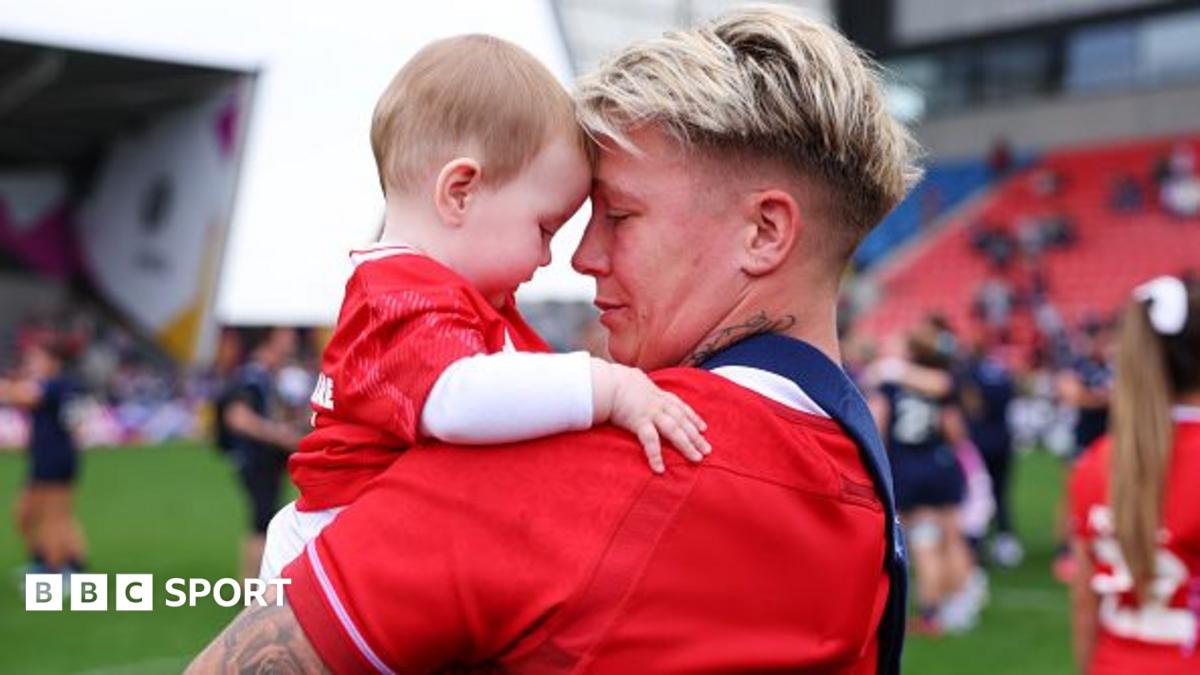
Tighthead prop Donna Rose has had an unforgettable 12 months on the rugby pitch. Last year, she proudly represented Wales at her second World Cup before helping Saracens lift the Premiership Women's Rugby title in June.
From the outside looking in, she is known as a hard-hitting player with a big personality.
But off the pitch, few see the daily struggles the 35-year-old copes with.
Rose has borderline personality disorder (BPD), a mental health condition that causes unstable moods, behaviours and relationships.
"When people hear the words 'borderline personality disorder', they tend to think I've got 10 personalities," she told BBC Sport.
Rose says her BPD often presents itself as severe self-doubt and that it is like having a "devil" telling her she is not good enough.
"It affects me every day of my life," she adds. "If I feel something, I feel it twice as much as someone else. Something that is so little to someone could be so big to me.
"You wake up and you'll be in your head. You don't want to get out there, you're being told you're worthless and what's the point of getting out of bed.
Rose was diagnosed with the condition when she was 21 years old.
Growing up in the traveller community, she knew she was different from those around her but could not work out why. She found concentrating at school a challenge and felt that she was just seen as "naughty".
As her mental health deteriorated, she got in trouble with the police before everything came to a head.
"I was going through a really draining time in my life where I was just sad, uncomfortable with me, my surroundings," she said.
"I got put into the mental health crisis team, where I was then diagnosed with borderline personality disorder.
"I didn't know what it was, I just thought it was a label until I really dived into it.
"I knew I had to change my life around, so I did some research on the internet and I started to get an insight into what borderline personality disorder was. I started to learn that triggers were something that sets my brain off to take myself back to a place where I didn't want to be."
If you have been affected by issues raised in this article, there is information and support available on BBC Action Line.
Rose helps control her symptoms by taking a daily pill, but she says rugby is her true "medicine".
"It gives me the buzz," she said. "There's a lot of adrenaline that's stored inside my head and it helps to bring it out."
The front-rower was a latecomer to the sport and only made her international debut in 2021, but is now one of the most senior members of the Wales squad, having been capped 42 times.
She has competed at two World Cups and four Six Nations, and has won the PWR title with Saracens twice, but she says her biggest success in rugby is that it helps her manage her symptoms.
"If I've done a rugby session and I'm exhausted, then it kind of does die down a bit because I'm exhausted and the devil on my shoulder is exhausted too," she explained.
Rose believes having the condition in fact makes her a better player.
"I was never very good at catching and passing, but I'm good at getting the ball and smashing through people.
"It took me a while to learn to control that anger, but now I really use that as my superpower, because it makes me disciplined."
The changing room, which will often have more than 30 people in it, is one of Rose's most challenging environments. And she had to carefully manage her mental health at last year's World Cup.
"I had a support network of my team-mates, the staff and the doctor," she explained.
"They are all obviously well aware of what I go through daily, so we'd have daily check-ins.
"If I was going to lose my mind, I would just go out for a coffee and talk about it."
Rose says fear of abandonment can be a trigger for those who live with BPD and she values support from Saracens team-mate Marlie Packer and Wales' Carys Phillips.
"There could be loads of noise [in a changing room], and I would just feel alone, like no one likes me and I could basically be in an empty room," she said.
"But on the flip side, sometimes that noise can get a little bit too much. That's when I just quickly get ready and take myself out.
"My teams are very good at letting me have my five minutes to myself, but they also know when I need an arm round me and they will give me that too."
Eighteen months ago, Rose welcomed a new member to her 'support network' when daughter Margot was born, something she says "changed her world".
"On those days where I'm having a really bad day, I come home and walk through the door and just see her smile at me, it just changes me completely," she said.
Rose admits she is now "an open book" when it comes to talking about the condition she "lives with" rather than "suffers from".
"The reason I talk about my disorder so openly is because I want to help people around me," she adds. "I know with a mental health disorder, you feel segregated, on your own and that you cannot be who you want to be.
"But I want to show everyone that even if you have a mental health disorder, that is not a full stop. You can push to thrive to be who you want to be."