
AI Cheating on the Rise in French High Schools
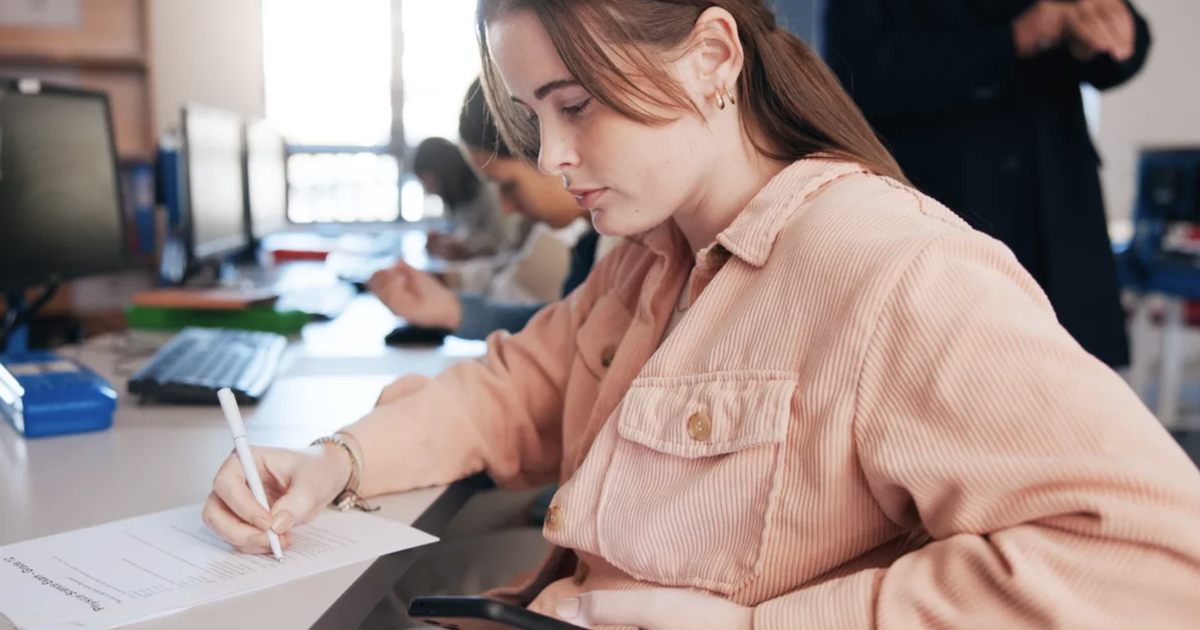
In high school, the era of cheat sheets already seems like a distant memory. During exams, cheaters no longer need to painstakingly copy their notes onto tiny scraps of paper. “It’s become so easy—just take a picture of the test and send it to AI,” quips Clarisse, 17.
The senior says that during supervised exams, many of her classmates discretely pull out their phones. In her class, some do not even bother using general-purpose models such as Claude or ChatGPT. “They use the AI built into Snapchat to answer questions for them,” says the student at Suger High School in Saint-Denis, north of Paris.
For Clarisse, who continues to study seriously and review her lessons, such behavior is more than frustrating. “It’s unfair to those who make the effort to work,” she insists. The phenomenon is all the more concerning because it is occurring on a massive scale across France. At a press conference on May 19, French Education Minister Édouard Geffray revealed that during the most recent baccalaureate session for final-year high schoolers, cheating increased by more than 30%, with a total of 1,208 suspected cases among 1.2 million candidates.
For teachers, assignments and exams have become a real game of cat-and-mouse. The most reliable way to identify a cheater is still to catch them in the act. “And that’s not easy,” says Jean-Rémi Girard, president of the teachers’ union SNALC. “First, because phones are very easy to hide, but also because some students use wireless earbuds, smartwatches, or smart glasses.”
Most of the teachers interviewed by Le Figaro say they have changed the way they supervise exams. “You have to stay extremely alert; you can no longer just sit at your desk,” notes Félix Tourmente, a philosophy teacher at a French high school abroad.
Already officially banned in middle schools, cell phones are set to be prohibited in all high schools beginning next school year. For now, many schools already require students to surrender them during tests, either by leaving them in their bags or using designated storage systems. At Notre-Dame des Oiseaux High School in Paris’s 16th arrondissement, the student affairs office provides compartmentalized boxes for storing phones during exams. “But all you need is two phones and keep one on you to get around the rule,” laments Estelle Challamel, a philosophy teacher at the school.
At her school, which is known for its high academic standards, Challamel has observed a “massive” increase in cheating since the arrival of AI. This year, several students were caught cheating red-handed. They were disciplined with formal academic warnings, but their identification also had more unexpected consequences. “Once we discover it, we start monitoring them more closely,” explains the philosophy teacher. “Generally, our vigilance prevents them from doing it again. As a result, their grades plummet across all subjects. It proves they were students relying entirely on cheating to get by.”
In most cases, cheating is not detected during the exam itself but during grading. Work that is far above a student’s usual level, formulaic writing, references far removed from the material studied in class—usually, the signs are unmistakable. But without proof, punishment is difficult.
“I can’t give a very low grade because it wouldn’t be justifiable,” says Challamel. “So I settle for a very average score. It’s also a way of showing that I’m not fooled and of not encouraging this behavior.” AI-detection software might seem like the ideal solution. But handwritten papers are more difficult for these applications to process. Moreover, their reliability has been widely questioned. According to a Stanford University study, these platforms have an average error rate of 30%.
Scientific subjects have not been spared either. AI can generate essays just as easily as it can solve equations. Lucas Markarian, a mathematics teacher, has developed his own method for exposing offenders. When he suspects a student while grading a paper, the teacher at Chevreul Blancarde High School in Marseille deliberately calls the student to the board during the collective review session. “I ask them to reproduce their proof. If they are completely incapable of doing so, then they are probably not the author,” the teacher says with a smile. According to Markarian, the “very unpleasant moment” experienced by the guilty student is enough to discourage many classmates from trying the same thing.
If cheating has become so widespread during exams, it is also because students are deeply concerned about their academic records. Starting in the junior year of high school, grades are taken into account on the national “Parcoursup” platform for admission to university. “For many students, the ends justify the means,” notes Challamel. “The search for meaning, culture, and knowledge does not interest them. All that matters is getting into the program of their choice.”
According to the teacher, cheating ultimately does students little good because their level is likely to collapse after high school. “Those aiming for selective institutions are going to be in for a rude awakening. They won’t have learned how to work. And entrance exams will be monitored closely enough to prevent cheating,” she warns.
To curb the phenomenon, one radical method is the use of cell-phone detectors. The Ministry of Education recently reminded schools that some of these devices will be installed at random in examination centers for the 2026 baccalaureate exam. Their use is not new, since academic districts have already been equipped with them since 2013. In practical terms, these small devices can detect signals emitted by a smartphone within a radius of about 20 meters. It is a way of ensuring that students have actually turned in their phones before exams begin. The solution is effective but costly: a detector often costs more than 100 euros.
For SNALC, the teachers’ union, the use of this technology is a step in the right direction. “If technology can help combat cheating, then it should be used,” says Jean-Rémi Girard of SNALC.
However, the parents’ federation PEEP is concerned about the spread of such devices. “We’re not going to start turning high schools into airports and constantly checking people—that is not a desirable model,” insists Laurent Zameczkowski, one of the organization’s officials. In his view, the problem should primarily be addressed by hiring more educational assistants. “As a reminder, there is only one of these assistants for every 120 students on average in schools, which is far from sufficient. Hiring more would strengthen supervision, of course, but would also help address many other issues such as bullying and safety.”
A strictly enforced ban on cell phones in high school appears to be one solution for preventing cheating. At Stanislas High School (in Paris’s 6th arrondissement), the use of such devices is strictly forbidden in the courtyard and hallways. “If a student is caught with a phone, it is confiscated immediately. Generally speaking, that is quite a deterrent,” explains François Jubert, the school’s dean and principal. At the school, where about 900 students attend from sophomore through senior year, no cases of AI use during supervised exams have been reported this year.
To avoid a disaster during the upcoming 2026 baccalaureate, the Education Minister Geffray called this year for the utmost vigilance. At a press conference on May 19, he announced that it would now be possible to cancel a single exam, a group of exams, or an entire examination session because of the actions of a single cheating student.
In addition, in a decree published in February, the minister instructed graders who discover “fraud after the examination” to file a report with the regional education authority. Previously, only students caught in the act could face consequences. According to the Ministry of Education, this update was adopted “primarily for suspicions of plagiarism or AI use.”
Teachers’ unions hope that the ministry’s show of firmness will have an effect. “It is important to send this signal. Let us hope it will deter potential cheaters,” says Sophie Vénétitay of the SNES-FSU union.