
Europe cancels planned upgrades for Ariane 6 rocket
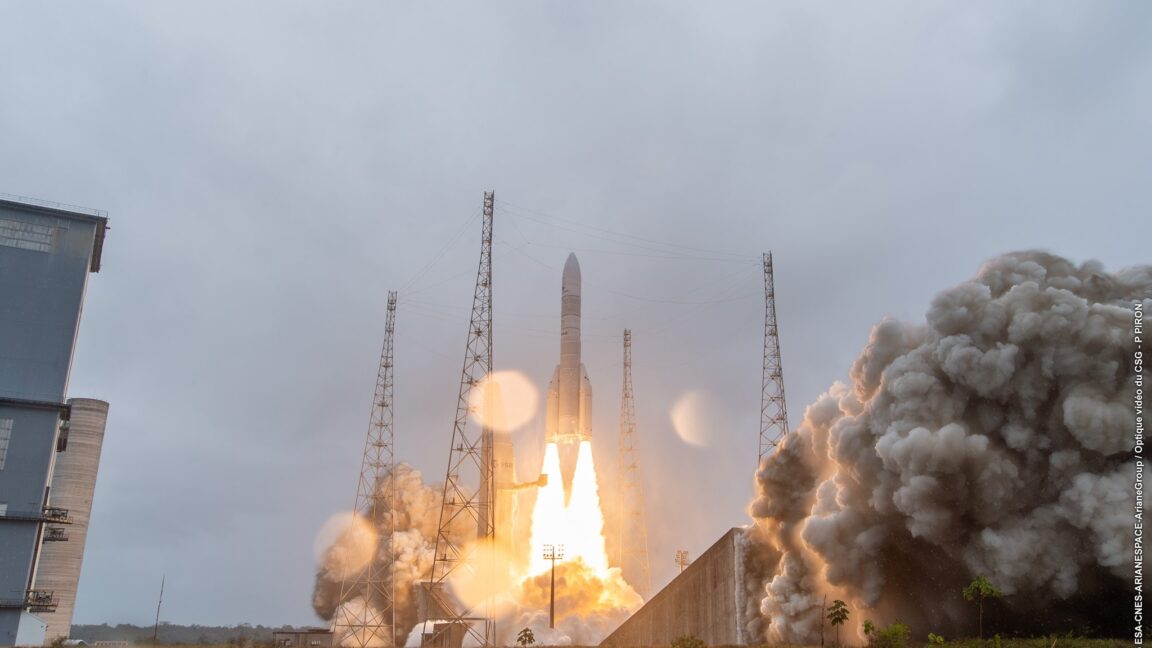
In the two years since it made a largely successful debut, Europe’s Ariane 6 rocket has launched eight missions, all of which reached orbit safely.
The large, expendable rocket has a capacity of more than 20 metric tons to low-Earth orbit. And to the credit of European rocket scientists and planners, the Ariane 6 has had a substantially smoother rollout than comparable vehicles in the United States—Blue Origin’s New Glenn and United Launch Alliance’s Vulcan rockets—both of which have had significant growing pains.
However, even though the Ariane 6 rocket has had a successful debut, its future is clouded by high costs.
On Thursday, European Spaceflight reported that “Block 3” upgrades for the Ariane 6 rocket have been shelved by the European Space Agency. A key element of the “Block 3” evolution of Ariane 6 was the lightweight ICARUS upper stage, which would have used carbon-composite structures.
The cancellation of this upgrade has implications for some of the European Space Agency’s science missions, including a probe to Saturn’s icy moon Enceladus.
Perhaps the bigger question is what the cancellation of future versions of the Ariane 6 rocket tells us about the program’s future. In some ways, the vehicle has been a tremendous success. It has provided the continent reliable access to orbit for its most important satellites when the war in Ukraine pushed Europe to end its use of Russian rockets and ended Europe’s need to launch on SpaceX rockets owned by Elon Musk.
However, the fact that the European ministers who provide funding for Ariane 6 balked at these upgrades may indicate growing impatience with the rocket’s cost.
Arianespace hasn’t publicly disclosed the cost of an Ariane 6 launch, but it is likely somewhere in the range of 80 million to 100 million euros. The rocket has a number of European customers but also a major US corporation, Amazon, which contracted for 18 launches to get its Amazon Leo constellation into space. Three Amazon flights have occurred so far, all this year.
That may sound like a commercial success, but Europe is likely losing money on each of those private missions.
Europe invested about 3.6 billion euros in the development of the Ariane 6 rocket and its launch site in French Guiana, but that’s not the end of it. The European Space Agency’s director general, Josef Aschbacher, has publicly confirmed that, based on nine flights a year, the European governments involved with the space agency will still need to subsidize each launch with between 32 million and 38 million euros per flight.
If we amortize the development costs with the ongoing subsidy, European taxpayers have put more than 100 million euros into each launch before the customer pays the rocket’s operator, Arianespace, anything.
Europe’s current goal is to fly the Ariane 6 rocket nine or 10 times a year, but given the growing global demand for launch and lack of capacity, there is some discussion about increasing the number of Ariane 6 rockets available.
In June, Aschbacher said Europe is on track to have the capability to launch Ariane 6 a total of 10 times next year, meeting the target set for Arianespace. However, he added that the agency is looking at various scenarios to increase that capacity to 12, 15, or even 20 launches a year.
Because the Ariane 6 rocket is expendable, Europe must increase production of all of the vehicle’s elements, from its solid-rocket motors to first-stage engines, in addition to upper stages and payload fairings.
Aschbacher said he hopes to have “clarity” from European ministers by the end of this year as to plans, if any, for scaling up production of the Ariane 6 rocket. The question for ministers may not be easy, however, because they will have to make investments in factories and other logistics to increase rocket production. And would it be worth doing that to meet growing commercial demand, if the only way to attract that demand is to heavily subsidize the price of its launch vehicle?
Ministers may decide that these funds would be better invested in the next generation of Ariane rocket that would incorporate at least partial reuse, and better compete with a growing number of reusable vehicles in the United States and China.
The decision by ministers later this year on whether to scale up capacity should reveal a lot about how they’re thinking about the long-term future of Ariane 6.