
Europe wildfires: 2 dead, 500 evacuated as twin blazes hit Greek island near Athens
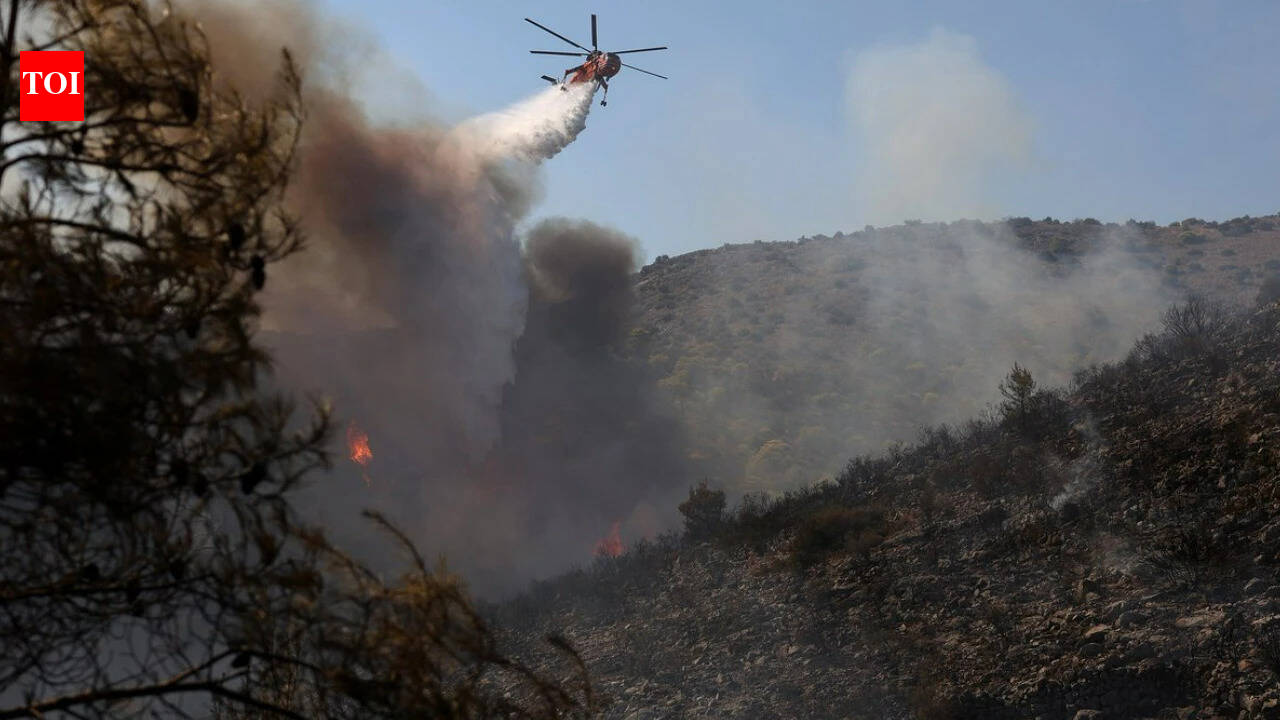
Two wildfires that broke out minutes apart on the Greek island of Salamina on Sunday killed two people and prompted the evacuation of about 500 people by sea, as crews raced to prevent the fires from joining.The emergency began at 2.40pm local time in Peristeria in the island's south, where strong winds pushed flames through a wooded residential area.
About 20 minutes later, another fire was reported in the eastern town of Selinia. Officials had not established the cause of either blaze.About 37,000 people live on Salamina, west of Athens, and many of them are elderly. Authorities had placed the island at high wildfire risk on Sunday as winds approached gale force.“These conditions enabled the fire to quickly reach dangerous proportions and spread rapidly within seven minutes toward nearby residential areas,” fire brigadier general Vasileios Vathrakogiannis said, news agency AP reported.Fire crews found two bodies in Peristeria.The local mayor told Greek media that the dead were believed to be a couple.
Greek health minister Adonis Georgiades said on X that at least 10 others had burns or showed “symptoms of smoke inhalation”. Five were taken for treatment locally.200 firefighters try to keep Salamina fires apartFirefighters were deployed across Salamina, backed by 50 fire engines, aircraft, water tankers and construction machinery.
Deputy mayor Thodoris Zannis said crews were trying to stop the fires from spreading over a mountain and joining to form a single blaze.About 500 people, including beachgoers, were evacuated by sea. Firefighting and coast guard vessels joined the operation, while five patrol boats and several private vessels were also sent to assist.One of the fires was under control and the evacuation operation had ended by Sunday evening, according to Greek media.
Crews were still dealing with scattered fires around Peristeria late on Sunday, while officials said the Selinia blaze had “no active front”.Two coast guard vessels and a fire department vessel were to stay in the area to provide assistance and keep watch.The fires on Salamina were part of a wider outbreak across Europe over the weekend, with crews also battling major blazes in Belgium, France, the UK, Germany and Croatia.Belgium fire burns 30 sq km in High FensBy Sunday, the fire in eastern Belgium's High Fens, or Hautes Fagnes, had burned about 30 sq km, making it one of the country's worst wildfires in recent history.
Crews were on their third day of operations in Belgium's largest nature reserve, where the affected area had more than doubled within 24 hours, BBC reported.The 30 sq km burned was already more than twice the nearly 14 sq km lost in a 2011 fire in the same area, which had previously been Belgium's largest wildfire on record, according to European Forest Fire Information System data.Shifting winds and spreading smoke prompted authorities on Saturday to order about 600 residents of Waimes and Butgenbach, in Liege province near the German border, to leave their homes.
Tourists were advised to leave as well, and a nearby gymnasium was opened to accommodate evacuees.More than 250 emergency personnel were involved in the response, Liege provincial governor Herve Jamar said. They included over 100 firefighters from Belgium and Germany, along with police, military personnel and civil protection staff.
Helicopters operated by Belgium's federal police and the Netherlands also supported the operation.Weeks of unusually hot and dry weather had left conditions difficult for crews, with the High Fens' heathland and peat bogs adding to the challenge. Nicolas Yernaux, a spokesperson for the Public Service of Wallonia, pointed to the dryness of the ground.
“We’re dealing with something much deeper because we have very dry soil,” he said.The fire was still advancing on Sunday in terrain that crews found difficult to reach, according to Rene Dahmen, chief engineer at the Department of Nature and Forest. “On the eastern flank, there’s a line at least a kilometer long where the fire is slowly advancing toward a municipal forest,” Dahmen said.
“That’s the first priority now.”Belgian interior minister Bernard Quintin said on X that firefighters had stopped the fire from spreading westwards and towards the German town of Monschau. German authorities said it was about 1.5km from the border on Sunday.Farmers on both sides of the Belgium-Germany border also assisted, using tanker trucks filled with water pumped from a nearby lake before heading towards the fire zone.Belgium had experienced another period of intense heat during the week, with temperatures in parts of the country reaching about 37°C on Friday.European countries send aircraft, helicoptersBelgium sought international assistance by activating the European Union's civil protection mechanism, EU commissioner for crisis management, with Hadja Lahbib saying “The High Fens are burning.
Belgium is not facing it alone,” on X.Sweden provided two water-bombing aircraft. Three helicopters were also being sent — two from the Netherlands and one from the Czech Republic.France evacuates 650 as fires spread across regionIn southwestern France, about 17 sq km had burned in a pine forest in the Landes region and roughly 650 people had been evacuated.
Landes prefect Gilles Clavreul said firefighters encountered no major flare-ups overnight.The Landes fire was the third major blaze in the pine forests of southwestern France this summer, after two others in late July.Elsewhere in the southwest, a fire in neighbouring Gironde department burned about 420 sq km and led authorities to evacuate around 220,000 people as the flames moved towards the Atlantic coast and the Bordeaux area.UK battles 14 wildfires as blazes hit Germany, CroatiaIn the UK, military personnel were supporting emergency crews fighting 14 wildfires in South Wales.
More than a dozen homes were gutted by fires in the West Midlands during the week, while temperatures reached 38.1°C on Thursday, the country's hottest day of the year.Firefighters made progress against another blaze in Germany's Hurtgen Forest, allowing about 2,000 residents evacuated from Gey to return on Saturday.
By Sunday, officials reported no open flames and said crews had created a cleared cordon around the affected area to stop the fire spreading.Croatia was also dealing with the aftermath of a wildfire along its coastline that began overnight on Friday. At least one person died and dozens were injured, while around 1,200 residents and tourists were evacuated.Croatia's fire chief Slavko Tucakovic called it “one of the worst” blazes in the country's history.The EU's Copernicus climate monitoring service has confirmed that western Europe recorded its hottest June-to-July period on record.Authorities in the UK warned that although the heatwave was easing, drought conditions meant the risk of wildfires remained high.Catch the latest World News and Live updates.
Download the TOI app.