
European Athletics Championships: Keely Hodgkinson - why is 800m world record so tough to break?
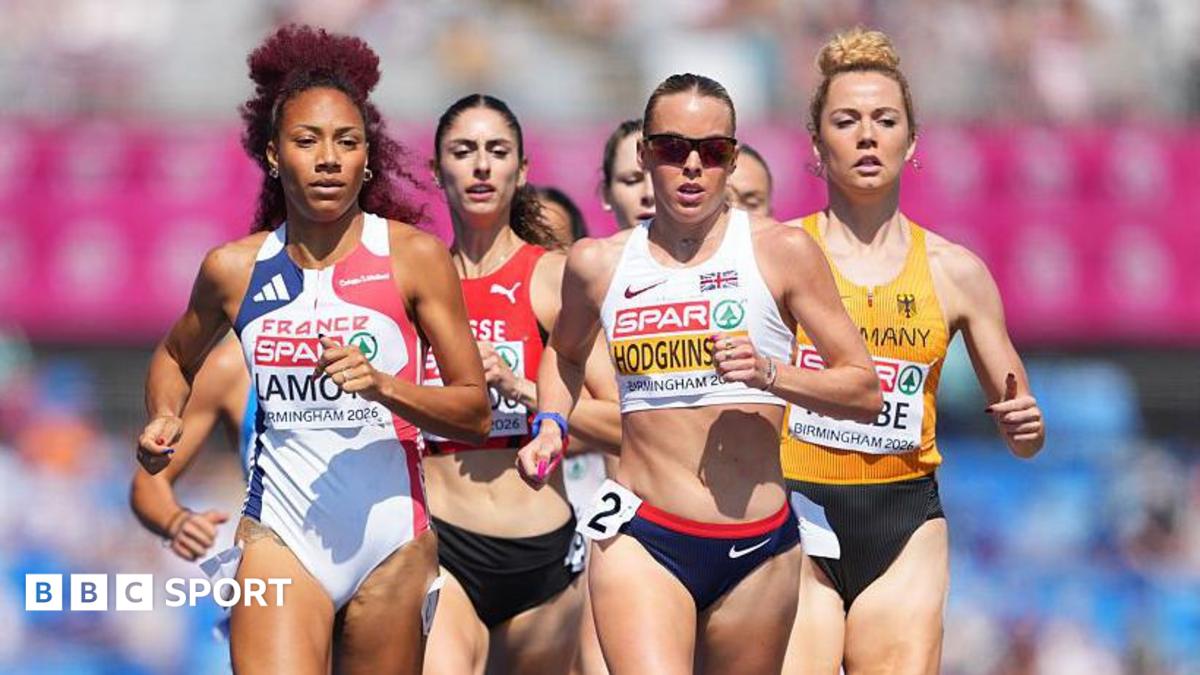
The world record for the women's 800m is the longest-standing in athletics. No-one has managed to break it for 43 years.
So why, despite leaps forward in shoe technology and our understanding of nutrition and recovery, has that record not fallen?
Great Britain's Keely Hodgkinson is one of the top three middle-distance runners in the world competing at the European Athletics Championships in Birmingham this week. So could that record, finally, be broken?
The women's 800m world record is held by Czech athlete Jarmila Kratochvilova, who ran a time of one minute 53.28 seconds in 1983.
There have been claims that Kratochvilova's performance in Munich was assisted by the systematic doping regime that existed in her country at the time - something she has strenuously denied.
Kratochvilova's record is not the only one to be questioned.
Marita Koch of East Germany set the women's 400m record two years later, in 1985 - when the country was known to be systematically doping its athletes.
But Koch never failed a drugs test, and always maintained she did nothing wrong.
In 2017, European Athletics proposed wiping out records set before 2005.
The proposals never went any further. But they sent a strong signal that some records set before 2005 - when World Athletics (formerly IAAF) started storing blood and urine samples - could be disputed.
Back in 1983, then 32-year-old Kratochvilova crossed the finish line more than seven seconds ahead of her closest rival, Poland's Jolanta Januchta.
No-one would come within a second of Kratochvilova's record for 25 years.
The closest any athlete has come to breaking it is Swiss athlete Audrey Werro, who ran a time of 1:53.80 in June this year.
"Believe you me, that time of 1:53.28 is astonishing," Jenny Meadows, former British runner and coach to Hodgkinson, told BBC Sport.
"I won medals on a global level and I could not even comprehend that a female could run that sort of time."
But athletes have never been closer to breaking it.
Werro has twice gone under 1:54 this year, but still more than half a second from Kratochvilova's record.
Olympic champion Hodgkinson broke the 800m indoor record in February, which had stood since 2002, crossing the line in 1:54.87.
Then there's the Netherlands' Femke Broeders-Bol, still largely an unknown in the 800m after deciding to switch disciplines from 400m hurdles. But, with little 800m experience, she ran a time of 1:55.60 seconds at the Paris Diamond League event in June.
"They're all dragging each other to these incredible times. The level of the 800m has risen significantly in the past two years," said Jessica Ennis-Hill, who won heptathlon gold at the London 2012 Olympics.
Innovations in sports science have edged athletes closer too.
"Everyone is going faster than they used to be because the shoe technology is so much better," University of Exeter professor Andrew Jones told BBC Sport.
Jones specialises in applied physiology, working with middle and long-distance runners to chase faster times.
"We know more about various supplements, things like creatine, nitrate, but in particular bicarbonate.
"And we know more about what limits performance".
This includes our understanding of carbohydrates, and how to best fuel for a middle-distance race like the 800m.
"It's a bit like a Formula One race car," he added. "You want the car to cross the line almost empty of fuel. If you've got half a tank left, you've been weighing yourself down."
Now, in Birmingham, the best three 800m runners in the world are looking like they will contest a gripping final, if they come through Thursday's semi-finals. Whether that final will turn into a more tactical race or develop into a battle of speed remains to be seen.
"All it takes is one person to raise the bar and you think more things are possible," Hodgkinson told BBC Sport.
"Everyone knows that to keep up you have to keep getting better. It's a really exciting time for the women's 800m."
This article is the latest from BBC Sport's Ask Me Anything team.