
Evacuations in Guam as super typhoon Bavi approaches
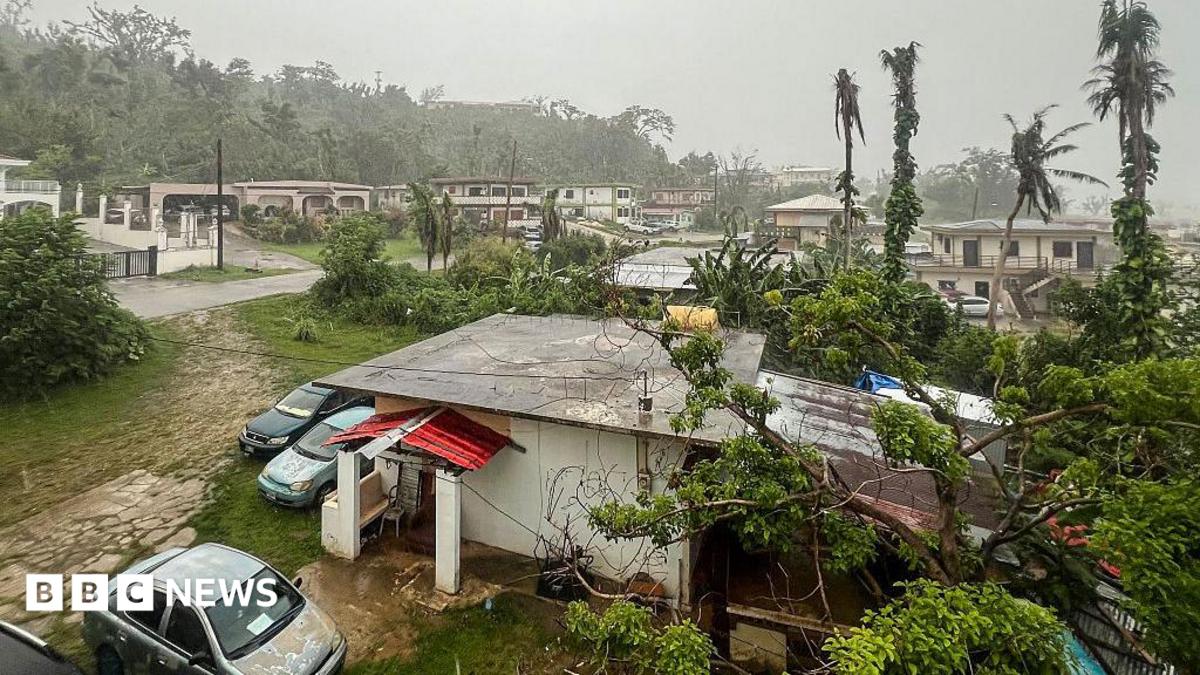
Emergency evacuations are taking place in Guam and the Northern Mariana Islands as a super typhoon bears down on the US Pacific territories.
Bavi is forecast to make landfall early on Monday morning, with winds of up to 257km/h (160mph), according to the US National Weather Service (NWS).
It warned the "very dangerous" storm could cause "catastrophic" damage, with "significant flooding from torrential rains" possible and waves potentially nearly 11m (35ft) high on Monday.
The western Pacific region is particularly prone to tropical cyclones. While storms of this strength are unusual for the US islands, scientists say climate change is making powerful typhoons more common.
Bavi is expected to pass directly over Guam and the Northern Mariana Islands by Monday afternoon, but the NWS warned that destructive conditions could be expected for eight to 10 hours prior to or after the arrival of the storm's centre.
"The window is rapidly closing to evacuate if directed to do so by local officials, or if your home is vulnerable to high winds or flooding," the agency said, adding that winds "will pose a deadly threat to those venturing outside".
Guam, usually a sun-soaked tourist destination with a population of about 170,000, has opened five evacuation centres in its schools. These sites have a maximum capacity of around 1,700 and are primarily intended for vulnerable people.
The island's civil defence office said at 13:00 local time (03:00 GMT) on Sunday that one of the evacuation sites had already reached maximum capacity and that people were being redirected to another site.
Bavi has been classified as a super typhoon by the Joint Typhoon Warning Center (JTWC), a part of the US Navy responsible for monitoring tropical storms in the western Pacific.
A super typhoon has winds in excess of 130 knots (150mph). JTWC predicts that Bavi will have winds of 150 knots (173mph) when it arrives over the islands, with gusts reaching as high as 180 knots (207mph).
The NWS considers super typhoons to have the equivalent destructive potential as a category four or five hurricane.
Pinky Cubacub, 55, told news agency AFP that she had been boarding up the windows of her eatery in Guam with $500 (£373) worth of plywood.
"I cannot afford to lose so many days. It hurts," she said. "Because I just started, whatever we're making right now is just for rent, utilities, and my people, and supplies. I don't even pay myself yet."
Japanese tourist Miku Sakurai, 25, told AFP that her return flight to Tokyo on Sunday had been cancelled.
"We will stay in the hotel when the storm comes. I am scared," she said.
Bavi will be the 11th category four or five tropical cyclone to hit US territory in the past decade - one more than the total recorded in the prior 57 years.
A strong El Niño event - a periodic warming of an area of surface water in the Pacific that contributes to weather patterns - is expected to push more tropical storms into these higher intensities.
Guam and the Northern Mariana Islands have already experienced one super typhoon this year - Sinlaku in April, which killed 17 people and caused about $1.5bn (£1.1bn) in damage.
Warmer sea surface temperatures drive more moisture into the atmosphere, supercharging storms.