
Finlay Tarling: Cycling union CPA calls for better helmets for racers
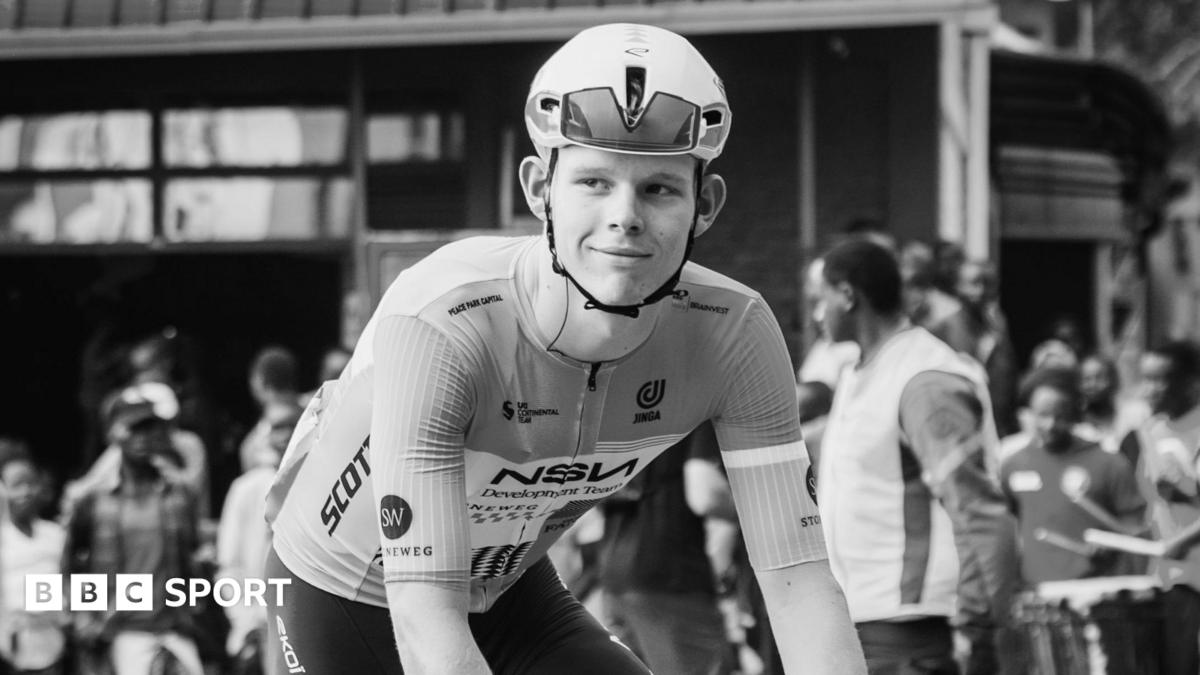
The cyclists' union has expressed "fury" over the death of British rider Fin Tarling during Friday's stage of the Volta a Portugal.
The 19-year-old NSN Cycling rider reportedly collided with a vehicle not involved in the race.
And the union's president Adam Hansen told BBC Sport there needs to be better helmet safety as cyclists hit record-breaking speeds during races.
"We are speechless and filled with anger," said the Cyclistes Professionnels Associes (CPA) on social media.
"It is not right that a young athlete's life should end this way, and we are furious that even today it is still not possible to prevent such serious accidents.
"We share in the grief of his family, friends, team, and everyone who knew Finlay. Rest in peace, young rider; we pray for you, and we will carry you in our hearts."
Tarling was the younger brother of Josh, a time trial specialist for British super team Netcompany Ineos, who has won a stage of the Giro d'Italia and a European Time Trial title.
Fin Tarling himself had finished strongly in the time trial a few days earlier in the race he would never finish.
He was part of a new generation of male and female British riders on the World Tour who grew up on the success of highly decorated road cyclists, such as Mark Cavendish, Chris Froome and Lizzie Deignan, during a golden decade for British participation in the sport from 2012.
Just like all young professionals, Fin spent hours every day trying to extract as much performance as possible. But he was known to love every element of cycling and was always in the saddle.
His parents, Michael and Dawn, frequently attended races and even set up their own team in their home in Ceredigion, west Wales.
BBC Sport understands organisers are considering a tribute to Tarling at the men's Tour of Britain, which starts on 2 September.
As tributes to Tarling flowed in on Saturday the investigation into a "collision between the cyclist and a light goods vehicle" had begun, according to the National Republican Guard in Portugal.
Cycling might not seem as dangerous as motorsport or boxing, but on descents out on public roads lycra-clad competitors can reach up to 60mph protected by nothing other than a helmet.
Although reporting on incidents has grown, the feeling in the sport is that there are more fatalities now as speeds increase.
In a sport where the peloton used to pick its moments to exert energy, today's racing is "full gas from the word go" as riders try to find pace advantages in all areas of stages.
At the Tour de France last month the record average speed was broken on stage 11 as riders reached 50.91km/h (31.6mph)., external
Six riders have died during road races in the past three years.
These include high-profile fatalities such as Switzerland's Muriel Furrer, who was not spotted leaving the road during the 2024 Road World Championships' junior road race, leaving a head injury untreated for more than an hour.
Furrer's compatriot Gino Mader was killed a year earlier during the Tour de Suisse following a high-speed crash on a descent.
Tarling's death is the first in a road race in 2026 and the full circumstances are yet to be disclosed.
"One thing we have to look at is helmets," Hansen told BBC Sport.
"They need a major upgrade. Bike helmets only need to meet standard testing like all helmets, EU standard CE EN 1078 is only rated for 19.5km/h and I do not believe this is enough for road racing."
BBC Sport has contacted the sport's world governing body the UCI for comment on helmet standards.
There are hazards everywhere along a road course in cycling and it is impossible to control exactly what lies around any corner across a stage which could be in excess of 100 miles.
In the biggest races in the sport, such as three-week Grand Tour the Tour de France, some stages take place on fully closed roads, but many World Tour events use a 'rolling roadblock'.
This is where police and organisers use motorbikes and cars to ensure the road is clear at certain junctions and temporarily enforce a closure in theory until all competitors have passed through.
It is a costly procedure which often involves more than 30 vehicles.
It is understood Friday's stage was using a rolling roadblock and that Tarling was adrift of the peloton, which is common for a rider who does not need to keep pace with the main bunch after a certain distance, or who may need to fall back for a team service car.
"The organisation is [generally] very good, but what happened [on Friday] is a bit of a hole in the system," added Hansen.
"When the breakaway or the main group goes past, sometimes the drivers [from the general public] think that's the whole race. But in fact there are riders behind and on some mountain stages the difference can be 45 minutes.
"If people do not know racing, then they just naturally think the race has past and go onto the course, where in fact there can be many groups."
There have been many examples where riders have had collisions or close calls with cars entering a live stage route regardless of the type of closure.
German Max Schachmann was hit by a car during Il Lombardia in 2020, and the 2023 Tour Feminin des Pyrenees was cancelled before the final stage after riders refused to compete following several close calls with vehicles on the route., external
Hansen added: "To close every single road and driveway is difficult and it gets to the point how little risk the organisers want to take and if it's even possible for them to have people at all those points."