
From DF-11 to DF-27: What China has in its regional ballistic missile arsenal - The Times of India
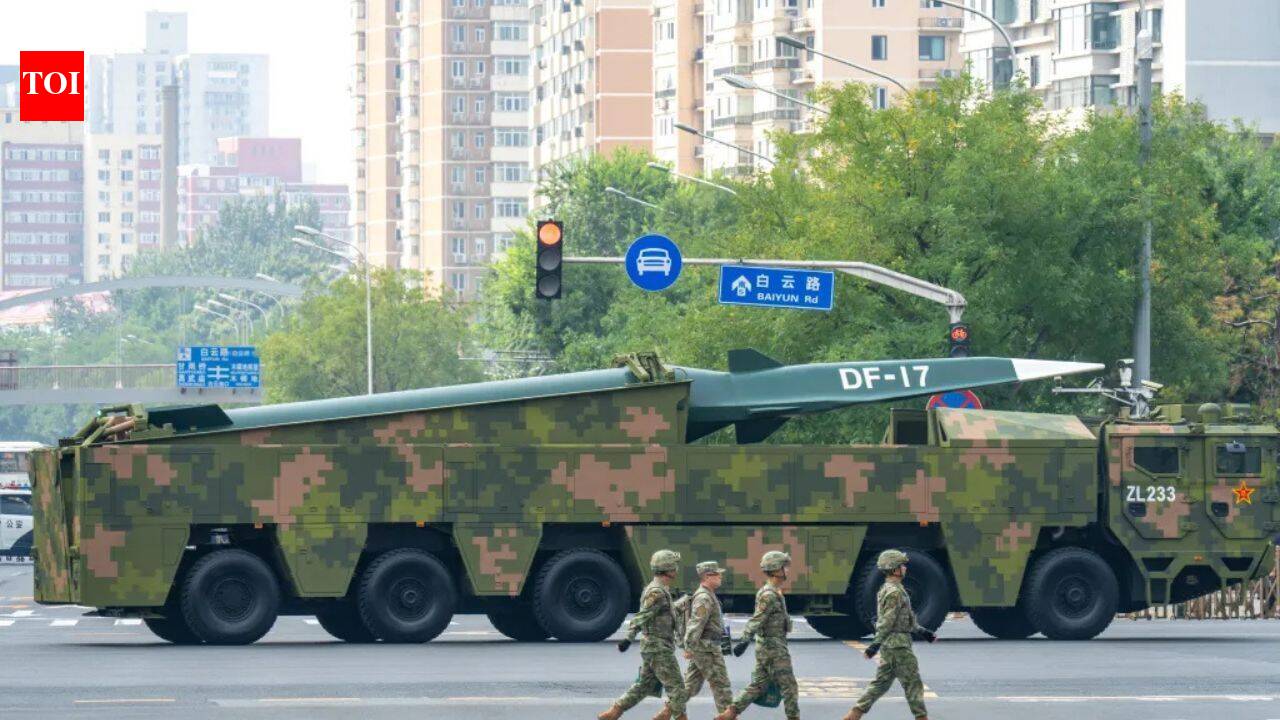
China's rapidly expanding ballistic missile arsenal has become one of the defining features of the People's Liberation Army's (PLA) military modernisation, significantly enhancing Beijing's ability to project power across the Indo-Pacific.Over the past two decades, China has developed a layered inventory of short, medium and intermediate-range ballistic missiles capable of striking military bases, naval assets, command centres and critical infrastructure with increasing precision.
Many of these systems are designed to support a potential Taiwan contingency while also holding US and allied forces at risk across the region.The Pentagon's latest assessments underscore the scale of China's missile expansion. As of last year, the US Department of Defense estimated that China fielded around 600 missiles in the "boosted hypersonic" category, a classification that includes ballistic missiles equipped with hypersonic glide vehicles (HGVs) as well as air-launched ballistic missiles (ALBMs).The Pentagon classifies China's regional ballistic missiles into three broad categories based on their range and intended targets.
Short-range ballistic missiles (SRBMs) have a range of up to 1,000 kilometres and are primarily intended for battlefield and nearby regional targets. Medium-range ballistic missiles (MRBMs) can strike targets between 1,000 and 3,000 kilometres, allowing China to engage military bases and strategic assets across much of the Indo-Pacific.
Intermediate-range ballistic missiles (IRBMs) have a reach of 3,000 to 5,500 kilometres, enabling them to threaten distant regional targets, including key US military facilities such as Guam.According to recent Pentagon estimates, the People's Liberation Army Rocket Force (PLARF) operates around 200 SRBM launchers supported by approximately 1,000 missiles, roughly 300 MRBM launchers backed by about 1,300 missiles, and another 300 IRBM launchers equipped with around 550 DF-26-class missiles.From short-range missiles designed for battlefield strikes to long-range systems capable of targeting military bases and naval assets thousands of kilometres away, here's a closer look at the key missiles that form China's regional strike arsenal.DF-11The DF-11 (CSS-7) is one of China's earliest road-mobile short-range ballistic missiles (SRBM) and remains an important component of the PLA Rocket Force.
With an estimated range of 300 to 600 kilometres, it is primarily intended for precision strikes against airfields, command centres, logistics hubs and military infrastructure, particularly in a Taiwan contingency.DF-15The DF-15 (CSS-6) is a more advanced short-range ballistic missile with a range of 600 to 900 kilometres.
Over the years, China has upgraded the missile with improved guidance systems, significantly increasing its accuracy. It is designed to destroy runways, air defence sites, command centres and hardened military targets, making it a key weapon for suppressing enemy defences during the opening phase of a conflict.DF-16The DF-16 represents the next generation of China's short-range ballistic missiles, with an estimated range of 800 to 1,000 kilometres.
Compared to earlier systems such as the DF-15, it carries a larger payload and offers greater accuracy and survivability.DF-17The DF-17 is among China's most advanced missile systems and the world's first operational ballistic missile equipped with a hypersonic glide vehicle (HGV). With an estimated range of 1,800 to 2,500 kilometres, the missile releases a manoeuvrable glide vehicle that travels at hypersonic speeds, making interception significantly more challenging than conventional ballistic missiles.DF-21The DF-21 is a medium-range ballistic missile (MRBM) with an estimated range of around 1,700 kilometres and exists in several variants for different missions.
The most well-known is the DF-21D, often described as the world's first operational anti-ship ballistic missile, earning it the nickname "carrier killer." Using a manoeuvrable re-entry vehicle and supported by satellites, drones and over-the-horizon radars, the missile is designed to threaten aircraft carriers and other high-value naval targets operating in the Western Pacific.DF-26The DF-26 is an intermediate-range ballistic missile (IRBM) capable of striking targets more than 3,000 kilometres away.
It is a dual-capable system that can carry either conventional or nuclear warheads and also has an anti-ship variant. The missile places key US military facilities on Guam, as well as regional bases and carrier strike groups, within its range. Its versatility makes it one of the PLA Rocket Force's most strategically important weapons.DF-27The DF-27 is China's newest long-range ballistic missile to emerge in recent years, although Beijing has not officially disclosed its specifications.
Western defence assessments estimate its range at 5,000 to 8,000 kilometres, placing it between an intermediate-range and intercontinental ballistic missile.JL-1 (Air-Launched Ballistic Missile)The JL-1 is an air-launched ballistic missile (ALBM) carried by the H-6N strategic bomber, adding an airborne dimension to China's long-range strike capabilities.
Estimated to have a range of 1,500 to 2,000 kilometres, the missile is widely assessed to be intended primarily for nuclear delivery, strengthening China's air-based nuclear deterrent. Its deployment gives the PLA greater operational flexibility compared with fixed or ground-launched ballistic missile systems.