
From the Marquis de Sade to Cardi B: the history of dangerous art
The adjective depraved, according to the Oxford English Dictionary, occurs about 0.03 times every million words in modern written English. The graph tracking its usage shows a sharp decline from its heyday in the late 1700s. If Daisy Dixon’s first book, Depraved: The Story of Dangerous Art, gets the attention it deserves, however, the word’s fortunes might be about to change. An assistant professor of philosophy at Cardiff University, Dixon makes an outstanding case for reviving the term in this compelling work.
Her book, as the subtitle has it, is the story of dangerous art. This is not a comprehensive history – it’s ultimately more philosophy than history – but Dixon’s range is impressive and enjoyably global. The text jumps from Palaeolithic Europe to contemporary Japan; from India to Norway. Dixon grapples throughout with the question of which artworks deserve to be considered depraved (in other words, degrading and morally corrupt), even if they haven’t always been described that way, and those that have been wrongly identified as immoral. There’s no distinction made between high art and popular culture. Everything is on the table here: “from cave paintings to video games and from classical sculpture to extreme metal music”. Dixon is as adept at discussing Rupi Kaur and Cardi B as she is Joseph Beuys and Marina Abramović.
This is the latest in a flurry of publications in recent years on art and ethics, including Erich Hatala Matthes’s Drawing the Line (2022) and Claire Dederer’s Monsters (2023). Some of the topics that were raised in these texts have since become very familiar: is the “cancellation” of an artist ever justified? Is it right to pull down statues of slaveholders without due process? Can you enjoy Gauguin’s paintings, even when they depict the victims of his sexual predation? Dixon suggests that the issues have never been more important, but you might feel that the cultural moment has passed. Our hands are full with the depravity of politicians. And the words that Maggie Nelson wrote eloquently on art and cruelty 15 years ago have become only more pertinent today: “The enormity of certain geopolitical crises has made a viewer’s complicity in the presumed evils of spectatorship seem like small potatoes.”
Dixon’s book, though, has large ambitions. Consider her treatment of the now well-worn question of what to do with the legacy of morally unsavoury public art. When the Robert E Lee Confederate monument in Richmond, Virginia, was scheduled to be removed in 2020, Dixon notes, the announcement generated an upsurge of artistic and community activity in response. George Floyd’s face was projected over the sculpture; a gospel band played; there were posters and cloth squares; there was graffiti, there was ballet. The statue was left mostly physically intact, but its meaning was shattered. Lee was turned from a proud general into a ridiculed figure. His effigy, says Dixon, had become the site of “one of the most influential American protest artworks since the Second World War”.
If iconoclasm as traditionally conceived involves literal destruction, then the “artistic counter speech” at the Lee monument offers an alternative. What it shows is that oppressive works of art can be broken not by materially dismantling them, but through creatively remaking their significance. A more mundane example would be when a traffic cone is placed over the sculpted head of a racist from the past. These “simple aesthetic acts”, Dixon remarks, “douse the art in bathos”. In fact, Dixon draws a radical lesson. She contends that the Lee statue was changed as a symbol: “We still have the same lump of bronze, but the original work of art as we knew it has ceased to exist.”
What might you call such a process? Dixon comes up with “metaphysical iconoclasm” as a label, which captures the idea that you can destroy a work of art’s soul while leaving it physically unscathed. It’s a clever term, but an academic mouthful, and unlikely to catch on at street level. I suggest instead, in a tribute to the author, a new verb: to dixon a work of art is to undo its bigoted message using artistic means. Still, it is sobering to remember that it is not only the left that can transform the meaning of a symbol. Think of what the Nazis did to the swastika. And, while I admire the author’s gusto, there are reasonable worries about aesthetic civil disobedience: perhaps it encourages the kind of tit-for-tat culture wars that, just as in real wars, escalate and leave us all worse off.
Art, in Dixon’s view, is never neutral. Every artistic creation is value-laden, and those values alter the world. After all, that art can be dangerous is a sign of its influence. It makes sense, then, that she embraces the idea of ethical and political responsibility both for artists and their audiences.
A fair amount of the book consists of Dixon, with considerable moral confidence, assessing the depravity (or lack thereof) of one artist or artwork after another. She does this in an appealing spirit, but there’s an obvious hazard of coming across as too moralistic, or of overstating the stakes involved in choosing what to listen to on the train. Dixon responds by highlighting how some of her own artistic tastes reside in ethically questionable territory. (She wrote part of the book, she says, while listening to Michael Jackson.) She also stresses how even morally dubious art can offer unexpected benefits: the “abhorrent” work of the Marquis de Sade – someone with a good claim to being the most depraved artist ever – has inspired a variety of politically progressive thinkers.
Sade produced violent pornography but, as Dixon points out, sometimes what is alleged to be depraved is simply the candid depiction of the human body. Clearly, the presence of Christianity has heavily shaped the history of Western attitudes towards such a topic, while its prohibitions on nudity and sexuality have been, in many respects, cast aside. Yet Dixon shows how a sense of sin can linger, often combined with sexism and misogyny. This is particularly the case when it comes to the subject of female genitalia. Dixon notably criticises the Musée d’Orsay website for its commentary on Gustave Courbet’s L’Origine du monde (1866) and its insinuation that a painting of a vulva can be considered pornographic unless it is redeemed, as in Courbet’s case, by fine technique.
No doubt the notion of depravity also has conservative connotations, because of its long-standing connection to obscenity law, which used to be highly restrictive. But since the middle of the 20th century, as Dixon observes, many societies “have undergone a collective revolution in standards and attitudes” and “words and images that would once have been considered indecent, offensive or immoral are now commonplace, especially in the West”. The result has been a welcome artistic freedom, but the gain is not cost-free: many worry about a process that, over time, turns what was underground vice into mainstream content. The worsening user experience of the web has only added to concerns about cultural degradation. Dixon is no political conservative, but she has updated an old moral idea at the right time as we all reckon with what feels like an increasingly depraved world.
The book is enriched throughout with well-chosen elements of autobiography. For instance, when discussing how the experience of art can be affected by ethical revelations about the artist, Dixon mentions how her parents own two prints by Rolf Harris, who was convicted in 2014 for sexually assaulting girls and young women. The art was part of her home growing up. One was a landscape and the other a portrait of two old men, so the subject matter didn’t relate to Harris’s crimes. Still, once the news broke of Harris’s behaviour, her parents “decided to cover them over with 18th-century prints of the city of Bath, to at least save the frames”. The anecdote captures how art can be tainted by a creator’s moral wrongs even when the content is entirely innocent.
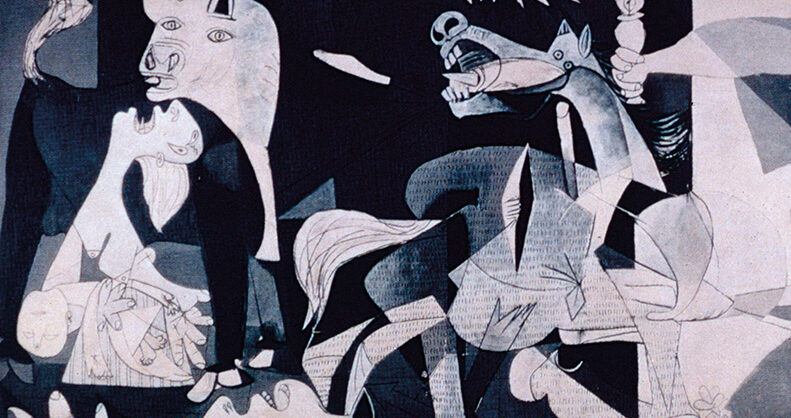
One of the risks of looking at creative activity solely in terms of ethics and politics is that you can end up with a reductive view of art as simply an ideology-delivery device. Depraved doesn’t entirely avoid this unhappy outcome, yet what comes across most strongly – and inspiringly – is the author’s belief in the power of art. Read, for instance, her convincing account of how Picasso’s Guernica manages to speak out against the devastation of war. Many people have lost faith in art’s ability to make any difference at all. Dixon, in this deeply impressive book, argues that art can help change the world. Let’s hope she’s right.