
Germany's aversion to air conditioning is melting in the heat
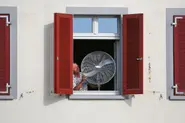
The aversion to air conditioning (AC) in Germany, and more broadly Europe, is an old story. While AC use has become commonplace in countries like the US, Australia, Japan and South Korea, Germany has largely relied on more traditional methods for coping with the heat, i.e. shuttering the windows all day and turning on a fan.
But as heatwaves become more common, and hotter, there are signs that the country's ideological resistance to AC is weakening. The latest heatwave, and even saw some medical facilities evacuated for lack of AC.
With each extreme heat event, increasingly the debate seems to be shifting from, 'Should Germany install more AC?' to 'How should Germany install AC?' and 'Can it do it so fast enough?'
While AC remains relatively rare across the country, evidence suggests that its becoming more common.
In the summer of 2024, a survey by price comparison website Verivox suggested 19 percent of German households were using AC, up from just 13 percent a year earlier. Another 19 percent of respondents said they would buy an AC unit, and more than half of respondents said increasingly hot days caused by climate change was the reason why they were considering it.
Recent figures from Germany's statistics office (Destatis) give a sense of how AC is being installed in more and more new buildings. But the figures also show how far there is to go.
In residential buildings, the share of new builds with AC has doubled in the last decade, according to Destatis -- from just 1.9 percent to 4.3 percent.
Far more office buildings are also built with AC. In 2025, 37.8 percent of new office and administrative buildings had cooling systems. That's up from 30.9 percent in 2015.
In schools and research institutions, just about one-third of new builds (33.9 percent) had cooling systems in 2025. Notably that proportion was about the same as it was 10 years prior.
Social facilities such as daycare centres and nursing homes followed with just 14.5 percent having AC, up from 5.7 percent in 2015.
The share of healthcare buildings with cooling systems rose from 24.8 to 34.4 percent in the same time. While that is a significant increase, the flip side of that stat is that even last year nearly two-thirds of new healthcare facilities were built without AC.
Note that the above stats also include cooling systems like ceiling cooling or underfloor heating with a cooling function.
The federal government has been notably quiet during the heatwave itself, and on the topic of heat preparedness and AC after the fact.
Under German law, having a heat preparedness plan and carrying out protective measures is a task for states and municipalities.
Federal Environment Minister Carsten Schneider had little more to say on the topic in an interview with Deutschlandfunk following the record-breaking heat at the weekend.
Schneider recalled that the government had provided the states with 100 billion euros from the for infrastructure for climate protection measures for the next few years: "I think that's adequate to finance the whole thing..."
The Environment Minister added that it's clear "that we are in climate change" and that "it is getting hotter..."
In terms of actionable measures or plans, he only cited Germany's goals to reduce emissions by least 65 percent by 2030 compared to 1990.
"And we will achieve that by 2030. If there is a deviation, we will make adjustments," he said.
But Germany's ability to achieve those goals is increasingly in doubt, especially as the federal government, led by Chancellor Friedrich Merz's conservative Christian Democrat (CDU) party has been criticised for proactively to walking back many of the country's previously enacted climate protection policies.
Recently Merz's government presented a proposal to change the so-called heating law, which intended to cut significant carbon emissions from the country's residential heating. Merz had also , and .
While Germany's governing coalition leaders remain silent, the Green party has begun to campaign for widespread AC use.
This week Green parliamentary group leader Katharina Dröge has called for Germany to prepare for more extreme heat events to come.
"Germany needs an immediate cooling programme to air condition hospitals, care facilities, daycare centers and schools," Dröge told Bild am Sonntag.
She, along with Green party leader party leader Felix Banaszak propose that Germany make a push to build and install solar-powered AC systems.