
Google and the UK think changing flights paths could cut down on climate change | Fortune
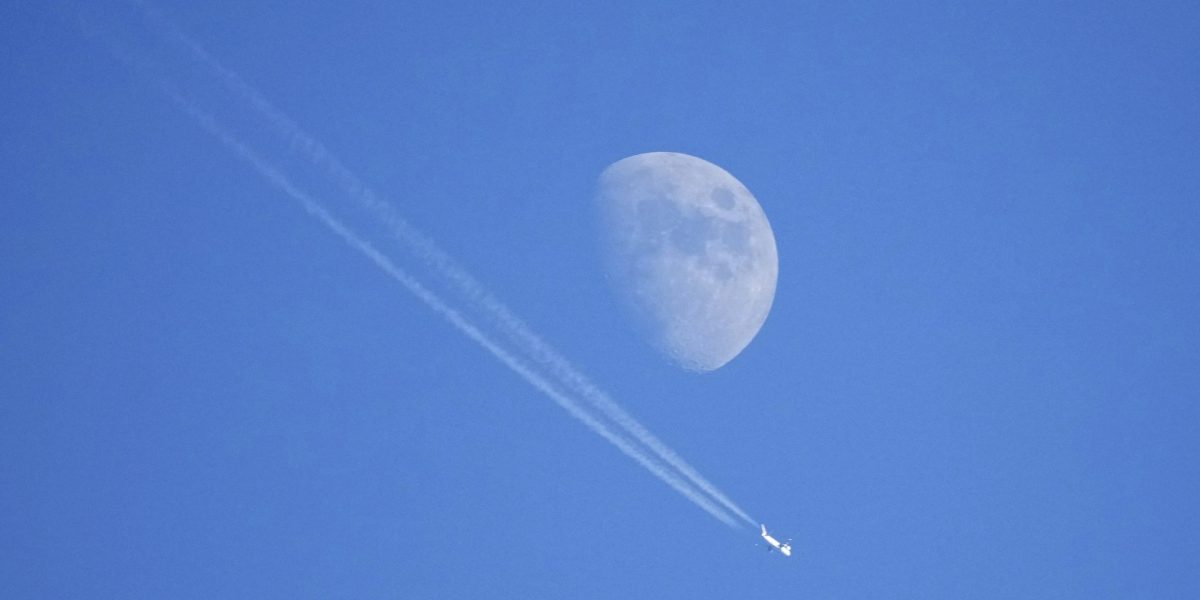
Hundreds of commercial flights will be told to change their paths over the northeastern Atlantic Ocean during the next two winters to show how minor altitude adjustments can reduce aviation’s climate impact.
The British government is backing the landmark airspace-scale trial, launched Tuesday, to avoid creating condensation trails, or contrails. Google UK is contributing its artificial intelligence-powered forecasts to identify the contrail regions.
When airplanes fly through cold and humid areas, ice crystals can form around the soot particles emitted from the engine, creating clouds that trap heat and warm the planet. The Shanwick Oceanic Control Area in the eastern half of the North Atlantic corridor, the location of the trial, is a busy gateway for air traffic between Europe and North America. It’s also a hot spot for where contrails form.
The 30-month research program known as Operation Blue Skies includes test periods this winter and next, when air traffic controllers will tell some flights to deviate up to 2,000 feet (610 meters) to avoid areas where contrails are likely to form. These will be minor altitude adjustments within standard flight operations, coordinated through established air traffic control communication channels, according to the British government.
There will be about 20 to 40 test days per winter, when there is less air traffic. Around 10,000 flights are expected to pass through the Shanwick airspace during the testing. Hundreds of those flights would deviate their routes. That 1 % to 5% would be enough to demonstrate a statistically significant reduction in contrail formation on an airspace-scale, said Paul Hodgson, Google’s technical lead for Operation Blue Skies.
Individual airlines have tested shifting altitudes to avoid contrail regions. Earlier this year, Google and American Airlines announced that the airline significantly reduced the climate impact of some flights using Google’s AI-based forecasting tool to help prevent contrails.
This new effort expands on individual airline trials to try mitigating contrails across an entire flight corridor.
The thin, white lines that form behind airplanes are responsible for a surprising amount of Earth’s warming — 1% to 2%, according to Contrails.org, a nonprofit research organization dedicated to reducing aviation’s climate impact through contrail management, as part of the Breakthrough Energy group founded by Bill Gates. Modeling shows that the Shanwick airspace accounts for about 5% of the total contributed by contrails, with a significant amount occurring during winter.
Keir Mather, the UK minister responsible for aviation, said the government is partnering with Google to back British experts and innovators to find practical ways to make flying cleaner. The government is paying for more than half of the 5 million pound ($6.76 million) study.
Google called contrails one of the most urgent yet solvable climate challenges facing aviation today.
Hodgson said testing over an airspace, versus individual airline trials, can show how it’s possible to move multiple planes away simultaneously from an area where contrails will form, and can show if contrails can be reduced overall for a region. This could provide a blueprint for similar airspaces, he added.
Along with Google and the UK Department for Transport, the consortium includes the Met Office, the UK’s leading air navigation service provider NATS, Contrails.org, Imperial College London and the University of Cambridge.
An Imperial College London study in 2020 found that small changes to flight paths could reduce the climate impact of contrails. Professor Marc Stettler said Operation Blue Skies is a chance to test that idea in the real world, on a scale never seen before.
The Associated Press’ climate and environmental coverage receives financial support from multiple private foundations. AP is solely responsible for all content. Find AP’s standards for working with philanthropies, a list of supporters and funded coverage areas at AP.org.