
Heads Up: NASA to Launch 'Daring' Telescope Rescue Mission This Week
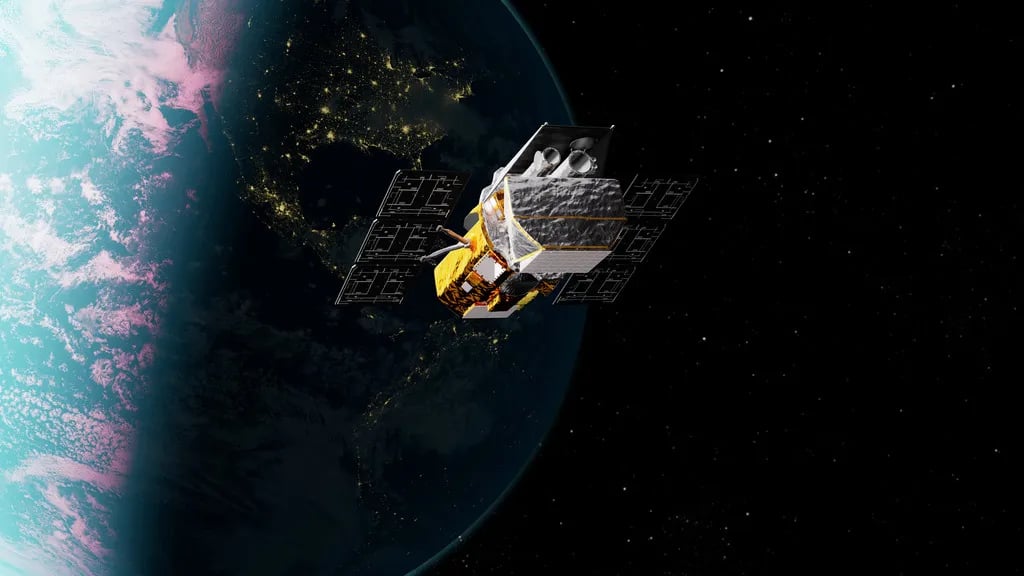
NASA will soon attempt something it's never done before: Save a space telescope from falling back to Earth using a servicing robot.
It sounds like something right out of a sci-fi film, but NASA is hoping it might be enough to keep its sinking Neil Gehrels Swift Observatory in action a little longer.
According to the US space agency, the mission could launch as soon as this Tuesday 30 June, 6:17 am EDT (10:17 UTC), and we'll be keeping you updated on the progress.
If this mission works, the much-beloved Hubble Space Telescope is one of the next targets to have its life extended.
"This is the first American space robot to go up and do anything like this," Ghonhee Lee, CEO of Katalyst Space, which has been hired to carry out the mission, told The Associated Press.
"This is a high-risk, high-reward mission," says Shawn Domagal-Goldman, NASA's Astrophysics division director.
"Swift plays a notable role in our fleet. We have much to gain by attempting this boost, which is more affordable than trying to replace Swift's capabilities and allows NASA to advance the nation's satellite servicing industry, for the benefit of all."
The Swift telescope launched in 2004 and is capable of capturing images in visible, ultraviolet, X-ray, and gamma-ray light.
Just check out this beautiful mosaic below, which is made up of 330 images captured by Swift.
It's the highest-resolution image of our neighboring Andromeda galaxy ever recorded in ultraviolet, showing a region 200,000 light-years wide and 100,000 light-years high.
But the observatory has been rapidly sinking in recent years.
All spacecraft in low-Earth orbit experience drag from our planet's atmosphere and, without propulsion systems, they gradually decline in altitude.
But Swift is falling faster than expected due to recent periods of intense solar activity (remember that solar maximum we just experienced?).
In order to survive, it needs to be boosted into a more stable orbit as soon as possible.
Which is why NASA contracted Katalyst Space to help them pull this off – a contract that cost a reported US$30 million.
According to NASA, as early as June 30, Katalyst's LINK robotic servicing spacecraft will be launched into space aboard a Pegasus XL rocket.
The robot will capture the space telescope and aim to raise it over the course of several months.
The contract was only awarded to Katalyst last September, so the company had "less than one year to design, build, test, and launch a spacecraft to meet, grab, and lift Swift," NASA explains.
While that was happening, the team at Goddard Space Flight Center has been making operational changes to the telescope to keep it at least 300 kilometers (185 miles) above Earth's surface, which will give it the best chance of success.
Of course, the telescope falling back to Earth wouldn't have been disastrous by any means. Satellites fall back to Earth often.
But NASA sees this as a test for the future potential of space exploration.
"This daring approach also extends Swift's scientific lifetime and is more affordable than replacing the observatory's unique capabilities," NASA explained.
Watch this space – we'll keep you updated on the mission's success.
This article was fact-checked by Rebecca Dyer and edited by Peter Dockrill. While we pride ourselves on our process, we are only human. If you spot a mistake, please let us know.