
Healey and Carns fire their parting shots in the Commons
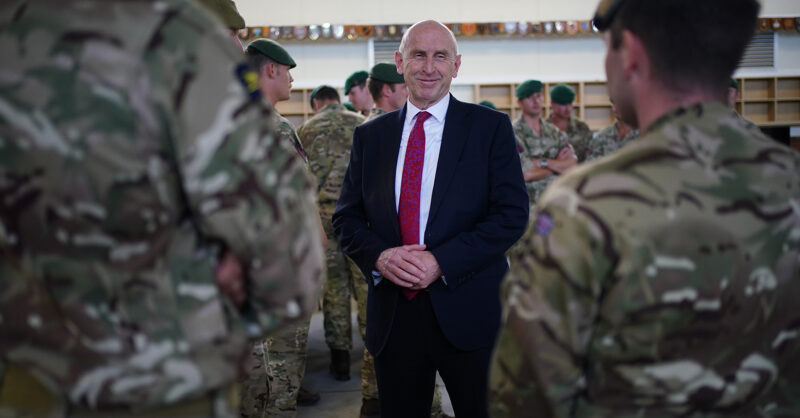
John Healey set out his vision for “bigger politics, bolder priorities, harder choices” on Tuesday as he delivered his resignation statement in the House of Commons. The former defence secretary left cabinet last week in a surprise move over irreconcilable differences with Keir Starmer and Rachel Reeves on defence spending. He said in the Commons that “our adversaries don’t follow timetables set by the Treasury” in a parting attack on the Chancellor.
Healey reiterated his position that the current Defence Investment Plan, with no pathway to spending his desired 3 per cent of GDP on the military, was “falling well short of what is required”. “The transformation and rearmament of our armed forces,” he said, was the big challenge that the Labour government had to address.
In his statement delivered on Tuesday afternoon, Healey said of the Labour party, “it is my family literally,” emphasising his credentials as a hardcore party loyalist and not somebody who would resign for the sake of personal advancement. He said explicitly that the move was not about his career. Nevertheless, Healey has been described as a dark horse candidate for the premiership who could strike a position that falls politically between the declared candidates Andy Burnham and Wes Streeting.
Al Carns, the defence minister and former royal marine who resigned alongside Healey, said, “We are spending too much time preparing for last year’s war,” before delivering a speech which was much broader in themes and will add to speculation that he is preparing a tilt at the leadership. “I resigned for several reasons,” he said, citing both the DIP as well as Northern Ireland legacy legislation that has led to the prosecution of veterans. He called this a “continued failure” on a “difficult issue”. He even suggested that legal wrangling against British veterans could allow the Irish Republican Army to achieve its ends “by other means”.
Expanding his own political beliefs Carns, who was brought up by a single mother in Aberdeen, used his speech to tell the Commons that “the Labour Party I joined is one that was chiselled out of the mines of the north” and laid claim to its long tradition of working-class politics. Like Healey, he has been talked up as a potential leadership contender.
He praised the decisions of the Attlee government elected in 1945, which spent on both public services and defence. “Somewhere along the road, we have stopped thinking like that,” he warned his parliamentary colleagues. “We inherited a mess, but the nation is fed up with us pointing the finger,” he added.
At the G7 summit in Evian, France, on Tuesday, the Prime Minister defended his position and said the Defence Investment Plan provides sufficient funding. He said he was talking to Healey’s successor as defence secretary, Dan Jarvis, about the next steps. “We’re talking to him about how and what we will spend that money on,” he said.