
'Historic new frontier': PM Modi hails 'talent of youth' ahead of Skyroot's maiden orbital attempt with Vikram-1 launch
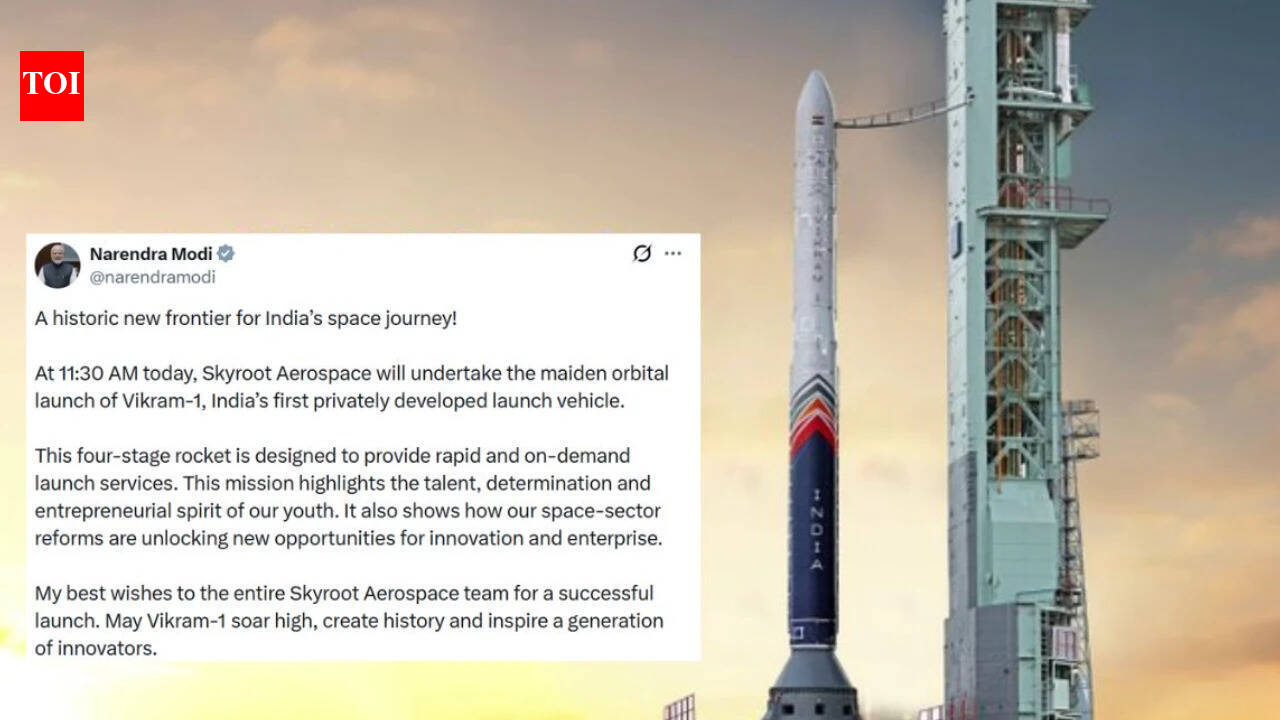
Prime Minister Narendra Modi on Saturday hailed the planned maiden launch of Vikram-1, India's first privately developed orbital launch vehicle, as “a historic new frontier” for the country's space programme as Hyderabad-based Skyroot Aerospace prepared for Mission Aagaman from the Satish Dhawan Space Centre in Sriharikota.The mission, scheduled for lift-off at 11.30am, marks the first time an Indian private company will attempt to place satellites into Low Earth Orbit (LEO) using an independently developed launch vehicle.In a post on X ahead of the launch, the PM said the mission reflected the growing capabilities of India's private space sector."A historic new frontier for India's space journey!
At 11:30 AM today, Skyroot Aerospace will undertake the maiden orbital launch of Vikram-1, India's first privately developed launch vehicle. This four-stage rocket is designed to provide rapid and on-demand launch services."Also read: 46 years after SLV-3, Skyroot’s Vikram-1 set to mark new chapter in private space journeyHighlighting the significance of the mission, Modi said it showcased the impact of India's space sector reforms.
Extending his wishes to the team, he added, "My best wishes to the entire Skyroot Aerospace team for a successful launch. May Vikram-1 soar high, create history and inspire a generation of innovators. I urge all Indians, especially my young friends, to follow this historic mission and join in wishing Team Skyroot success using #IndiaWithVikram1."Former Indian Space Research Organisation (ISRO) Chairman S Somanath also congratulated Skyroot Aerospace, describing the mission as a milestone for India's private space industry.In a post on X, he wrote, "My very best wishes to Team Skyroot Aerospace on the test launch of Mission Aagaman with Vikram-1 orbital rocket today." He added, "This is far more than the maiden orbital flight of a rocket, it marks the arrival of India’s private rocket building capability and reflects the remarkable..."Skyroot's orbital debutAccording to Skyroot Aerospace, Vikram-1 is a 24-metre, four-stage launch vehicle built with a lightweight carbon-composite structure.
It is powered by three solid-fuel stages and a liquid orbital adjustment module and is designed to carry payloads of up to 350 kg into a 450-km Low Earth Orbit.The maiden flight will deploy multiple technology demonstration payloads from Indian and international customers, including Grahaa Space, Cosmoserve, DCubed and Skyroot's SCOPE platform.
Among the payloads is Bengaluru-based Cosmos Diamonds' lab-grown "Diamond Lotus".Speaking to ANI, IN-SPACe Technical Director Rajesh Jothi said the mission reflected the rapid expansion of India's private space ecosystem after the Centre opened the sector in 2020."We are seeing the growth of the private sector.
We started with hardly five or six startup companies, and today we have more than 400 startups."Vikram-1 to carry PM Modi's handwritten ‘Vande Mataram’ postcard into spaceVikram-1 will carry a handwritten postcard by Prime Minister Modi bearing the message "Vande Mataram", alongside handwritten postcards from engineers, scientists and Indian astronauts.
The rocket will also transport a micro-art payload and technology demonstration payloads from organisations including Grahaa Space, Cosmoserve, DCubed and Skyroot's SCOPE platform.Skyroot Aerospace said engineering data gathered during the test flight will be used to validate the rocket's guidance and navigation systems and support refinements ahead of future commercial satellite launches.If successful, Mission Aagaman will establish Skyroot Aerospace as the first Indian private company to place payloads into orbit using its own launch vehicle.Get the latest India News and Live updates.
Download the TOI app.