
How a DIY Adobe Illustrator design landed Rebel Creamery in a $23.8 million fight with Van Leeuwen | Fortune
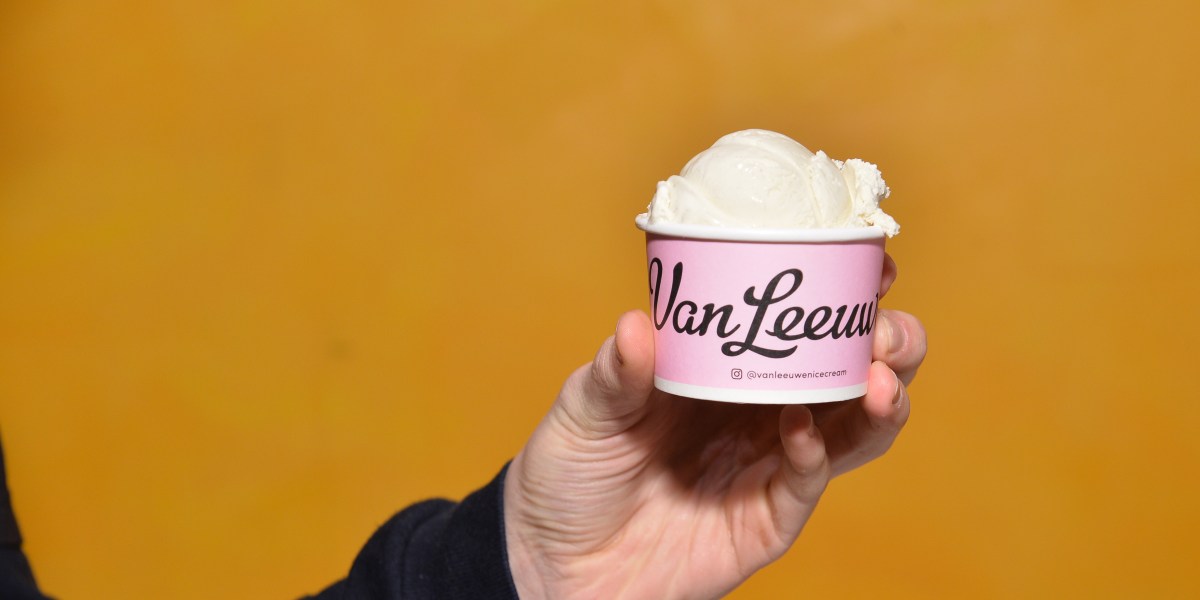
Rebel Creamery’s founders say they designed the company’s logo and ice cream pint packaging themselves in Adobe Illustrator. But that DIY branding design landed them in a nearly $24 million legal dispute.
The Utah-based, low-carb ice cream maker, whose products are sold at Target, Kroger, and Walmart nationwide, filed for bankruptcy on Aug. 14, days after appealing a federal judge’s order to pay rival Van Leeuwen Ice Cream millions over a trade-dress dispute.
According to a Chapter 11 filing in the U.S. Bankruptcy Court for the District of Utah, the maker of Rebel ice cream listed $13.78 million in assets and $23.85 million in liabilities. The bankruptcy follows a July 16 ruling over allegations Rebel deliberately copied Van Leeuwen’s design.
The dispute stems from Rebel’s packaging: solid-colored pint containers with a minimalist design and prominent black cursive lettering. Rebel’s founders told the court they designed the company’s logo and trade dress themselves in late 2017 using Adobe Illustrator, and claim not to have retained any drafts or initial records of the design.
In a July 16 memorandum and order, U.S. District Judge Eric Komitee found Rebel had intentionally infringed and diluted Van Leeuwen’s trade-dress, a legal term for the distinctive visual appearance of a product or its packaging.
“The evidence at that trial left no doubt that Rebel infringed and diluted Van Leeuwen’s trade dress and did so intentionally,” Komitee wrote.
Komitee issued Rebel to redesign its pints, writing the brand used “a near-identical color scheme and script on their packaging, with slight design differences to convey dietary information.”
“Van Leeuwen and Rebel are distributed at the same grocery stores often on the same shelf and are frequently intermingled,” Komitee wrote.
On Aug. 12, Rebel appealed Komitee’s ruling, and in the company’s bankruptcy filing two days later, Rebel listed the $24 million claim from Van Leeuwen “disputed” and “under appeal.”
“We are appealing the decision, and our products will continue to be widely available,” a spokesperson for Rebel told Fortune.
Van Leeuwen’s founders first noticed Rebel after an employee sent them a social media post of the company’s similar pint cup design in late 2018 or early 2019, according to the memorandum.
They were “shocked,” telling the court “it looked almost exactly like our packaging.”
Van Leeuwen eventually sued Rebel in 2021, alleging Rebel’s packaging copied the look of its ice cream pints, and sought $36.4 million from its competitor’s profits. Rebel appealed the ruling, and reduced the final award to just under $24 million, allowing Rebel to claim one-third of sales for customers specifically seeking keto-friendly ice cream.
Van Leeuwen’s trade dress was created by the design studio Pentagram, which kept record of every iteration of the ice cream pint and logo design, and became key evidence used in court.
Rebel formally stated they were unaware of Van Leeuwen’s existence when designing their trade dress in 2017, and were only made aware of the company a year later in a meeting with grocery store chain Wegmans.
The ruling cited evidence from customer mix-ups in stores, including a 2024 complaint from a shopper who said her husband returned from the grocery store with a pint of Rebel instead of Van Leeuwen.
“Your product was placed right next to Van Leeuwen and looked the same,” the customer wrote in a message to Rebel, according to the memorandum. “I nearly did the same thing when I shopped! Later, my friend shared the same experience on the other side of the country!”
Grocery store employees also reportedly confused the two brands when stocking the pints on shelves, and often accidentally assigned the wrong price stickers. At Walmart, Van Leeuwen had its own designated shelfspace, but some sections unintentionally housed many wrongly placed Rebel pints, according to the lawsuit.
Rebel was founded in late 2017 by married couple Austin and Courtney Archibald and initially raised money through a Kickstarter campaign, hitting their goal in only three hours and ultimately raising $80,000. The founders marketed their brand as a keto-friendly ice cream and claimed it had the lowest glycemic index on the market.
Van Leeuwen, meanwhile, was founded in New York City in 2008 by brothers Ben and Pete Van Leeuwen and Laura O’Neill, a friend of the Van Leeuwens, and Ben Van Leeuwen’s future wife. The trio opened their first bright yellow ice cream truck using $60,000 raised through crowdsourcing from 15 friends and family members. The brand focused on formulating ice cream with simple ingredients by limiting dyes and preservatives to offer dairy ice cream and vegan alternatives.
“We wanted every single guest who came into the store to feel like they were getting just as good of an experience as any other guests, regardless of their dietary restrictions,” Ben Van Leeuwen told Fortune in 2024.
Sarah Glodek is a Social and Audience Intern at Fortune and a student at New York University.