
How Britain can cool off
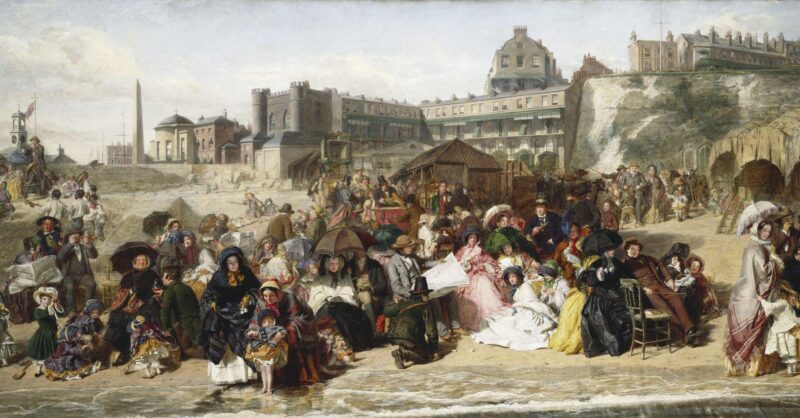
In the mid-1800s, the rooms at Brighton’s Grand Hotel had three taps: hot, cold, and seawater. At that time, the ocean was considered a tonic for all ailments: leprosy, rickets, bronchitis – even cancer and “female complaints”. Brits flocked coastwards not only to eat ice cream and enjoy the sun, but to take in “the water cure”. Seaside hospitals and sanitoriums, like the Royal Victoria Hospital in Bournemouth, offered and promoted sea bathing. Throughout the 19th century, lidos and tide pools were constructed around the country in an effort to bring safe swimming and salty vitality to all.
Had you shown those Victorian bathers this week’s weather forecast, with temperatures predicted to reach 39˚C, they would have expected us to head straight to the lido. But most of those once-bustling baths are now car parks, or worse. There are fewer places to swim than ever, leading to tragedy when people swim in unmonitored or unsafe spots out of desperation. Somehow, just as Britain started to heat up the world’s climate, it forgot about the best way it knew, physically and spiritually, to cool off.
One of the most impressive constructions was the Clifton Baths in Margate, Kent, built 1824. The huge structure included pools for male and female bathing, multiple hot baths, and later an indoor pool. Today, the town’s iconic orange-and-yellow “LIDO” sign still emblazons local merch, but the original stands over a wasteland of dirt and broken glass, and you are more likely to see people taking drugs than the water cure on the remains of its tilework. Margate was also the home of the Royal Sea Bathing Hospital, where patients with tuberculosis went to take in the cure. The building is now flats, marked forever with the words “SEA BATHING”.
Sea bathing, where it is still possible, retains a large population of fervent devotees. Just down the front from the abandoned lido is Walpole Bay tidal pool, the biggest of its kind in the UK. If you visit in any season and time it right with the tide, you’re likely to find several swimmers enjoying the water. One crisp December morning, I was followed by ten women wearing fluffy winter hats, as if they could stop their hands and feet from cramping.
Often these pools are maintained by members of the community. Around the country, there are groups working tirelessly to not only preserve this part of our history but to ensure that current and future generations can enjoy it too. One such group is Friends of Bude Sea Pool, who care for a pool in Cornwall. Their communications manager Jodie Harper learned to swim at a very young age and finds herself always returning to the sport, but doesn’t feel confident swimming in open water. Bude gives her the best of both worlds, “the experience of being in the sea without any worries about waves or currents”.
The sea pool is Harper’s her favourite place to be, and she believes that access to swimming is essential for all. “As an island nation with many rivers, canals and lakes, learning to swim and be comfortable in the water can save lives,” she says. “It’s a fantastic form of exercise that supports physical and mental wellbeing and, in a country dealing with rising inactivity and pressure on the NHS, access to pools and safe outdoor swimming spaces plays a meaningful role in keeping people active.” Harper also mentions the strong social networks that appear around outdoor and cold water swimming. “These groups offer not only the benefits of swimming itself, but also friendship, support, and a sense of belonging… we hear so many stories about how joining a swimming group has helped people build confidence, connect with others and improve their general wellbeing.”
All of the research shows that swimming, and sea bathing in particular, has a positive impact on mental and physical health. Swim England research shows that 6.81 million people swim outdoors every year, including 2.45 million in open water. Surveys of outdoor swimmers return the same words over and over again: “community”, “nervous system” and “mental health”. Hana Walker-Brown is a documentary maker currently working on humans’ relationship to the water. “There was something so liberating and ceremonial about a gaggle of shrieking women getting into freezing cold water together to start the year and I was hooked,” she says. Now, Walker-Brown swims in the sea when she can and London lidos through the winter. Cold water swimming helps to quiet her mind: “I love the ritual of it as much as the swim itself: the walk to the water, the weather, the conversations afterwards, the feeling of re-entering the world slightly rearranged.”
Walker-Brown feels that access to outdoor swimming should be a universal right in Britain. “So many people experience profound physical and mental benefits from being in open water, yet access in the UK is often limited by pollution, privatisation, geography, class, or safety concerns,” she says. “Clean waterways and safe swimming spaces are public health issues as much as environmental ones.” Walker-Brown has had planned swims cancelled by sewage dumps in the water. “Outdoor swimming reconnects people to the natural world in an intimate way. Once you’ve swum in a river or the sea regularly, environmental degradation stops being abstract. You feel it personally and feel a greater sense of care and responsibility.”
The neglect of public lidos and tidal pools costs us important parts of our history. Many of these sites were historically significant structures as well as community spaces. The Lost Lidos project traces the dozens of outdoor pools all over the country that have now either been filled in, neglected or repurposed. Keeping pools open and maintained, even ones that seem relatively low maintenance, is a constant battle.
The lack of care for existing pools and outdoor swimming spaces can be attributed to a number of things. Michael Wood, a co-founder at Future Lidos, says “There’s always been a public movement for wanting them, but it’s never connected with anyone who has any power to make decisions around leisure.” His research shows that people would love to have more outdoor swimming spaces around the country, and that they would create healthier communities, and perhaps even tourism. However, for private investors, there is little money to be made. “If you wanted to invest in leisure, you’d go and build a Padel court.”
Nonetheless, recent years have seen a promising flood of new facilities. In Sussex alone, the recent opening of Sea Lanes and restoration of Saltdean Lido just a few miles apart shows promise for increased access to outdoor swimming. The team behind Brighton’s Sea Lanes opened an open water swimming spot on Canary Wharf on June 19, offering access to more people in the city.
Medicine has moved on since the days when we believed saltwater could cure serious conditions. Maybe we won’t ever return to the golden age of the water cure, with sea bathing hospitals and third taps. But, as the country and the world heat up, access to safe swimming may come to seem more of a necessity than ever.