
How should we remember 7 October?
I am not used to exhibitions that begin before you enter the building. Walking down a sun-drenched street in the no man’s land between the City of London and Shoreditch, a security guard materialises from a doorway and beckons me over. Am I here for Nova? In that case, go round the corner between the pub and the anonymous office block. I realise, as I duck into an alleyway that eventually leads to the information desk and an inevitable security scanner, that his job is to scout passers-by and determine who is trying to find their way to a venue for which there are no signs, no advertising of any kind. Best not to draw too much attention. There might be protests. Or worse.
This is an exhibition dedicated to a festival that turned into a nightmare. Its strapline is “6.29am: the moment music stood still”. On 7 October 2023, as the sun was rising, Hamas terrorists crossed the border between Gaza and southern Israel with tanks and paragliders and came across the Nova festival, a weekend-long trance music gathering. Amid confusion and security warnings just after dawn, the music was cut, and revelry became bloodbath. Nearly 400 people were murdered and 44 were kidnapped and taken into the Gaza strip. Some died in captivity; others would not return for two years.
You know all this, of course. You saw the news reports flooding in that awful autumn Saturday, on which 1,129 people were killed across Israel and a further 250 taken hostage, the majority civilians. Your social media feed was likely full of images you wish you could unsee. And you know what happened next. Israel’s response to the mass slaughter on 7 October was a brutal, bloody campaign to rid Gaza of Hamas, no matter the devastating human cost. When a ceasefire was finally announced on 5 October 2025, the Gaza Ministry of Health estimated the death toll at 67,075. Tens of thousands more Palestinians have been displaced from their homes. Such numbers, such revenge, are unfathomable.
The war has claimed non-human casualties too. It has wrecked relations between Israel and its allies, made the Israeli government a target for international condemnation, driven a rise in antisemitism across the world, and left the global Jewish community uncertain and fearful about their future. And the sheer, overwhelming loss of life has meant that what came before has been scrubbed from the narrative. Discussions about the politics of the region rarely feature the Nova victims – indeed, attention on the horrors they endured began to fray as soon as the Israeli government launched its first retaliation initiatives, just days after the attack, as volunteers were still combing the wreckage, identifying bodies from piles of ash.
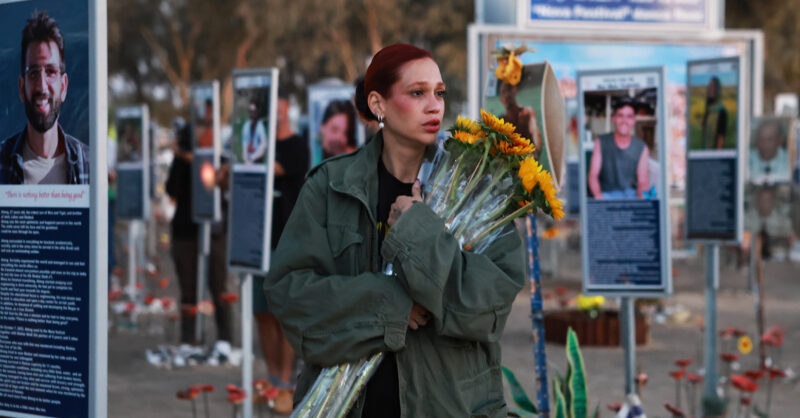
The Nova Exhibition aims to return the spotlight to that moment techno trance turned to bullets, just for an hour or two. It has been put on by the Tribe of Nova Foundation, the organisation founded in the wake of the attack to provide support for survivors. As I descend the stairs I enter not a museum, but a reconstruction of the festival itself. There are psychedelic posters espousing the values of Nova: “Find Your Peace”, “Good Vibes”. An introductory film explains the ethos of trance to the uninitiated. You let the music possess you, bound to the stranger dancing beside you by the rhythm pulsing through your feet. I’ve been to trance raves, danced with glitter on my cheeks, felt the air sparkle, become one with the atmosphere. I imagine feeling the euphoria rise with the sun as the minutes ticked past six. I imagine what happened next.
Imagination, however, is unnecessary. This is Nova: the immersive experience. The first room is full of tents, foldable beach chairs, portaloos, and scattered with festival paraphernalia. Hats, water bottles, a backgammon set – it could be the Glastonbury campsite. And phones, everywhere there are phones, their bright screens playing videos on a loop. Footage from when the attacks began and in the hours after. People running, screaming, hiding, bleeding. Teenagers with sunhats and friendship bracelets recording desperate messages for their parents, messages they believe could be their last. Messages that were their last. By the backgammon set, a young man is using his belt as a makeshift tourniquet on his friend’s gun-shot leg. A Dorito packet, a carton of coconut milk, a video of a girl with her face down in the grass, wearing a peace ring. I read that people tried to hide in toilets, fridges, under the bars. I read that everything here is taken from the scene itself, and look back at the portaloos. One is peppered by bullet-holes.
There are interviews too, survivors reliving their trauma for the camera. A man recounts his determination not to have to tell his girlfriend’s father he couldn’t bring her back alive. A woman sings lullabies in a bomb shelter at the side of the road, crushed underneath bodies machine-gunned from outside. There were around 40 of them hiding there, she says. You can experience the bomb shelter yourself, a reconstruction of the bunkers that lined the road back from the festival. There are five of us in there, watching her video interview, and it’s already verging on claustrophobic. The bunker stands in between a separate exhibition room dedicated to the scenes of sexual violence responders encountered, which are too graphic to detail here, and another screen. This one plays a recording of one of the Hamas terrorists calling his father on a victim’s phone. “Dad, open WhatApp,” read the subtitles as enthusiastic Arabic echoes from the speakers. “Your son killed Jews, Dad.”
That word – “Jews” – is barely mentioned elsewhere. The context of the attacks has been stripped away. There is no history, no religion or politics, just the moment itself. As I navigate the husk of a burnt-out car, I can hear in my head the protestations that this is just propaganda, that the focus on these beautiful young festival-goers is intended to distract us from the tens of thousands of Gazan civilians killed by the IDF in turn.
There’s a Hebrew term for that kind of public relations communication undertaken on behalf of the state of Israel: hasbara, roughly translated as “explaining”. It’s a word I only learnt in the aftermath of 7 October, when I posted on social media about my horror at the atrocities and was called “a disgusting hasbara propagandist”. To express revulsion about the Jewish women my age found tied to trees with bullets between their legs and the Jewish children shot in their beds in the nearby Kibbutzim was, I was told, to excuse decades of persecution against the Palestinian people and the inevitable devastation of Gaza that was to come. There wasn’t space for both.
But is it propaganda to acknowledge an atrocity, to grieve its victims, even if there are also other atrocities worthy of our attention? Is that a bar we set for other massacres? For, whatever came after it, this was a massacre.
In the next room, tables are spread out below a re-creation of the music festival stage. Neatly organised upon them: hundreds of shoes, sunglasses, make-up cases, keys. A pair of Mickey Mouse pyjamas. Glittery purple cat ears. This is the “lost and found” section, unclaimed items recovered from the victims and the survivors. I wonder what happened to the woman who was so excited to wear those cat ears to dance. I wonder if she’s alive, if she will ever go to a festival again.
The Tribe of Nova Foundation wants me to leave on a hopeful note. “We will dance again” is the message, repeated like a drumbeat. The connective power of trance music is presented as a healing remedy. A community bound together by music and trauma. They want us to celebrate the victims, to remember the joy that Nova was meant to represent, before music stood still at 6.29am.
Out on the street again, there is no trace of the exhibition, no publicity, no signs inviting visitors in. To advertise would be to become a target, like synagogues and Jewish schools have become, and put everyone inside at risk. I reach for my headphones and put on a trance playlist. It seems the only thing to do.