
How to Best Watch the Unpredictable June Bootids Meteor Shower
Follow this section to personalize your feed and get instant alerts.
Follow this tag to personalize your feed and get instant alerts.
Follow this author to personalize your feed and get instant alerts.
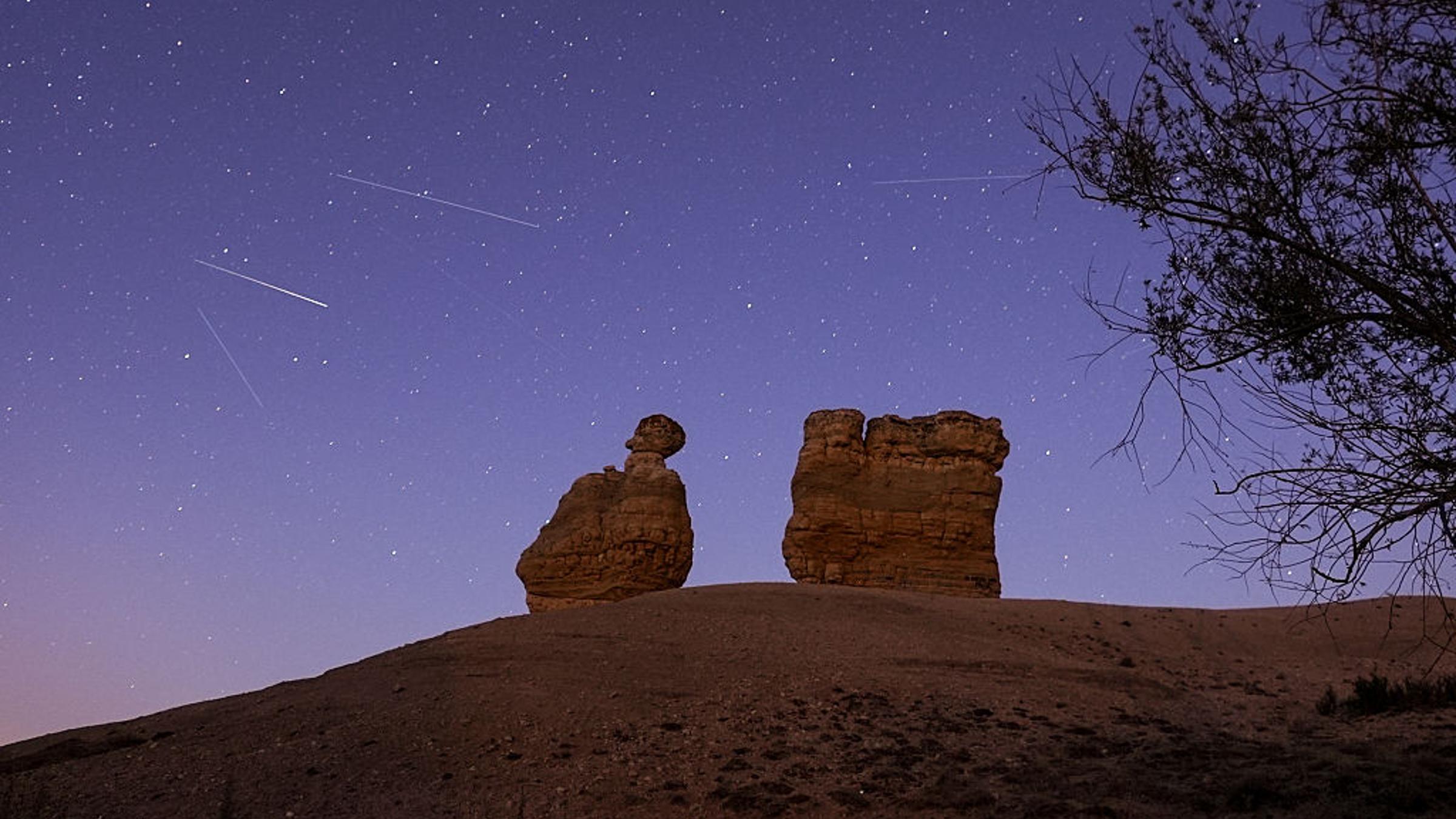
A view of the sky shows the Perseid meteor shower captured with long-exposure photography at the Kusca fairy chimneys in Cihanbeyli district of Konya, Turkiye, during the night hours on Aug. 12, 2025.
Follow this author to personalize your feed and get instant alerts.
You could have the opportunity to see an unpredictable meteor shower at its peak this week.
The June Bootids meteor shower tends to be less active than other meteor showers, but has, at times, surprised astronomers with bursts of activity. And it may peak in the coming days.
Here’s everything you need to know about the celestial phenomenon.
Meteors—sometimes called “shooting stars” or “falling stars”—are streaks of light that can be seen in the night sky. The phenomenon is the result of space debris burning up as it enters the Earth’s atmosphere. On any given night, you could see a handful of meteors per hour, assuming that the conditions are right for stargazing. During a meteor shower, you can see many more—at times dozens per hour when some showers are at their peak.
The June Bootids meteor shower, though, generally results in little activity, according to the American Meteor Society.
That being said, the June Bootids have surprised astronomers a few times over the years. On June 27, 1998, there was an “unexpected outburst” of activity, when stargazers could see 50-100 meteors per hour, according to the Society for Popular Astronomy. On June 23, 2004, there was another “outburst” of activity, with up to 50 meteors being spotted each hour, the society reported.
Astronomers predicted that the June Bootids would be overly active again in June 2010, but that year the meteor shower “proved disappointingly very weak,” the society said. These events have given the June Bootids a reputation for being “unpredictable.”
“There are no predictions of an outburst this year,” the Royal Museums Greenwich said on its website. “But there never are, until it happens.”
“You might see almost nothing. You might see a storm. We cannot tell you which,” it continued. “That makes the June Bootids, in their own chaotic way, one of the most exciting meteor showers of the summer.”
The shower is expected to peak this week; the American Meteor Society estimated that “maximum activity” for the June Bootids would occur on June 20, while the Society for Popular Astronomy predicted that the shower would peak on June 27.
You can see a meteor shower with your naked eye—all you need to do is to find a dark spot outside, away from city lights, with a clear view of the night sky. Experts recommend giving your eyes time to adapt to the darkness, preferably about half an hour.
Cloudy conditions and bright moonlight can affect your view of a meteor shower, so make sure to check the weather before you head outside.
The radiant of the June Bootids shower—the point in the sky from which the shower’s “falling stars” seem to originate—is in the Bootes constellation. For people in the Northern Hemisphere, according to Space.com, that constellation is high in the western and southwestern sky at night. The radiant can help you identify the shower you’re looking at, but to get the best view of the meteors, don’t stare just at that spot—looking at a broad expanse of the clear night sky is the best way to see the most “shooting stars.”