
Hubble has spotted ‘impossible’ light in deep space, and scientists are trying to explain where it came from
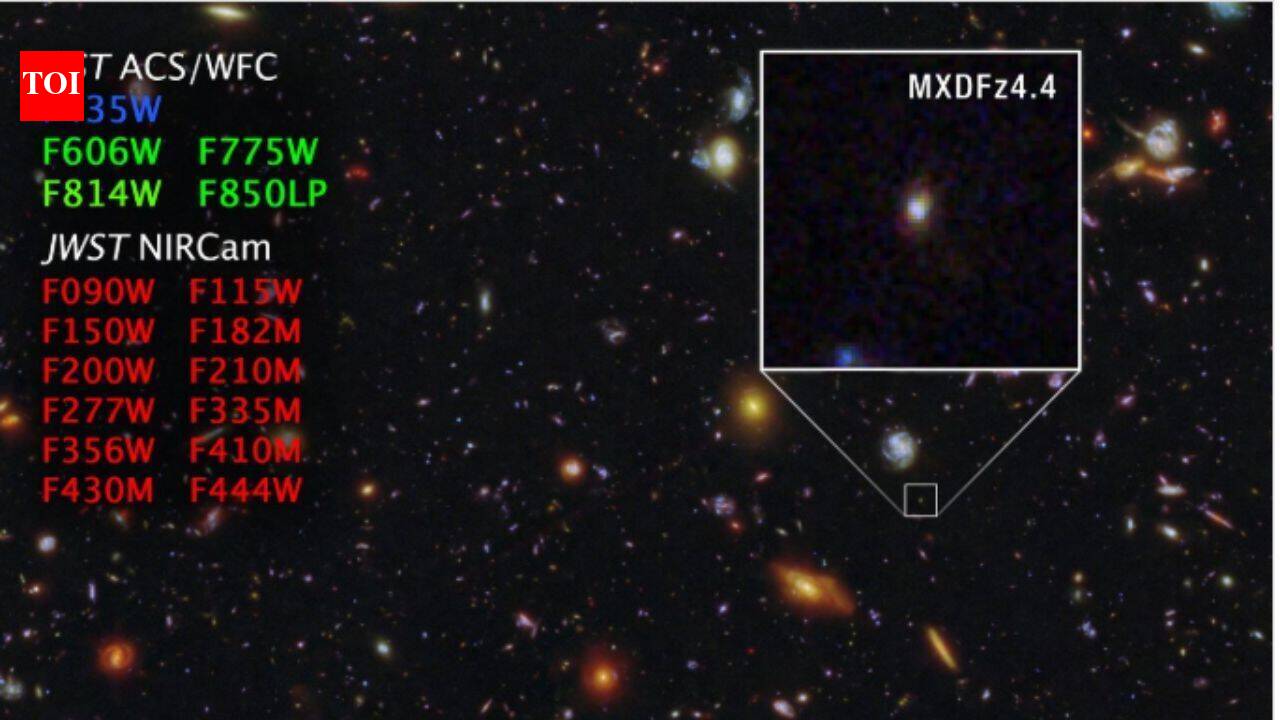
Astronomers have detected light from a tiny but powerful galaxy that existed when the universe was still emerging from a vast fog of hydrogen gas. The discovery, made using the Hubble Space Telescope and confirmed with data from the James Webb Space Telescope and a giant telescope in Chile, gives scientists one of their clearest views yet of a period once thought to be almost impossible to study.For hundreds of millions of years after the Big Bang, the universe was filled with neutral hydrogen that blocked much of the energetic ultraviolet light produced by the first stars and galaxies.
Over time, that fog gradually cleared in a major transition known as the Epoch of Reionization. The newly studied galaxy, called MXDFz4. 4, appears to have punched through that fog.Researchers detected powerful ultraviolet light escaping from the galaxy and travelling across space, something never before seen from such an early period in cosmic history.
The light began its journey only about 250 million years after the end of the Epoch of Reionization.Tiny galaxy, outsized impactMXDFz4. 4 is surprisingly small. Astronomers estimate that it covers an area roughly 100 times smaller than the Milky Way. Yet it is producing stars at an extraordinary pace of around 10 times faster than our galaxy.The intense burst of star formation packs huge numbers of young, massive stars into a compact region.According to the researchers, those stars may be carving channels through the galaxy's gas, allowing energetic light to escape into intergalactic space.Discovery by accidentThe signal was found in October 2025 while Ilias Goovaerts of the Space Telescope Science Institute, was preparing an unrelated funding proposal.He checked a deep Hubble image to see whether anyone had searched for this kind of signal before.
Within a couple of hours, he noticed something unusual.What followed was months of analysis using data from Hubble, the James Webb Space Telescope, and the European Southern Observatory's Very Large Telescope.Why astronomers are excitedScientists think galaxies like MXDFz4. 4 may have helped transform the early universe by clearing away the hydrogen fog and allowing light to travel freely across space.So far, no other known galaxy from this early era has shown escaping ionising light this clearly.
That makes MXDFz4. 4 a rare window into a time when the first galaxies were beginning to reshape the universe.Researchers now believe more such galaxies may be waiting to be discovered, hidden in the deepest images ever taken of the cosmos.