
India to get plastic notes soon: Why the move is important - explained
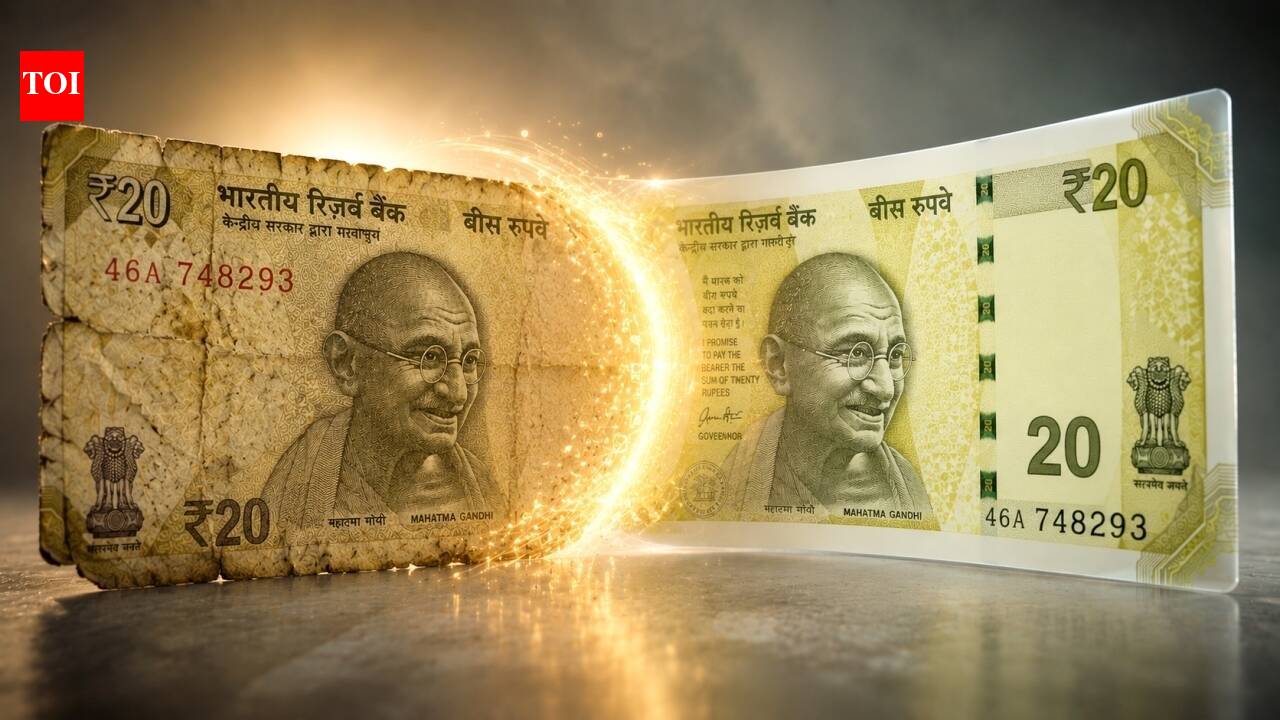
In the coming months you may be holding a currency note made of plastic instead of paper! India has taken the first step towards introduction of plastic or polymer notes. The move revives a project that was first considered some decades ago but shelved. According to the government, the Reserve Bank of India (RBI) has been permitted to print as many as 2 billion polymer notes - one billion each of Rs 10 and Rs 20 notes.
These notes will be printed for field trials and as of now there is no move to replace paper currency which will continue to co-exist as legal tender money.RBI has already floated the tender to source materials for the polymer notes with its currency printing arm Bharatiya Reserve Bank Note Mudran Pvt Ltd (BRBNMPL) inviting global expressions of interest.
The tender is for supply of polymer substrate sheets with embedded security features. The suppliers must meet strict security conditions which include government clearance, restrictions on China and Pakistan-linked operations and raw materials, and prior experience of supplying polymer banknote substrates to central banks.
“RBI has informed that as per international studies, the life span of polymer banknotes is significantly higher than that of paper banknotes. The introduction of polymer banknotes is currently in a preliminary phase,” Minister of state for finance Pankaj Chaudhary told the Lok Sabha.The step assumes significance because India has discarded around Rs 50 trillion worth of soiled notes in the last decade.
Spending on security features is also substantial at Rs 5,000 crore annually, according to estimates. Reports suggest that since FY17, for every 100 new notes that RBI supplies, 71 soiled notes have been withdrawn from circulation. The number of counterfeit notes are also on the rise. (function(){function e(){window.addEventListener(`message`,function(e){if(e.data[`datawrapper-height`]!==void 0){var t=document.querySelectorAll(`iframe`);for(var n in e.data[`datawrapper-height`])for(var r=0,i;i=t[r];r++)if(i.contentWindow===e.source){var a=e.data[`datawrapper-height`][n]+`px`;i.style.height=a}}})}e()})();What are the benefits of using plastic notes?
Which countries in the world use them and what have their experiences been? And why is the project important for India?Benefits of plastic notes for IndiaThere are several benefits associated with the use of plastic or polymer notes; enhanced security and lowered chances of counterfeit currency, lower lifetime cost, lower carbon footprint among many.
Polymer banknotes address all the three problems of durability, counterfeiting, and costs together. DK Srivastava, Chief Policy Advisor, EY India notes that in India paper currency notes are easily soiled because of humidity and India’s diverse climatic conditions. The total soiled notes, in volume terms, as a percentage of total notes in circulation was at an average of 14.9% during 2023-24 and 2024-25.
This percentage has come down marginally to close to 10% in 2025-26. Experts say that the arithmetic favours introduction of polymer currency, but the payback is multi-year, not immediate. India spent nearly Rs 6,500 crore on security printing in FY25, up from just above Rs 5,000 crore the year before, and disposed of 24 billion soiled notes in FY25 — nearly double from the previous year.
“Global experiences suggest that polymer notes last two to three times longer than paper, so even at two to three times the unit production cost, the lifetime cost per note-year is comparable or lower — and the savings extend beyond printing to transportation, storage, logistics and destruction of soiled notes,” says Sujan Hajra, Chief Economist & Executive Director, Anand Rathi Group.“The gains are largest precisely where India is likely to start: Rs 10 and Rs 20 notes, which have the highest churn and shortest lives.
The upfront investment is real; the net present value over a decade is favourable. That is why no major adopter has regretted the economics,” he tells TOI. Counterfeiting resistance is the third dividend: the tender on polymer currency floated by India recently specifications require a clear window with portrait, metallic numerals, magnetic pseudo thread, shadow images and iridescent patterns.According to Sujan Hajra, these features are structurally, not just graphically, difficult to replicate.
“Solving the durability issue, results in cost saving. Embedding the security features in the substrate itself addresses the counterfeiting resistance angel. Polymer is one intervention with three payoffs.” he says.Global experiments with plastic notes and lessons for IndiaPolymer notes were first introduced by Australia in 1988.
They are now used by several countries including Canada and the UK.Global experience suggests that polymer or plastic notes last significantly longer and are more effective in curbing counterfeiting. Estimates suggest that a polymer note lasts 2.5 times longer than a normal paper currency. A UK study says that a £5 note's lifespan can rise from 1.9 years to 4.8 years.
Canada's experience showed that the actual lifespan increased fourfold after rollout. The Bank of England in several reports and studies has noted that counterfeiting has substantially reduced due to robust polymer banknotes.In the UK, counterfeit £20 notes fell from an average of 197 per million notes in circulation before polymer to 68 after introduction, while counterfeit £10 notes dropped from 51 to six per million.In Canada, the annual average number of counterfeit notes passed into circulation declined from 57,481 during 2009–2011 to 24,054 during 2015–2025.
“The life expectancy of polymer notes also makes them more environmentally friendly. The Carbon Trust has certified that the carbon footprint of a polymer fiver is 16% lower than its paper predecessor,” says Bank of England.“As part of our own assessments, new banknote materials were subjected to a range of chemical and physical tests to assess their durability; including being put through the Bank of England washing machine (they survived!),” says the Bank of England in one of its reports on polymer notes.For Sujan Hajra, three lessons stand out.First, the introduction of polymer currency needs to be gradual.
Australia took eight years to full conversion after its 1988 launch; the UK sequenced £5 in 2016, £10 in 2017 and £20 from 2020. Denomination-by-denomination rollouts let ATM and cash-logistics ecosystems recalibrate without disruption. Second, substrate quality and procurement integrity decide outcomes.
Nigeria's reversal to paper after 2013 followed fading notes in its hot climate — and bribery allegations against the supplier — while humid-climate successes like Singapore, Malaysia and Brunei were among the earliest adopters. The Nigerian failure was procurement governance as much as physics.Third, field-testing by a country in its own climate is essential before scaling.
Bharatiya Reserve Bank Note Mudran Private Limited doing this by trial-first structure. Importance of experiment and the road aheadExperts acknowledge the security and durability benefits, but caution that the roll out and transition will need to be gradual.DK Srivastava of EY India says, “Along with polymer currency, there is a need to also upgrade cash handling infrastructure including ATMs, vending machines and note processing systems.
If this infrastructure can only be expanded in a gradual way, the speed of transition to polymer notes should also be adjusted accordingly.”As Sujan Hajra says, only a handful of countries - Australia, New Zealand, the UK, Romania and Vietnam - have gone fully polymer, and each took years.Madan Sabnavis, Chief Economist at Bank of Baroda cautions that financial literacy will be key to the success of the project.“The roll out of such notes is important so as to ensure that there is less confusion in the country.
For quite some time both sets of notes will be operational, and this has to be seamless. Given that financial literacy is still low, there could be resistance to accept such notes and hence an education drive has to precede the roll out. At any rate it should not be a case where everyone goes running to banks to exchange old notes for new as that can be a disruption,” he tells TOI.According to Sujan Hajra for India, three factors argue for a long transition: scale (currency in circulation is a record Rs 43 trillion, growing 11.5 per cent annually); infrastructure (every ATM, sorting machine and vending unit needs recalibration); and supply (high-grade polymer substrate production is concentrated among a few global manufacturers, and India will initially import while building domestic capacity).
Also, while polymer notes with higher security security features are more difficult to counterfeit, the task is not impossible.“Based on global experience, a 75–80 per cent reduction in counterfeiting is a reasonable expectation. However, Australia's rate later crept back above 25 ppm by 2015 as counterfeiters adapted,” Hajra says.
“Polymer resets the security race decisively - it does not end it. Currency security is a moving target; polymer moves the target much further away,” he concludes.The experiment has been scrapped in the past and if it comes through this time, it would definitely be an important step in the direction of a more secure currency framework, and one that reduces lifecycle costs associated with currency printing and destruction, while at the same time being environmentally friendly.Get the latest Business News and Live updates.
Download the TOI app.